What a Social Media Agency Is and What It Actually Does
A social media agency is an external service provider that runs a brand's social accounts under contract. Its scope runs from content production and the publishing calendar to comment and message handling and paid campaign management. What you buy is not an account. It is a defined production and management capacity.
The market for this service is large. Turkey had 62.3 million social media user identities in October 2025, equal to 70.9% of the population1. In the same period 80.4% of internet users used at least one social platform1.
That 62.3 million is not an independent count. In its own method note the source says it may only be able to factor in users of the platform with the largest active audience when it calculates a country total, and the same figure appears below for Instagram. Do not treat the two as separate facts and add them up. What decides an agency purchase is not this scale but exactly what the contract hands over.
The four work items an agency takes over
- Strategy and publishing plan: fixing which platform, at what frequency and with what message, on a monthly calendar.
- Content production: copy, design, photography and video; formats and quantities defined in advance.
- Community management: answering comments and messages, an escalation path for a crisis, a committed response time.
- Paid campaign management: setup, targeting, budget allocation and continuous optimization; the media budget does not sit inside this item, it sits next to it.
The fourth item calls for a different skill set from the first three: measurement setup, bidding logic and working with the platform algorithm. It may not sit in one person, and where it does, either content production or campaign management usually weakens. The quote should carry a separate line for who runs this item and with which tools.
Who works at a social media agency?
- Social media manager: runs the calendar and the approval flow.
- Copywriter: produces post copy and video scripts.
- Graphic designer: prepares the static visuals and the template set.
- Video editor: cuts the short video and reels formats.
- Performance specialist: builds and optimizes the paid campaigns.
- Account manager: runs the brief, approval and reporting traffic.
The role list looks similar at most agencies; the capacity split is what differs. So when you read a quote, do not ask for the name of the role but for the monthly capacity assigned to it: how many hours, how many pieces of content, how many revisions. Most of the gap between two quotes comes from that split, not from the list of names.
Control question: how many hours a month does every role named in the quote spend on this account? If the answer is not in writing, the quote is not comparable.
Organic Social Media Management or Paid Social Advertising?
The two are not the same thing and they are not paid out of the same budget. Organic management is the production and distribution of posts published without payment. Paid social means buying reach by paying budget to the platforms. In an agency quote the two should appear as separate lines; one combined figure hides the price of two different jobs.
Why the agency fee and the media budget are separate items
The fee goes to the agency and pays for work: strategy, production, management, reporting. The media budget goes straight to the platform and buys impressions. On Meta Ads, TikTok and LinkedIn that amount is spent from the ad account; it never turns into agency revenue.
There is a one-sentence control question to ask when you take a quote: is the media budget included in this figure or not? If it is included, the share the agency keeps as its fee and the way the rest will be spent across platforms have to be written down.
Where the two items are buried in one number, the most common outcome is this: when performance drops the media budget is quietly cut and the fee stays the same. The brand only notices when it opens the platform report from its own ad account. That is the first practical reason for opening the ad account in the brand's name.
How to split the budget while organic engagement falls
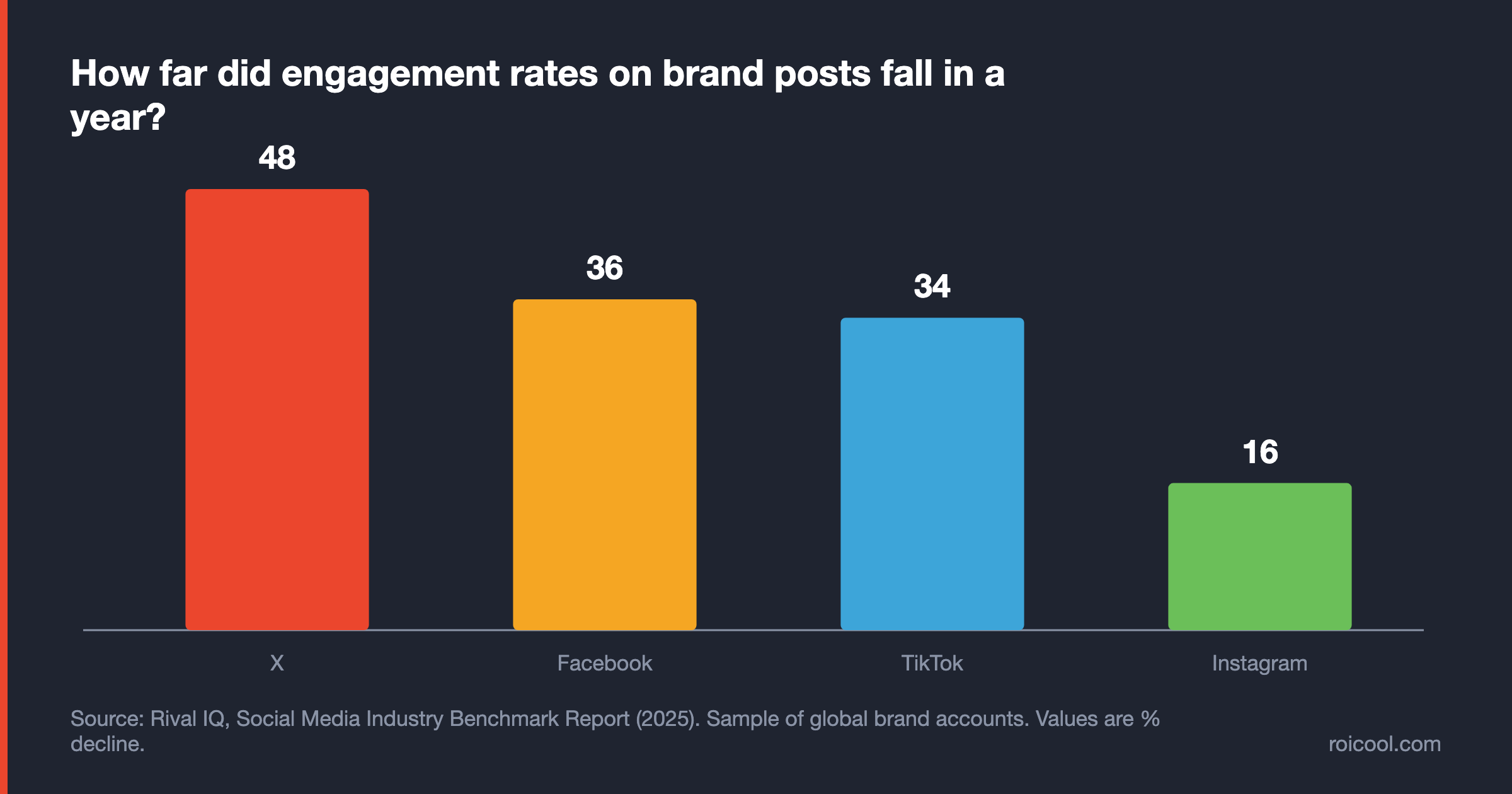
In the benchmark report Rival IQ published on 25 February 2025, engagement rates on brand posts fell year over year by 48% on X, 36% on Facebook, 34% on TikTok and 16% on Instagram6. The measurement rests on global brand accounts and is not specific to Turkey. What is measured is the engagement rate, not reach: the same content collects less engagement than it did a year earlier.
In a Sprout Social compilation, around 80% of marketing leaders plan to shift budget from other channels into social and 87% expect their paid social spend to increase7. The paid side is not getting cheaper either: Meta's global average price per ad rose 12% year over year4. The two trends point the same way.
The conclusion is this: the two items do not substitute for each other. Organic management builds the brand voice and the community, paid advertising buys reach. How campaigns are built and optimized is a separate discipline, and the execution detail on the social media advertising side falls outside the scope of this article.
In-House Team, Freelancer or Agency?
Three variables decide this: monthly content volume, the size of the paid budget, and the resource the brand already carries in-house. Company size on its own decides nothing; a ten-person e-commerce brand can produce more content than a two-hundred-person industrial firm. The distance between ten posts a month and sixty is a difference of model.
It helps to frame it this way: a freelancer is one person, an agency is a team, an in-house team is a permanent cost line. The breaking point is the same for all three. When volume rises one person cannot keep up; while volume is low a team stays expensive.
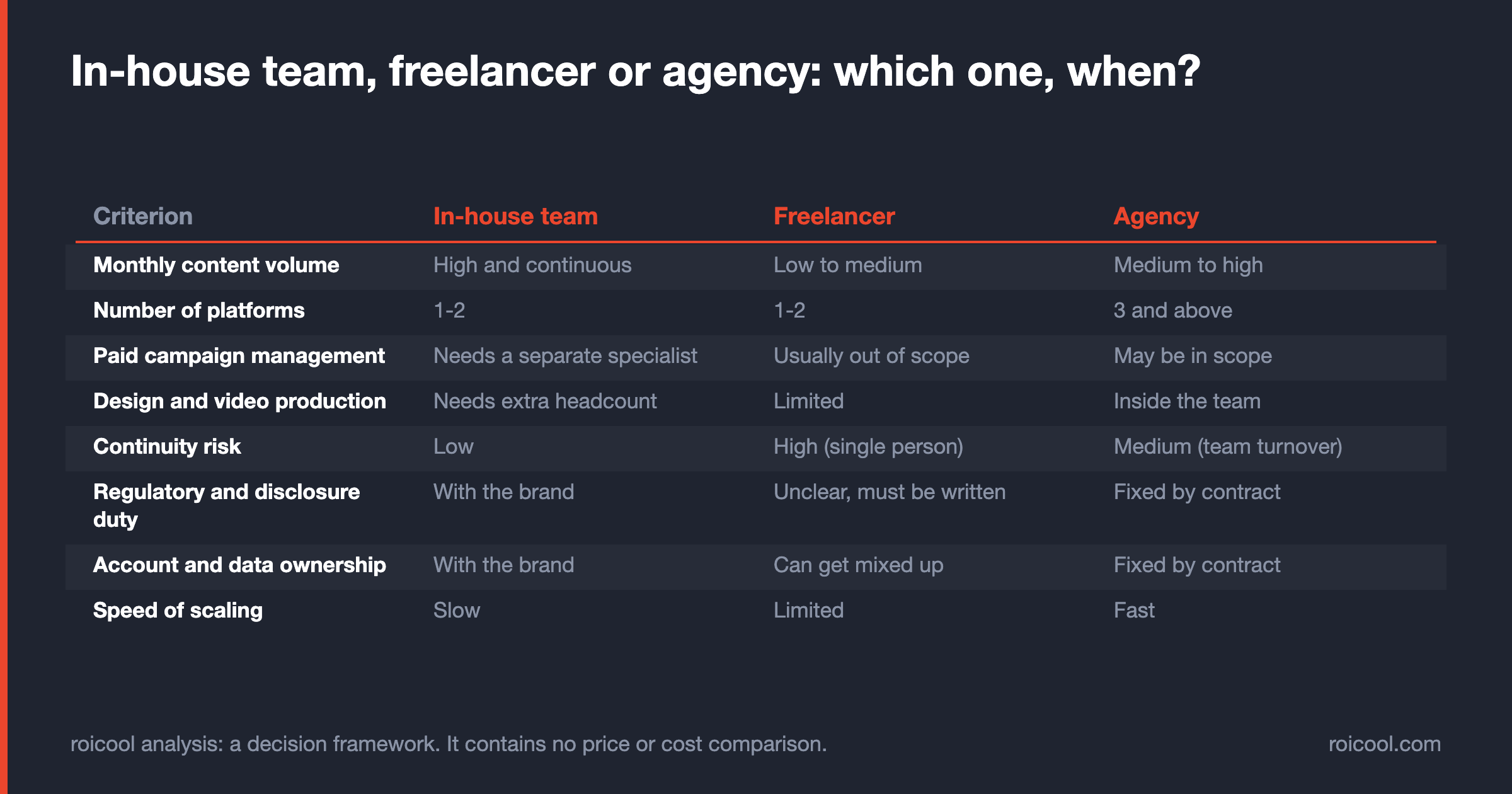
| Criterion | In-house team | Freelancer | Agency |
|---|---|---|---|
| Monthly content volume | High and continuous | Low to medium | Medium to high |
| Number of platforms | 1-2 | 1-2 | 3 and above |
| Paid campaign management | Needs a separate specialist | Usually out of scope | May be in scope |
| Design and video production | Needs extra headcount | Limited | Inside the team |
| Continuity risk | Low | High (single person) | Medium (team turnover) |
| Regulatory and disclosure duty | With the brand | Unclear, must be written | Fixed by contract |
| Account and data ownership | With the brand | Can get mixed up | Fixed by contract |
| Speed of scaling | Slow | Limited | Fast |
Which one makes sense when?
One platform, a limited number of posts a month and one person inside who can approve: a freelancer is enough. The critical point is that the account, the templates and the working files stay with the brand when that person leaves. If those three are not in writing, the cost advantage turns into a handover problem.
If three or more platforms, regular video production and paid campaign management are needed at the same time, an agency makes sense. That combination exceeds one person's weekly capacity and calls for separate skills: design, editing, copy and campaign management.
If daily operations are heavy, brand safety is critical and content volume is permanent, an in-house team gets built. This option does not rule out an agency. Many brands keep content production inside and hand paid campaign management out; in a hybrid model the boundary between the two sides has to be written down.
All three models face the same test: continuity. When the freelancer falls ill publishing stops, when the team changes at the agency brand knowledge has to be transferred again, when the key person leaves an in-house team someone goes looking for account access. The question to ask before deciding is this: does this model stay standing while the responsible person is away for two weeks?
Whichever model you pick, account ownership and regulatory responsibility have to be in writing; those two items carry the same risk in all three. If they are missing from the contract, the choice of model is not a saving but a deferred cost. If you have settled on an agency, the next question is the platform mix.
Which Platforms to Work On? A Platform Mix Read From Turkish Data
Platform choice is made from where the audience is and which way ad reach is growing, not from brand preference. For Turkey both questions have a measured answer, and the source of that answer is not brand instinct but the reach data the platforms publish themselves.
The number of social media user identities in Turkey rose by 4.8 million, or 8.3%, between the end of 2024 and the end of 20251. Platform sizes at the end of 2025 were as follows: Instagram 62.3 million1, TikTok 44.9 million among people aged 18 and above1, Facebook 34.7 million1 and LinkedIn 21.0 million members1.
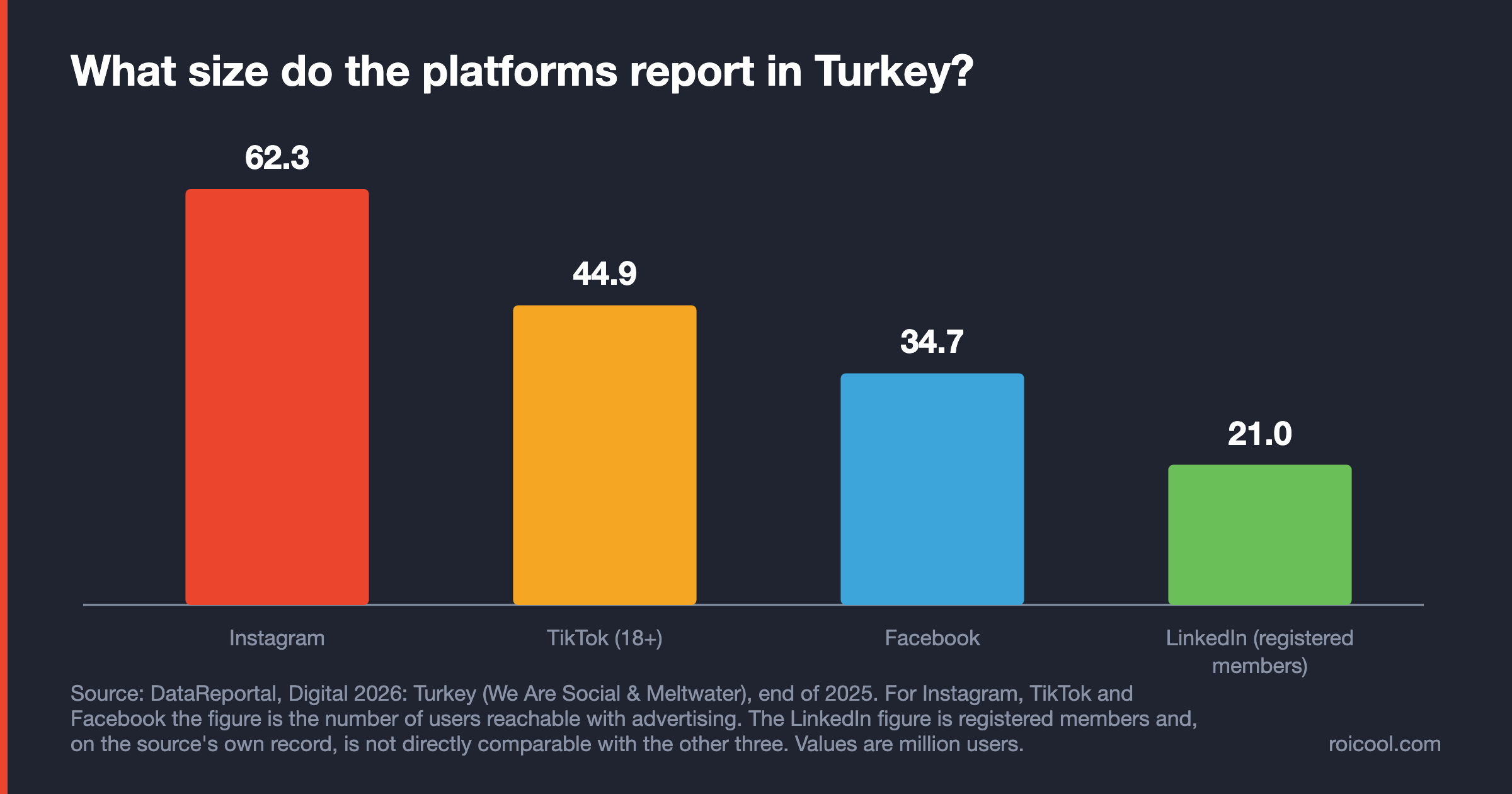
These numbers are what the platforms' own advertising tools declare. For Instagram, TikTok and Facebook what is shown is not the number of registered accounts but the number of users reachable with advertising. LinkedIn is the exception. By the source's own record, LinkedIn data is published on total registered members and not on monthly active users, in its words "based on total registered members, rather than the monthly active users".
The LinkedIn figure therefore cannot be compared directly with the other three, and the source writes that too: "not directly comparable". The practical consequence is that you should not read those four numbers as one ranking. Putting LinkedIn on the same scale as the other three means comparing registered members with monthly active users.
That Instagram's 62.3 million and the country total of 62.3 million come out the same is not a coincidence either. It is a product of the method. The source explains it in its own method note: because de-duplicating users across platforms is hard, a country total may only be able to factor in users of the platform with the largest active audience.
In the source's words, the methodology "may sometimes only factor users of the social media platform that has the largest active audience". So the national figure can look very close to the figure for the most popular platform in that country. Instagram's reach is not proof of the country total; it is largely its source.
The direction of growth says more than absolute size. Instagram's potential ad reach in Turkey rose by 5.80 million, or 10.3%, in a year1. TikTok's potential ad reach rose by 5.80 million over the same period; because it sits on a smaller base, that works out at growth of 14.8%1.
The platform mix is also a production decision. Short video on TikTok and Instagram takes separate editing work, LinkedIn runs on text and documents, and Facebook is kept in many sectors for community and retargeting. If the quote does not state a monthly content count for each platform, you are not buying a mix, you are buying a statement of intent.
What platform size alone does not tell you
User count does not show purchase intent. Ask the agency for the reasoning behind a platform recommendation: which audience, which format, which measurement. A quote that proposes being present on every platform at once is a warning sign; production capacity gets divided, no channel crosses its publishing-frequency threshold, and the result becomes impossible to measure.
B2B and LinkedIn
For B2B brands LinkedIn is assessed separately. The commercial side of the platform is growing: LinkedIn's total revenue rose 12%, or 10% in constant currency, in Microsoft's fourth quarter of fiscal 20265. That figure covers all of the platform's revenue lines and advertising revenue is not reported separately.
The decision comes from your sales cycle, not from platform size. If the buying committee does its research on LinkedIn, content gets built there. If it does not, keeping the channel on the list spends budget and produces nothing.
Social Media Agency Prices: Why Two Quotes Never Match
A scan carried out on 12 August 2026 produced no impartial average with a stated method for social media agency prices in Turkey; the monthly bands published in the market contradict each other by multiples. No such average appears in the publications of IAB Türkiye either, or in those of the Turkish association of advertising agencies — known in Turkish as “Reklamcılar Derneği”, with no English name of its own. Both bodies measure a different quantity.
The annual report that association commissioned from Deloitte, with contributions from industry bodies including IAB Türkiye13, measures the total size of the sector: 253.6 billion TL for 202413. Of that, 213.0 billion TL is media investment flowing to the channels13. The remaining 40.6 billion TL line covers creative work, production, printing, BTL, sponsorship and advertiser service fees13. The report does not break that total down into an agency fee per client, so the average you are looking for is not here either.
Measured on 12 August 2026, the quote-collection platform Armut showed a single band on its page with no tiers: 3,500 - 35,000 TL depending on the detail of the request10. The agency blog Hoops declared a band of 25,000 - 250,000 TL on the same date and split it into three tiers further down the page: entry 25,000 - 60,000 TL, middle 60,000 - 150,000 TL, top package 150,000 TL and above12.
Edvido declares two different quantities on the same page. In its city table it gives a single average monthly range for all five cities: 4,000 - 80,000 TL. In the tier list on the same page it writes entry or freelancer 4,000 - 25,000 TL, average agency 30,000 - 80,000 TL and corporate or premium 200,000 TL and above11.
The page states the scope of its own table: the band covers the entry and average tiers and does not cover corporate scale. The 80,000 - 200,000 TL range in the tier list is empty, which is why these tiers were not merged into one band. Across the three pages the declared floor values differ by roughly seven times9.
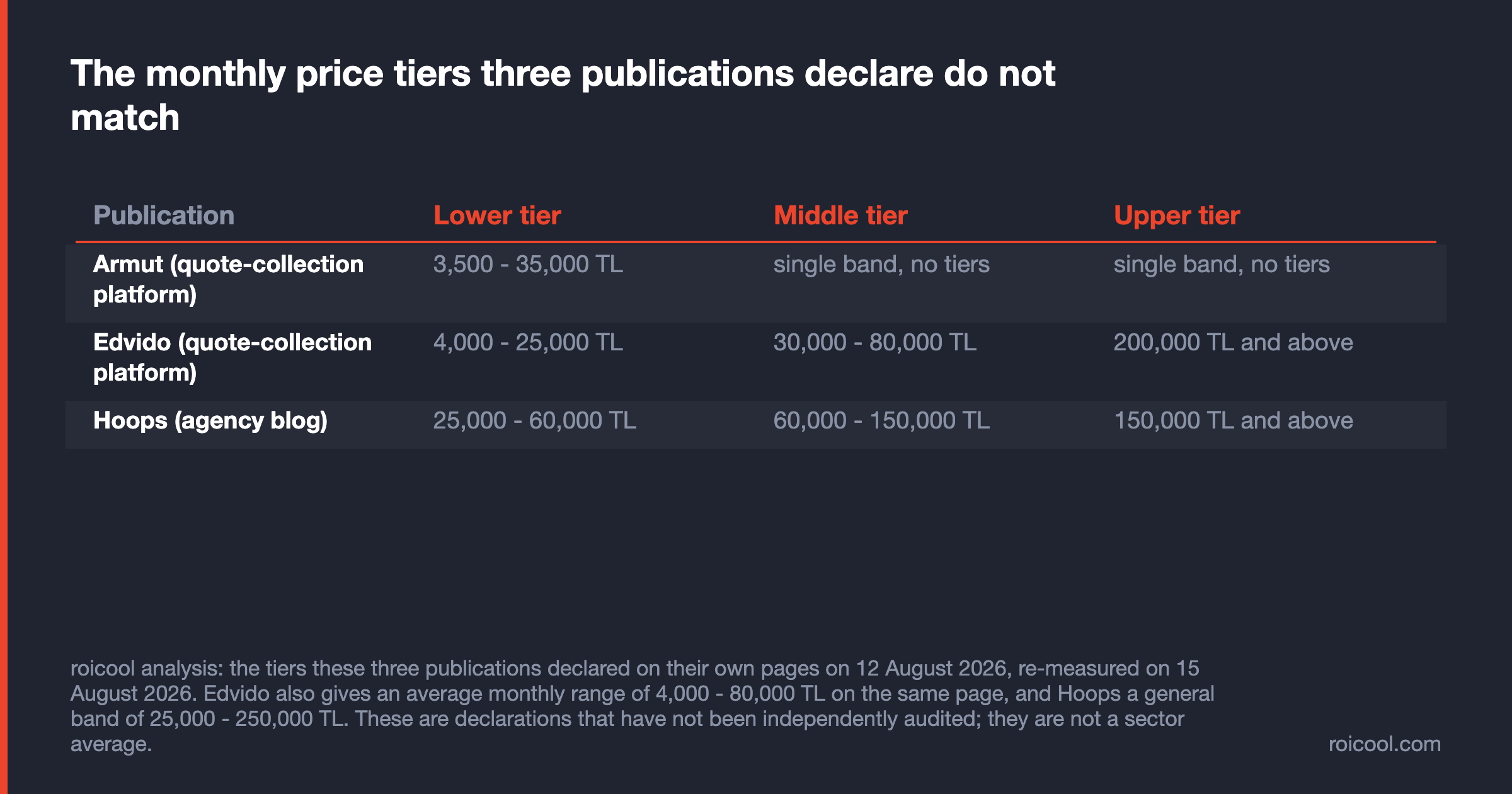
| Publication | Lower tier | Middle tier | Upper tier |
|---|---|---|---|
| Armut (quote-collection platform) | 3,500 - 35,000 TL | single band, no tiers | single band, no tiers |
| Edvido (quote-collection platform) | 4,000 - 25,000 TL | 30,000 - 80,000 TL | 200,000 TL and above |
| Hoops (agency blog) | 25,000 - 60,000 TL | 60,000 - 150,000 TL | 150,000 TL and above |
These figures and tiers are the declarations of the publications concerned. They have not been through an independent audit and they are not a sector average. They are also not reference points you can use to call a quote expensive or cheap. The only legible conclusion from the table is this: the opening figure for the same job is 3,500 TL in one publication and 25,000 TL in another. Price on its own carries no information. It carries scope.
Five variables that set the price
- Monthly content production volume and format: the number of posts, designs and videos should sit on separate lines in the quote.
- Number of platforms: every added platform means a separate calendar, a separate format and separate community management.
- Whether paid campaign management is in scope: is there a line in the quote called campaign management fee?
- The audit and regulatory load of the sector: in fields such as healthcare, health tourism and finance, approval steps raise production cost.
- The depth of the reporting and measurement setup: if conversion tracking is to be built, that is a separate work item.
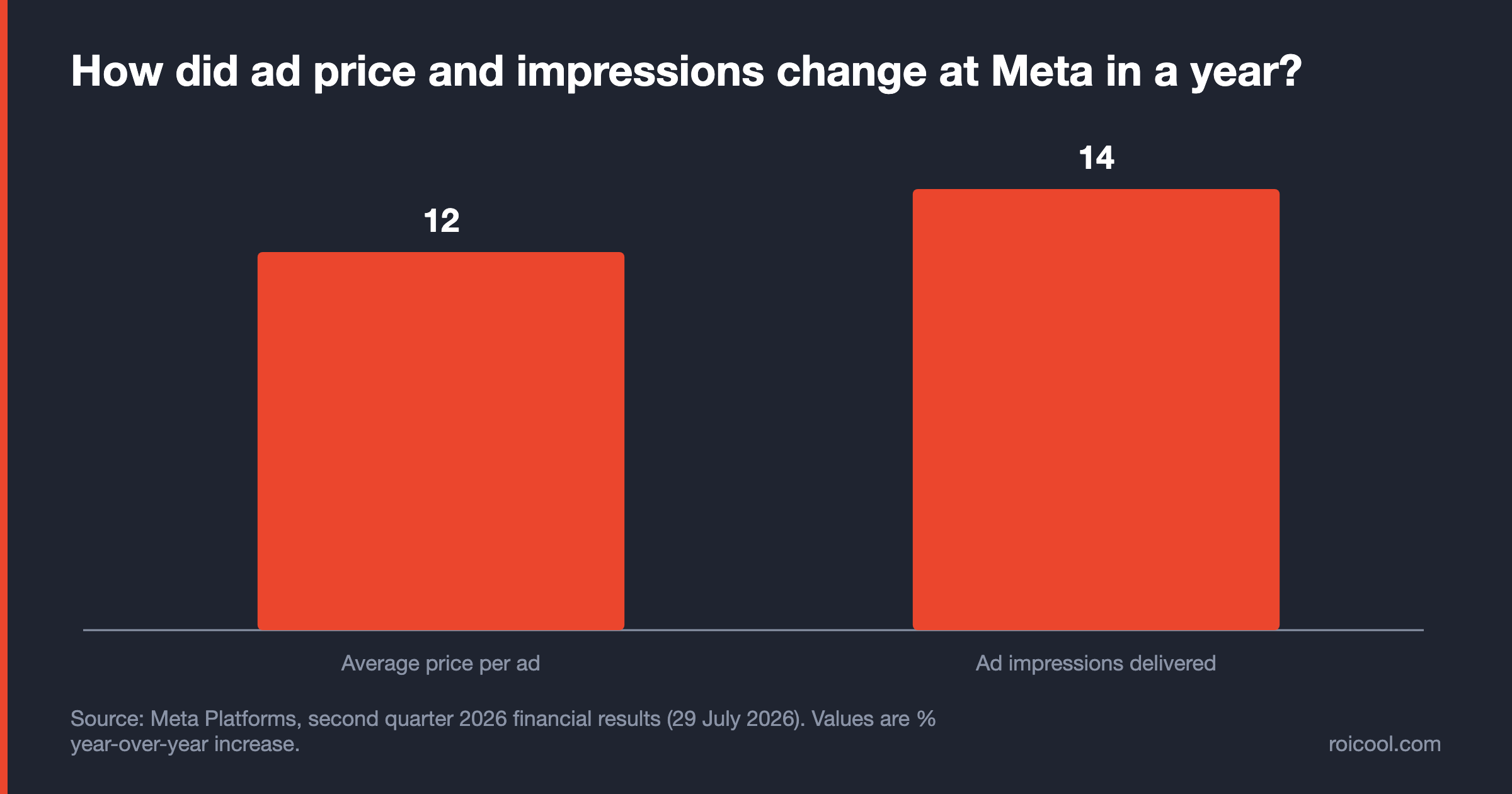
None of these variables covers the media budget. Meta's global average price per ad rose 12% year over year in the second quarter of 20264, and the ad impressions delivered rose 14%4. Both are company-wide global averages, not a cost measurement specific to Turkey, and the direction they show belongs to the media budget rather than the agency fee. Instagram advertising costs are a separate line item and are tracked separately.
A framework for making two quotes comparable
- Media budget included or excluded: pull both quotes onto the same assumption.
- Monthly content count and format: static posts, videos and stories written out separately.
- Number of platforms and the publishing frequency on each one.
- Reporting frequency and the metrics the report contains.
- Contract term, minimum commitment and termination notice period.
Two quotes cannot be compared until those five items are equalized. Once they are, most conversations end in the same place: what looked like a price gap turns out to be a scope gap. When scope is equal, the remaining difference comes from production quality and depth of measurement, and neither of those is visible in the text of a quote. You see them in sample work and a sample report.
How to Choose a Social Media Agency: Seven Criteria Specific to Social
Asking for references, reviewing a portfolio and testing communication hold in every agency relationship, and they are covered separately under choosing an advertising agency. On social the decision is made by looking at three concrete things: account ownership, content production capacity and regulatory compliance. Every criterion below derives from those three axes, and all of them can be put in writing at the quote stage.
- Account ownership: in whose name will the ad account, the page and the business manager account be opened, and what happens to them when the contract ends?
- Content volume: how many static posts, videos and stories are produced per month, how many revisions are included, and is it written into the contract as a number?
- Platform mix: on what basis were these platforms recommended, and at what frequency will you publish?
- Paid campaign management: who builds the campaigns, who optimizes them, and is it run as a separate discipline?
- Disclosure duty: who writes, who approves and who archives the wording Turkish law requires on influencer and artificial intelligence content?
- Measurement and reporting: which metric comes out of which tool, and how often is the report delivered?
- Handover plan: which files will be delivered in which format when the contract ends, and how will access be removed?
The fifth criterion got heavier in 2026. In a Hootsuite compilation, 83% of social marketers say artificial intelligence helps them create significantly more content8. As production volume rises the disclosure duty rises with it, and the contract has to say who carries that load.
In sectors with a high audit risk this criterion alone can decide the matter. Of the 707 social-media-sourced files Turkey's Advertising Board (Reklam Kurulu) handled in 2024, 592 concerned advertising published on Instagram; Facebook followed with 48 files, YouTube with 46, X with 12, TikTok with 6 and LinkedIn with 33.
Ask for a written answer to all seven, not a verbal one. An agency that cannot answer in writing does not carry a defined process on that subject. Attach the answers to the quote. By the time you reach the contract conversation, that attachment is a ready-made list of the clauses you need to negotiate.
What the Contract Must Say: Ownership, Copyright, Term and Termination
Social media assets are opened in the brand's name and the agency is given access rights only. The page, the ad account, the business manager account and the conversion data are four such assets, and all four should be named in the contract. Your lawyer writes the contract text, but the owner of the business decides which assets get named.
In whose name are the ad account and the page opened?
The business manager account is set up in the brand's name and the agency is added to it as a partner. When the contract ends, access is removed and the account stays where it is. An ad account opened under the agency's own business manager stays with the agency rather than the brand when the relationship ends, and the historical data goes with it.
The pixel and the conversions API setup have to be protected separately. The historical data that setup produces is the basis of retargeting audiences and campaign learning. If it is reset, the new agency starts from zero and the first months run both slower and more expensively.
An access hygiene clause is needed as well: who on the agency side can reach the account, within how many days authorization is removed when an employee leaves, and whose device two-step verification is tied to. These are the shortest lines in the contract and the most useful ones on handover day.
Who keeps the copyright on the content produced?
Usage rights on the images, video and copy the agency produces must be written into the contract. Influencer and user-generated content (UGC) is governed separately: that content belongs to third parties and the rights transferred to the brand are limited.
Three things must be written down: the term of use, the channels and the territory. The right to publish an influencer video as an organic post does not automatically cover the right to use the same video in a paid ad. Where that distinction is not made, the most common outcome is a piece of content that works well and cannot be put behind media spend.
Term and termination need clauses of their own: the minimum commitment, the notice period and the list of assets to be handed over on termination. There is no standard norm for the term. What sets it is production volume, the learning period of paid campaigns and the size of the handover load. If the agency wants a long commitment, it should also write down what it is committing to in return.
Regulatory Compliance in Turkey: The Rules in Force Since 1 August 2026
The amendments to Turkey's Regulation on Commercial Advertising and Unfair Commercial Practices were published in the Turkish Official Gazette no. 33297 on 1 July 20262. They took effect on 1 August 20262. Everything in this section is Turkish law and binds advertising published in Turkey. For a brand that outsources social media management, it means one more responsibility line in the contract.
Disclosure in influencer partnerships
In Turkey, social media influencers must carry an advertising or promotion notice, worded so that the commercial nature of the post is plainly understood, in any post where they obtain a benefit through earnings, a discounted product or service, or participation in an event2. The regulation names the wording that qualifies: the notice has to read “reklam” (advertisement) or “tanıtım” (promotion). An English hashtag such as #advertising does not satisfy it.
Three responsibilities have to be named in the agency contract: who writes the disclosure wording, who approves it and who archives it. The same obligation should be written into the agreement between the brand and the content creator. How the sponsored post label reads to the audience is a separate subject; the issue here is who carries the responsibility.
Advertising content produced with artificial intelligence
Where an advertisement features digital characters produced with artificial intelligence that cannot be told apart from humans, this must be stated clearly, understandably and distinguishably2. Disclosure does not rescue every case: advertising in which an artificial intelligence replica of a real person gives the impression of having personally experienced a product or service, or makes a recommendation, is banned2.
What to ask the agency for is a concrete procedure: which content was produced with artificial intelligence, how disclosure was made, where the record sits. One more check gets added to that procedure. Does the content contain a digital replica of a real person? On that second question disclosure is not a remedy, because the advertisement cannot be run at all.
There is a new limit on targeting as well. Targeted advertising aimed at children using profiling methods based on personal data has been banned2. Because the targeting setup sits in the agency's hands, this check is the agency's job too, and it should be visible in the monthly report.
These three headings can go into the contract as a single clause: responsibility for regulatory compliance. But the inside of the clause has to be concrete, naming which check happens at which stage and who performs it. A contract that compresses compliance into one general sentence does not say who does what at the moment of a breach.
Where is enforcement concentrated?
Of the 1,917 files that came before the Advertising Board in 2024, 707 concerned advertising published through social media3. In the same year 89.7% of the files decided, that is 1,720 files, sat in the internet medium3. In 2024 the Board applied a total of 277,664,783.00 TL in administrative fines3.
The penalty band varies by medium and is updated at the start of each calendar year with the revaluation rate. Where the breach happens through the internet, the band applied from 1 January 2026 is 1,083,706 - 10,837,065 TL14. The nominal amount written into the law in 2024 was 600,000 - 6,000,000 TL; verify the figure in force each year from the current communique.
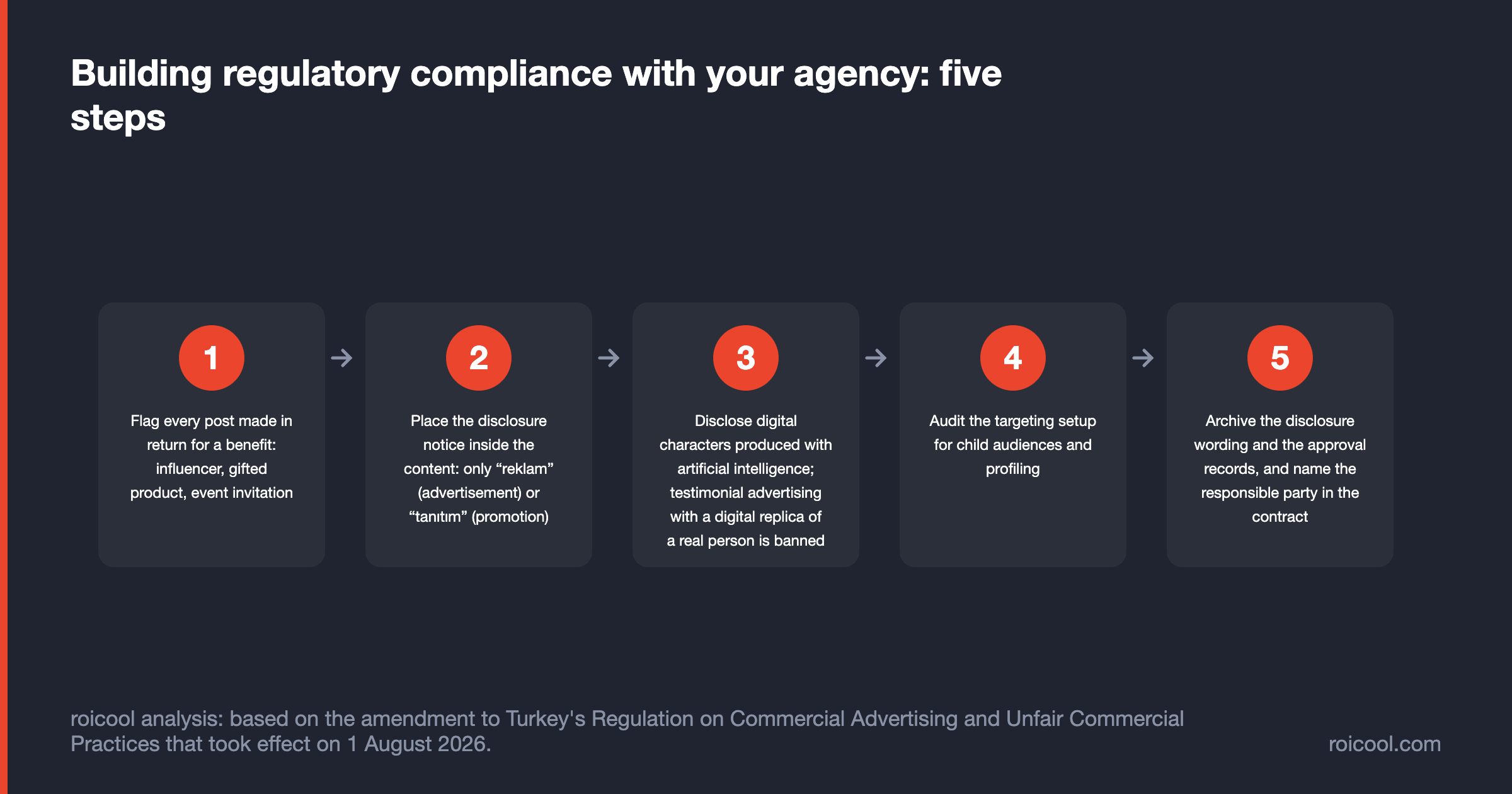
This picture is here to build a checklist, not to frighten anyone. The question to put to your agency is simple: do you have a written procedure under the headings above? The flow below is a compliance checklist, not legal advice.
- Flag every post made in return for a benefit: influencer, gifted product, event invitation
- Place the disclosure notice inside the content: only “reklam” (advertisement) or “tanıtım” (promotion)
- Disclose digital characters produced with artificial intelligence; testimonial advertising with a digital replica of a real person is banned
- Audit the targeting setup for child audiences and profiling
- Archive the disclosure wording and the approval records, and name the responsible party in the contract
How Is Agency Performance Measured? Which Report, Which Metric?
Agency performance is not measured in likes and follower counts. There is one rule: every metric has to be tied to a business outcome and none of them is reported on its own. How many people a post reached is not a result until you know who those people were and what they did next. On the paid side a campaign cannot be judged until spend and return are read in the same table.
In a Sprout Social compilation, teams tracking social media returns focus primarily on engagement (68%), conversions (65%) and revenue impact (57%)7. Response time has a commercial value too: in the same compilation around 73% of users say they will buy from a competitor if a brand does not answer them on social7.
Lines the monthly report must contain
- The target for the period and the rate of achievement against it.
- Media budget spend with a breakdown by platform.
- Cost per acquisition, conversion rate and the return on each unit of spend on the paid side.
- Reach, engagement rate and average response time on the organic side.
- The number of pieces of content produced and their formats.
- The action list for the next period and the reasoning behind it.
Those six lines also define your measurement framework. If the report format changes every month, periods cannot be compared and the agency's contribution becomes invisible. Fix the format at the contract stage.
How the report is delivered belongs in the contract as well. Will there be a monthly report meeting, within how many working days will it be sent, and to which date range will the data be closed? If these details are not in writing, reports will not match and a period of a different length gets compared every month.
On the paid social side this framework is the only way to audit the efficiency of the media budget: you do not raise the budget until you can see which conversion each unit of spend produced. The same measurement discipline is the substance of the work when you engage a performance marketing agency.
One last warning: there is no universal threshold that says this is a good return on ad spend (ROAS). The threshold is a number you set from your product margin, the return on investment you need and the acquisition cost you are willing to accept. The agency cannot impose that number on you; it builds it with you and reports against it. A campaign set up before the threshold is agreed is a campaign you cannot call good or bad.
How Are Accounts and Data Handed Over When You Change Agency?
The handover is planned before the contract with the new agency is signed. What has to move is not the content but the access rights and the historical data. The content stays published anyway; the data disappears beyond recovery in a badly run transition. That is why the handover is a subject for the contract, not for the moment you decide to leave.
- Confirm that ownership of the page and the ad account sits with the brand.
- Take an inventory of business manager access and remove the old agency's authorization.
- Protect the pixel, the conversions API setup and the custom audiences.
- Take delivery of past campaign records and the report archive.
- Take over the content files together with their working formats.
- Take over the influencer agreements and the archive of disclosure records.
The most common losses come from two sources: accounts that were never opened in the brand's name, and handovers completed without access being removed. Both can be prevented at the contract stage and neither can be prevented at the handover stage. Once the decision to part has been made, the only card left in your hand is goodwill.
The item most often skipped on the list is the source format of the content files. The exported version of a published image is useless. If the editable template file, the video project file and the fonts in the brand kit are not handed over, the new agency rebuilds the same look from scratch and spends the first month redrawing instead of producing.
Stopping paid campaigns completely during the handover can reset the learning period of the algorithm. Which campaign the new agency will rebuild in which order is therefore part of the handover plan, and it gets written down with dates.
Align the handover date with the end of the month rather than the middle. When reporting periods are not split, which result belongs to which agency does not become a matter of debate, and this simple rule closes most of the performance argument before it starts.
The handover plan is made at the start of an agency search, not at the end: when you sign the contract you are also signing the exit conditions.