How much does SEO cost? Three major surveys, three different answers
SEO pricing has no single benchmark. Ask three of the most-cited recent surveys how much SEO costs per month and you get three answers: $2,917 on average1, $1,000-$2,500 on average2, and below $1,000 for 64% of the agencies polled, in a sample of small agencies3. That is close to a threefold spread on the same question, in the same industry, within two years. The three surveys did not measure the same population.
What "SEO pricing" actually refers to
What you are buying is a recurring scope of work, not a product with a list price. A typical scope covers technical fixes, content production, link acquisition and reporting, sold under one of three billing models: a monthly retainer, an hourly rate, or a fixed project fee. Two providers can quote the same number for very different amounts of work, which is why a quote only becomes readable once you know the model and the scope sitting behind it.
An average is a poor tool here. In Ahrefs' 2024 data the reported range ran from $250 to $10,000 per month, with 63% of businesses spending between $500 and $5,0001. A single mean sitting inside a range that wide tells you very little about what your own quote should look like.
The three surveys, side by side
Here are all three, side by side. Each row uses the survey's own label for what it measured, because the labels are not interchangeable: an average across all providers is a different statistic from the share of agencies under a threshold.
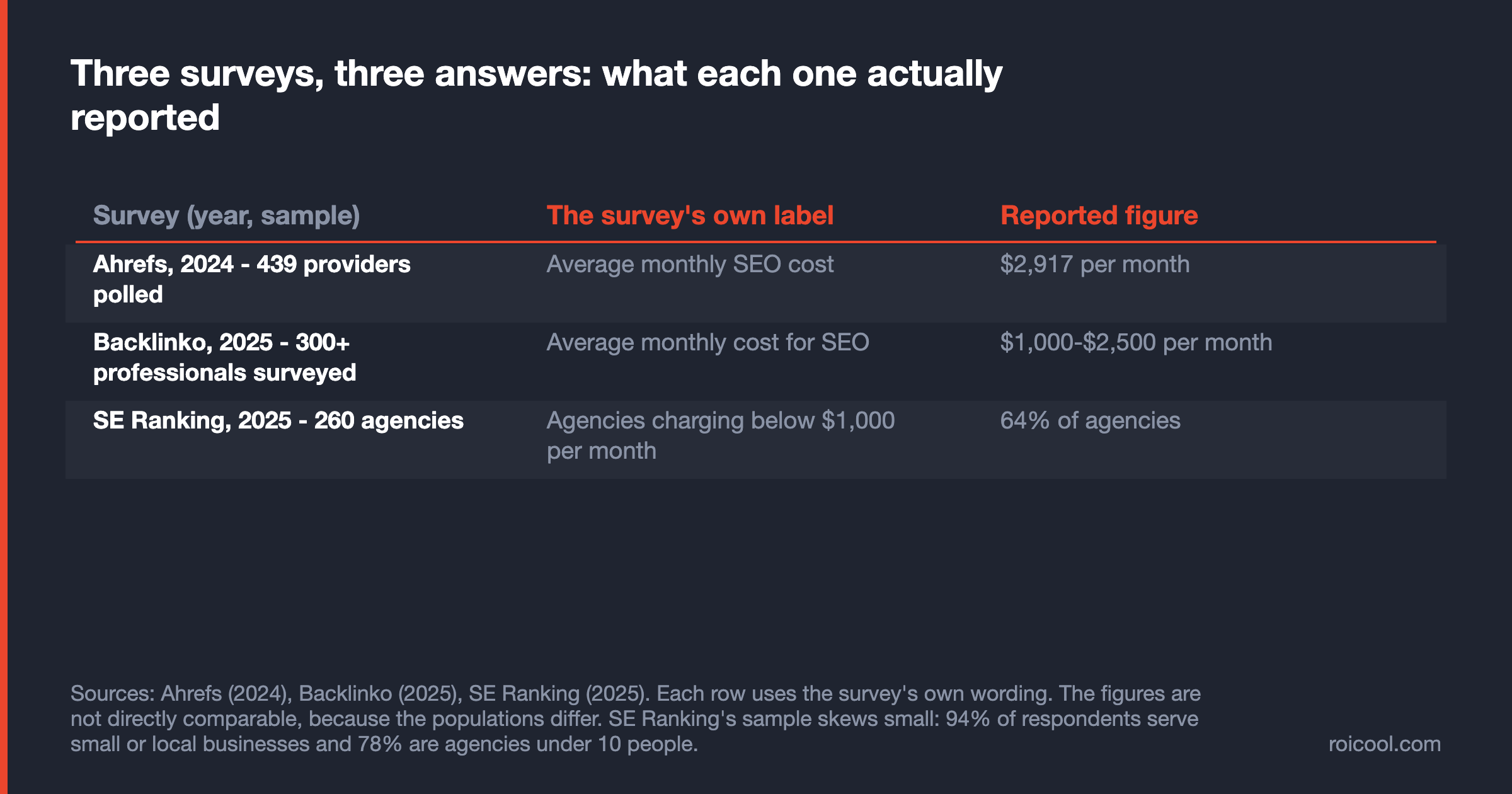
Sample size and sample type do most of the work. Ahrefs polled 439 SEO service providers in 20241. Backlinko surveyed over 300 SEO professionals in 20252. SE Ranking's 2025 dataset came from 260 agencies3, and that sample skews small: 94% of the agencies serve small or local businesses3 and 78% are agencies under 10 people3. Read the 64% figure3 without those two sentences and you will misread the market.
None of the three is wrong. They are answers to slightly different questions, put to different people in different places. The next section takes the three differences that decide the number - who was asked, which statistic was reported, and where the providers work - and shows what each one does to the figure you end up quoting.
Before you compare two quotes, check that they describe the same three things: scope, billing model and commitment length. Most price disagreements turn out to be scope disagreements.
Why the three numbers disagree: sample, statistic and geography
Three things separate these numbers, and geography is only one of them.
Who was asked
SE Ranking recruited 170 agencies in "the US, Canada, Australia, New Zealand, Singapore, the UK, Ireland, and continental Europe"3, then added 90 from its own catalog to reach 2603. Every one of those markets is a developed economy, and 94% of the agencies serve small or local businesses3. So the 64% figure3 is not a global average dragged down by cheap markets. It is what small agencies in high-cost countries charge.
Which statistic was reported
Ahrefs' $2,9171 comes from a different pool of 439 providers1 - and from a different statistic. It reports a mean across everyone, which a handful of large retainers can lift, rather than a share sitting below a threshold.
Where the providers work: the US premium in the data
Geography is the third reason, and it is real - but each survey measured it inside its own sample, not against the other two. The same scope of work is priced against a different cost base depending on where the provider sits. Salaries, overheads and the local rate for a senior specialist differ by multiples between countries, and agency pricing follows them.
Backlinko states it plainly. Among the headline findings of its 2025 survey of over 300 SEO professionals: "US-based SEO services cost 3-5x more than those from emerging markets"2. The survey lists it as a description of where providers are based, in the same breath as the average monthly cost - not as a judgment about quality.
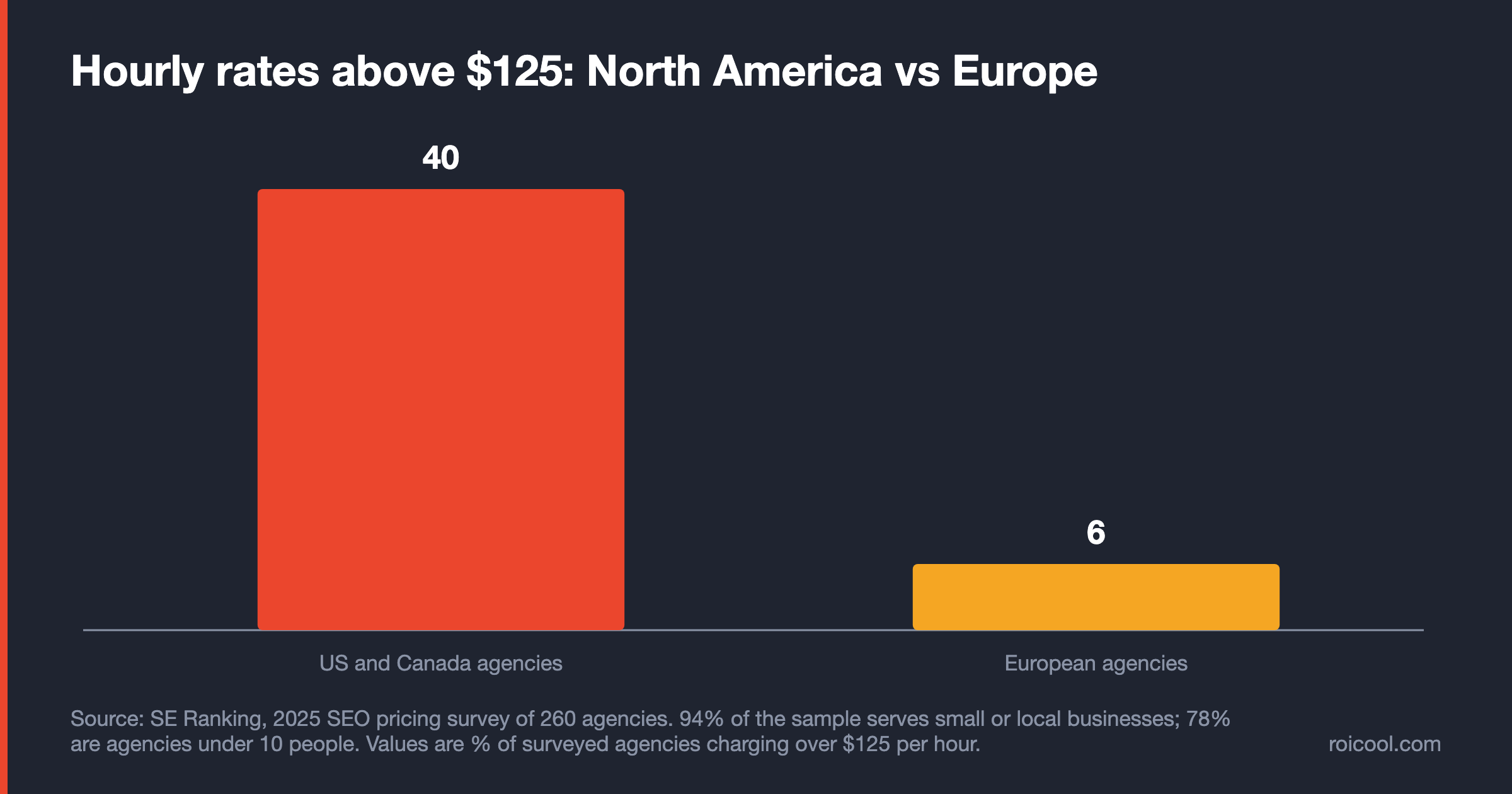
SE Ranking measured a different comparison - US and Canada against Europe, not the US against emerging markets - and found the same direction. For that comparison it grouped 232 of its 260 respondents3 into 113 North American agencies and 119 European ones3. The biggest gap was hourly: 40% of agencies in the US and Canada charge over $125 per hour, against 6% of European agencies3.
That sample skews small - 94% of the 260 agencies serve small or local businesses3 and 78% have fewer than 10 people3 - so read it as a picture of the small-agency market rather than of enterprise providers.
Which price tiers exist where
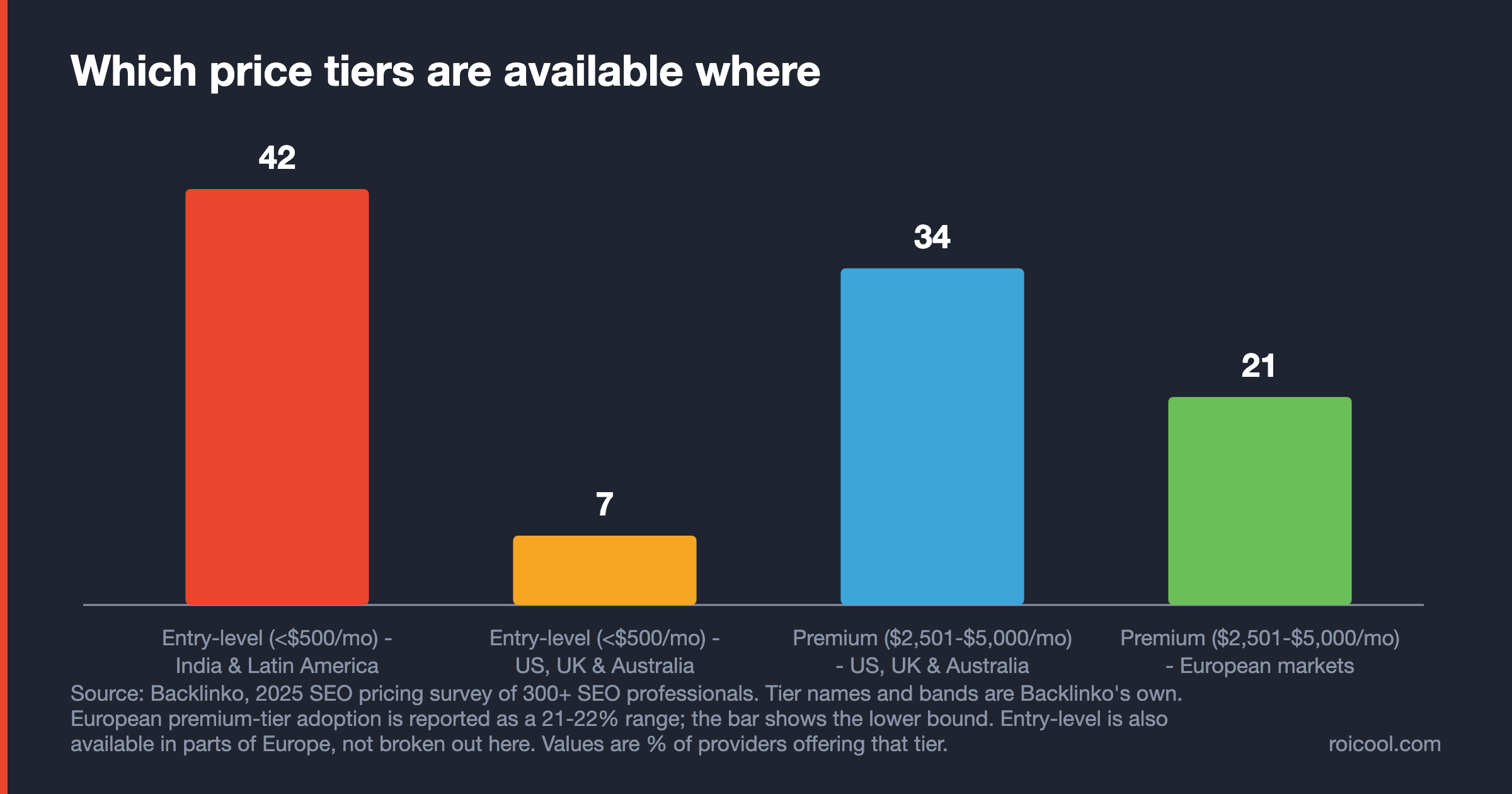
Geography does not only move the price. It decides which tiers are on offer at all. In Backlinko's data the entry-level tier below $500 a month is primarily available in emerging markets such as India and Latin America, at 42% of providers, and in parts of Europe; it is rare in the US, UK and Australia, at 7%2. The premium tier of $2,501-$5,000 runs the other way: predominantly US, UK and Australia at 34% of providers, with 21-22% in European markets2.
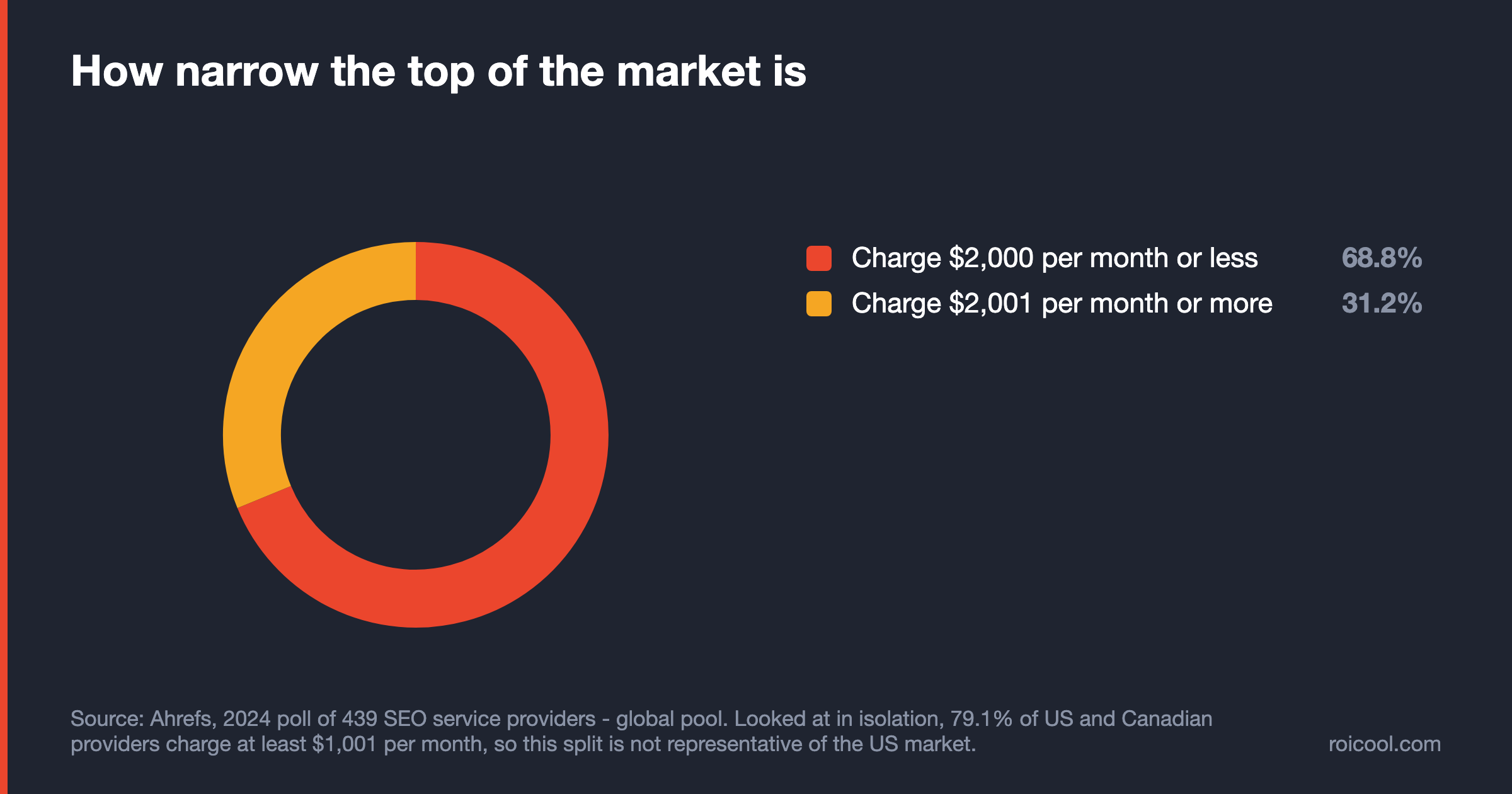
The global pool is also heavier at the bottom than most pricing pages suggest. In Ahrefs' 2024 poll, 68.8% of providers charge $2,000 a month or less, leaving only 31.2% above that1. The same survey splits by region: looking at US and Canada data in isolation, 79.1% charge at least $1,001 per month1. Both sentences describe one dataset. Quoting either alone misdescribes the market.
What you give up when you buy outside your own market
A lower rate is a trade, not a discount, and the trade is worth pricing honestly. Time-zone overlap shrinks, so a same-day answer becomes a next-day answer. Content written for your market needs idiom and tone that a non-native team may not carry without an editor on your side. Local market knowledge - competitor positioning, regulatory language, what your buyers actually type - has to be transferred rather than assumed.
Contracting is the part buyers underestimate. Jurisdiction, notice periods, invoicing currency, data processing terms and who you can call when something breaks are all simpler inside your own market. If the saving does not survive that list, it was never a saving.
None of this makes one market the right answer. It does make the headline averages unusable on their own. A $2,917 mean across 439 providers1 and a 64% share below $1,000 inside a sample where 94% serve small or local businesses3 are two measurements of two different populations. Neither one is the price of SEO.
The three ways SEO is billed: monthly retainer, hourly, and project-based
The monthly retainer dominates. Ahrefs found that 78.2% of SEOs charge a monthly retainer1. SE Ranking found that 53% of surveyed agencies prefer monthly retainers over other models3, and that 85% of agencies bundle their service into SEO packages3. If you are quoted anything else, the first question is why this work does not fit a recurring scope.
Monthly retainer
A retainer buys a fixed monthly scope: a set number of content pieces, a technical workstream, a link or digital PR target, and reporting. The most popular retainer band in Ahrefs' 2024 poll was $501-$1,000 per month, charged by 20.4% of respondents1. The overall range ran from $250 to $10,000, with 63% of businesses spending between $500 and $5,0001. The band tells you little on its own. The deliverable count inside it tells you almost everything.
Hourly
Hourly rates are where the two big surveys disagree hardest. Ahrefs reported an average hourly rate of $1111, with $100-$150 the most common band at 25% of respondents1. Backlinko reported that hourly SEO services average $50-$100 per hour2. Do not average the two. Read them against the regional split above: an hourly figure is largely a statement about where the person billing it lives.
Hourly works for bounded expert work - a migration review, a schema implementation, a second opinion on a strategy someone else wrote. It works badly for open-ended programs, because you end up paying for coordination and for the provider's uncertainty about how long anything will take.
Project-based and one-off audits
Project fees suit work with a defined start and end. The most common example is an SEO audit, priced as a single deliverable and often used as a paid trial before a retainer. In SE Ranking's 2025 survey the most popular project band was $500-$2,0003, in a sample where 94% of agencies serve small or local businesses3. Ask what the audit produces: a prioritized, costed implementation plan is worth paying for, an automated crawl export is not.
Performance-based - and why it is rare
Performance pricing sounds fair and is usually built on a promise nobody can keep. Google's own documentation is blunt: "No one can guarantee a #1 ranking on Google."4 If the fee is tied to a ranking the provider cannot control, the incentive shifts toward whatever moves rankings fastest, which is usually whatever Google's spam policies name. Deals that pay on qualified leads or revenue can work, but they need an attribution model both sides trust before the contract starts, not after the first dispute.
A model is not a price. The same budget can buy a month of retainer work, a short block of senior consulting hours, or a one-off audit - and those three things do very different work.
SEO pricing by business size and by service type
Most buyers sit in a narrower band than the headline range suggests: 63% of businesses spend between $500 and $5,000 per month1. The tiers inside that band are best read in the surveys' own words, because tier names carry meaning that a re-labeled table quietly throws away.
The three price tiers, in the surveys' own words
Backlinko's 2025 survey names its own tiers. Entry-level is less than $500 a month, described as common for small local businesses or sites with minimal complexity, and primarily available in emerging markets and parts of Europe2. Mid-tier is $1,001-$2,500 a month, which the survey calls "The most common range, ideal for mid-sized businesses or moderately competitive industries"2. Premium is $2,501-$5,000, typical for competitive industries requiring experienced providers2.
The label matters as much as the number. A $1,500 quote is not a budget quote in this dataset; it sits in the range the survey itself calls the most common one2. A $400 quote is not simply the same thing for less - it is a different tier, sold mostly in different markets2.
Local SEO
Local SEO is priced as its own line item. Ahrefs put the average at $1,557 per month1, with agencies typically charging $1,819 and freelancers around $1,1501. The scope is narrower than national SEO - Google Business Profile, location pages, citations, review flow, local links - and it is judged on map-pack visibility and calls rather than sitewide sessions. If the discipline is new to you, our local SEO guide explains the work before you price it.
Larger sites and more competitive markets
Above the mid-tier, price stops tracking company size and starts tracking site complexity. What moves it: the number of indexable templates, the number of languages and markets, the technical debt sitting in the platform, the content volume needed to cover a topic properly, and how many stakeholders have to sign off on each change. An ecommerce catalog with faceted navigation is a different engineering problem from a forty-page service site, and it is priced as one.
We are not publishing an enterprise band here, because we have no independently verified figure for one. The surveys above are dominated by providers serving small and mid-sized businesses3, and stretching their averages to enterprise work would be a guess dressed up as data.
What actually moves your quote up or down
Four things explain most of the distance between two quotes for the same website: who does the work, how experienced they are, how large the job is, and when you ask. The first two set the rate. The second two set the hours.
Who is doing the work: agency, consultant, or freelancer
The two surveys disagree on the size of the agency premium, and the disagreement is worth seeing rather than smoothing. Ahrefs' 2024 poll: agencies charge $3,209 per month on average, freelancers $1,3481 - a premium of 138%1. Backlinko's 2025 survey: agencies charge approximately 30% more on average than freelancers2. Both are published averages from real samples, and the gap between them is a gap between populations, not a rounding error.
Ahrefs also put consultants at $3,250 per month, slightly above agencies1. So if you are weighing SEO consulting against an agency, price is not the deciding variable - delivery capacity is. An agency gives you a bench; a senior independent gives you the senior person on every task.
How experienced they are
This is the least disputed factor in the data. Backlinko found a near-linear relationship between years of experience and hourly rates, with rates rising by about $15-25 per hour for each year, up to ten years2. That single factor accounts for much of the distance between two hourly rates before scope is even discussed. When a cheaper quote arrives, the first question is not what is missing, but who is doing it.
Scope, competition and starting point
Scope is the honest variable. A site with clean architecture, a workable CMS and existing authority needs less remedial work than one that migrated badly two years ago. Competition sets the content and link volume required to move at all. Your starting point decides how much of month one goes on repair rather than growth. None of these has a published price, and all of them should appear as visible line items in the quote.
Where the market is heading
Waiting is not a discount strategy. SE Ranking found that 70% of the agencies surveyed either increased their pricing recently or planned to3, citing inflation, higher operating costs and improved expertise. In that sample - 260 agencies3, 78% of them under 10 people3 - the direction of travel is upward, not downward.
Why SEO is billed monthly: what the ranking-timeline data shows
SEO is billed monthly because the results arrive on a schedule nobody can compress. The evidence is uncomfortable, and it is worth reading before you sign anything that promises speed.
How many pages actually reach the top 10 in a year
Ahrefs took 1M random URLs first seen by its crawler in September 2023 and found that 1.74% reached Google's top 10 within a year; filtering differently, across 2M URLs created in October 2023 and restricted to non-empty English content, 6.11% did8. The second filter is the fairer one for a business publishing real pages in English. Both numbers come from the same study and belong in the same sentence.
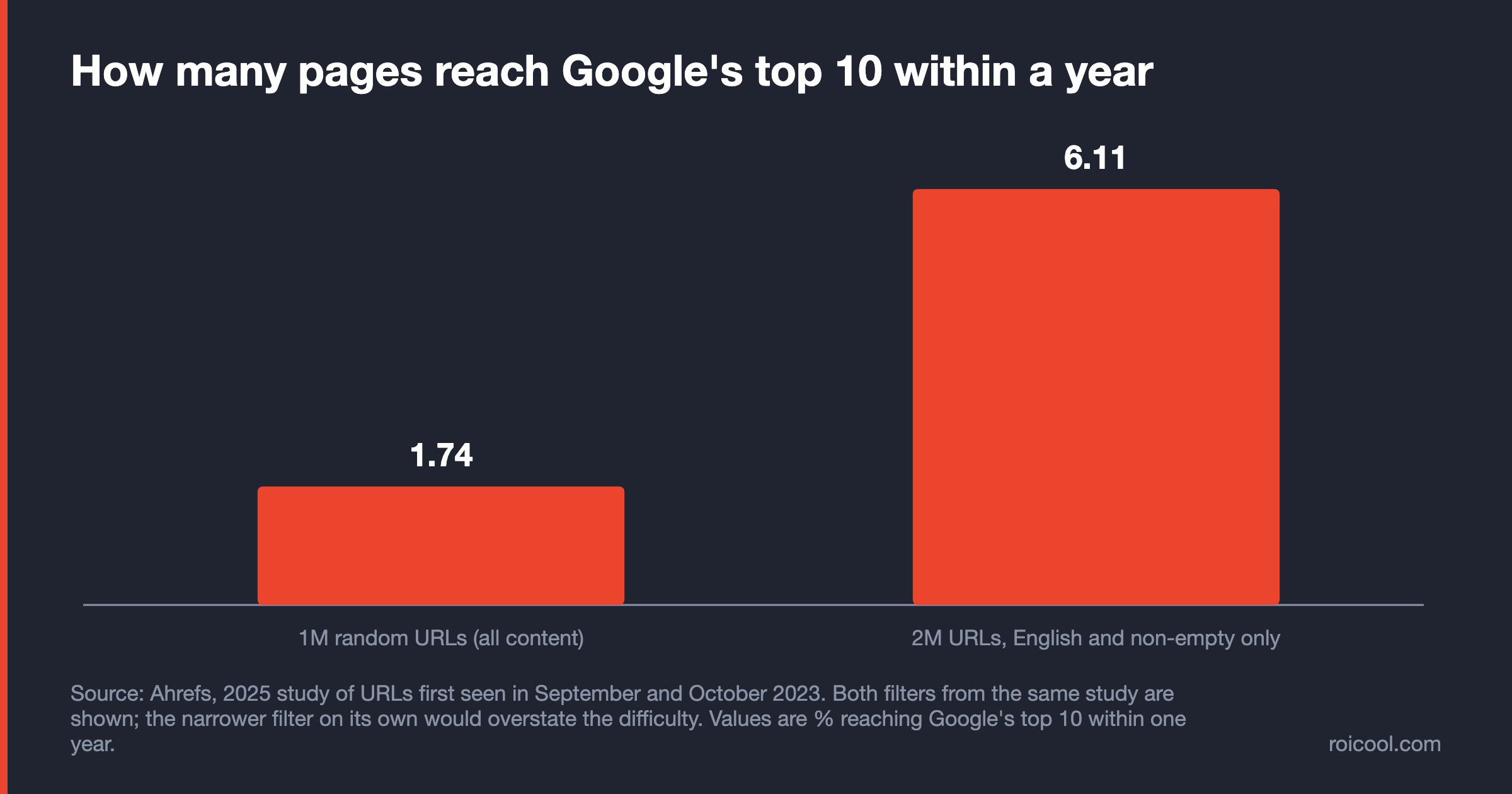
Slow does not mean uniform. Among pages that did reach the top 10, 40.82% got there within one month8. Ranking is not a queue you wait in; it is a distribution with a very long tail. A few pages land quickly, most never land at all, and the ones that land often keep improving for years afterwards.
How old the pages that rank tend to be
Age is the strongest visible pattern in the data. 72.9% of pages in Google's top 10 are more than three years old8, and the average number one ranking page is five years old8. That is what a retainer is really buying: compounding. A page published in month two is still earning in year three, which is also why canceling at month six usually destroys the return rather than capping the cost.
What Google itself says about timing
Google will not give you a timeline either. Its SEO Starter Guide says: "Some changes might take effect in a few hours, others could take several months."6 The same guide suggests waiting a few weeks before assessing whether a change had a beneficial effect in Search6. Any provider offering a firmer schedule than the search engine itself is selling certainty it does not have.
Read together, the three findings explain the billing model. Work that compounds over years cannot be delivered as a one-off project, and a provider paid once has no reason to still be there in month nine, when the compounding starts. The monthly fee is the mechanism that keeps the work continuous. It also means a three-month trial measures your setup, not your results - which is the strongest reason to be suspicious of a package sold on speed.
What are you actually paying for in 2026, when most searches end without a click?
You are buying presence in the answer, not only the click. That shift is recent, measurable, and it changes what a fair price looks like.
The click share has moved
SparkToro's analysis of Similarweb clickstream data found that in the first four months of 2026, 68.01% of US Google searches ended without a click7, up from 60.45% in 20247. This is US desktop and mobile data, not a global figure. SparkToro attributes the acceleration mainly to AI Overviews, now found on more than 20% of all searches, which reduce click-through rate by nearly 60% when they appear7.
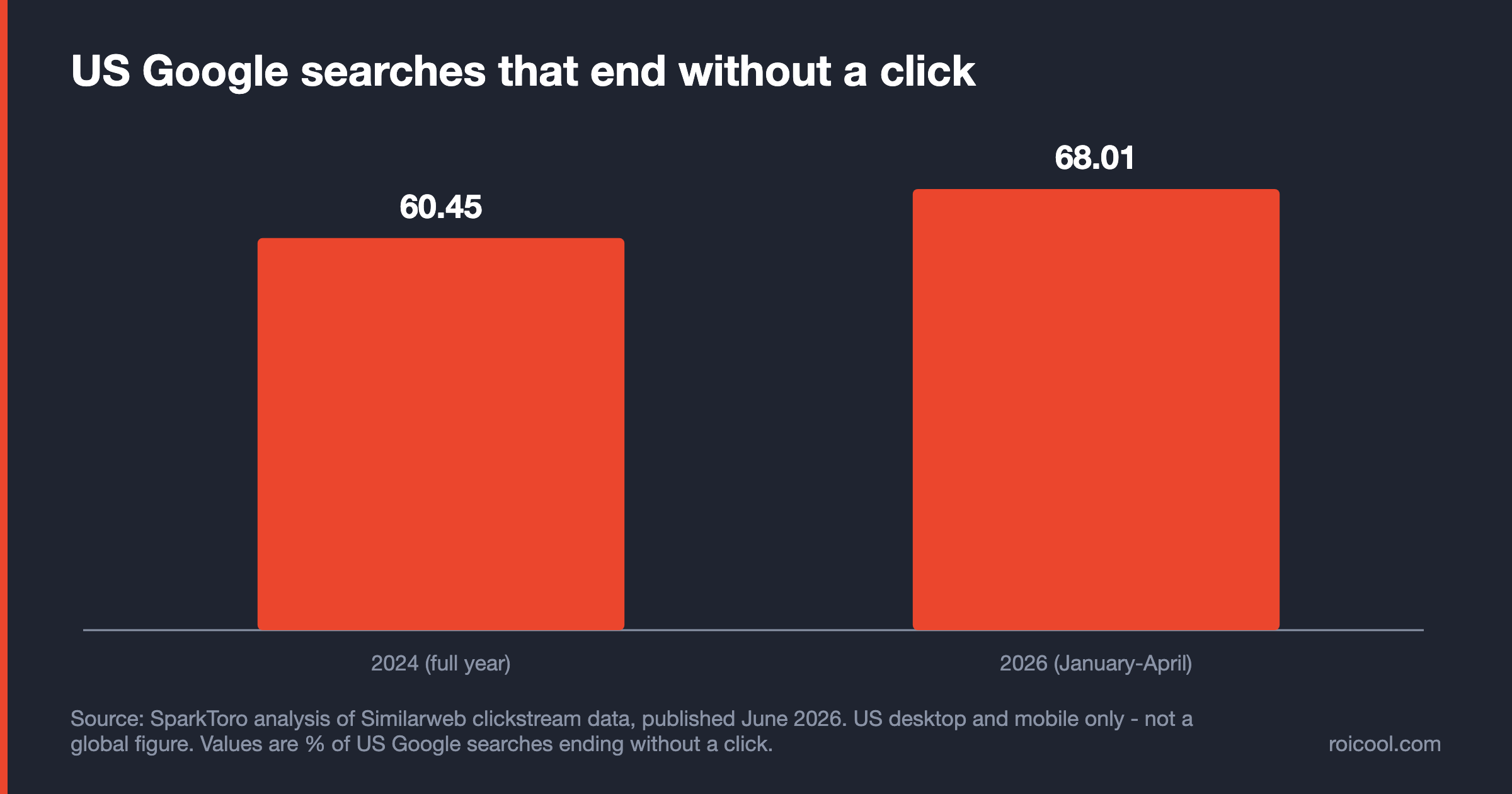
One study, one dataset. If you see this figure quoted elsewhere, it is the same SparkToro analysis being cited again rather than a second measurement confirming it, so do not treat repeated coverage as independent evidence.
What that changes about what you buy
If a minority of searches send a click and the rest resolve on the results page, a retainer measured only in sessions will look like it is failing while it is working. What you are buying is the chance to be the source the answer is assembled from: the page that gets cited, the brand that gets named, the entity Google has enough evidence to trust.
The underlying technical and editorial work has not changed. The evidence you judge it on has - which is the practical case for treating answer engine optimization (AEO) as part of the scope rather than as an upsell, and for agreeing up front how visibility inside an answer will be reported.
How to hold your provider to it
Fix the reporting lines before the first invoice. A defensible 2026 report shows impressions and average position alongside clicks, share of top-three positions for the queries that matter commercially, appearances and citations in AI answers and featured snippets, branded search volume over time, and assisted conversions rather than last-click only.
Two caveats keep this honest. The click decline above is measured in the US7, and your market may be moving at a different pace. And zero-click does not mean zero-value: an answer that names you still creates demand, it just arrives later as a direct visit, a branded search or a form fill. That is harder to attribute, which is exactly why the metric definitions belong in the contract.
The problem with a $150-a-month SEO package
At a package price point this low, the arithmetic only works if the work is automated, templated or bought - and two of those three routes are named in Google's spam policies.
What gets cut first
Strategy goes first, then original content, then anything that needs a senior person's attention. What survives is usually a monthly report, a handful of directory submissions, some templated text and, in the worst cases, links from a network. The output looks like activity. It is not the same category of work as the retainers described above, and the price is being honest about that even when the sales page is not.
The two policies that turn a cheap package into a liability
Google defines link spam as "the practice of creating links to or from a site primarily for the purpose of manipulating search rankings", and names "Buying or selling links for ranking purposes." as an example of it5. It defines scaled content abuse as when "many pages are generated for the primary purpose of manipulating search rankings and not helping users."5 Both describe methods a very cheap package has a structural incentive to reach for.
The consequence lands on you, not on the provider. Google's hiring guidance is explicit: "If an SEO creates deceptive or misleading content on your behalf, your site could be removed entirely from Google's index."4 The same page warns about providers who claim to guarantee rankings, allege a special relationship with Google, or advertise a priority submit to Google4.
A low price is not a violation. SE Ranking found 64% of surveyed agencies charge below $1,000 per month3, in a sample where 94% serve small or local businesses3. A legitimate market exists at that level. The risk is never the number on its own - it is what sits inside the package at that number.
How to read an SEO quote, using Google's own pre-hire questions
Google publishes a list of questions to ask before hiring an SEO. It is the closest thing this industry has to a neutral evaluation standard, it is free, and almost nobody hands it to a prospect.
The questions to ask before you sign
These are Google's own wording, from its "Do you need an SEO?" documentation4:
- Can you show me examples of your previous work and share some success stories?
- Do you follow the Google Search Essentials (previously known as Webmaster Guidelines)?
- What kind of results do you expect to see, and in what timeframe?
- How do you measure your success?
- What's your experience in my industry?
- What's your experience in my country/city?
- How long have you been in business?
- Will you share with me all the changes you make to my site, and provide detailed information about your recommendations and the reasoning behind them?
Three answers that should end the conversation
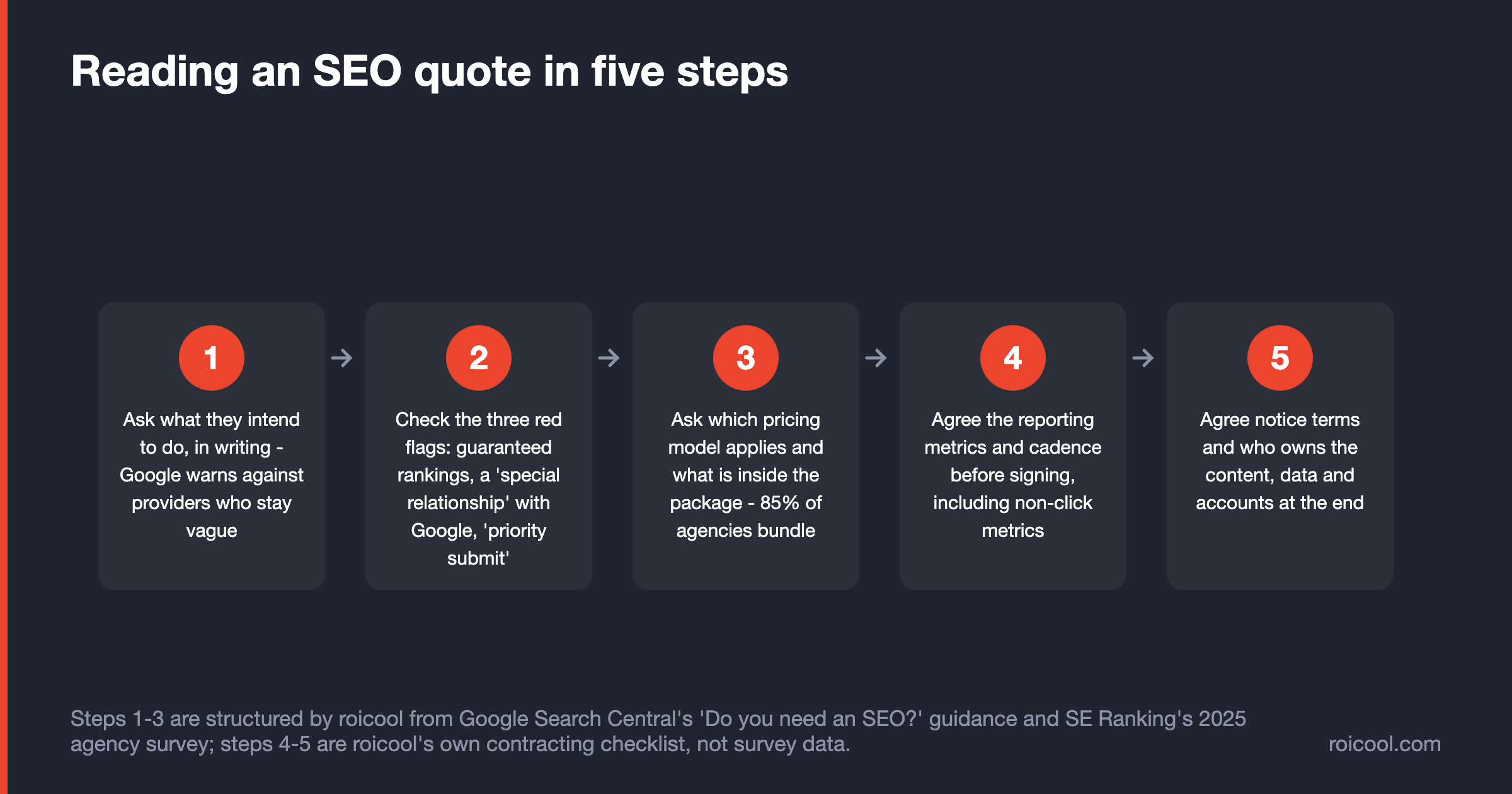
Google names the warning signs directly: be wary of providers that claim to guarantee rankings, allege a special relationship with Google, or advertise a priority submit to Google4. The same page adds a fourth test that catches most of the rest: "Be careful if a company is secretive or won't clearly explain what they intend to do."4 Vagueness in a proposal is not modesty. It is unpriced scope.
What a defensible quote looks like on paper
This checklist is ours, not survey data. A quote you can defend to a finance director names five things: the deliverables and their monthly volumes; who does the work and at what seniority; the reporting cadence and the definition of every metric in it; the notice period and exit terms; and who owns the content, data, accounts and tooling when the engagement ends.
There is a concrete reason to insist on the first item. SE Ranking found that 85% of agencies bundle their service into SEO packages3, so the package is the unit of sale - which makes its contents the actual negotiation.
What the monthly number does not include
The retainer is rarely the whole cost. Implementation time from your developers, approvals from your subject-matter experts, tooling and data subscriptions, design work for new templates, translation for extra markets and any paid placement budget all sit somewhere: either inside the fee or on your side of the line.
Monthly bands hide that split. Write both proposals out as twelve-month totals, with every line below assigned to a side. The cheaper monthly number loses this comparison more often than buyers expect.
| Cost line | Usually inside the retainer | Usually funded by you |
|---|---|---|
| Technical specification | Yes - the provider writes it | - |
| Technical implementation | Only if development is in scope | Developer time, in-house or external |
| Content strategy and briefs | Yes | - |
| Content writing and design | Up to the agreed monthly volume | Anything above that volume |
| Expert review and approvals | - | Your team's time |
| Tooling and data subscriptions | Sometimes, at agency seats | Analytics, CMS and CRM licenses |
| Digital PR and link acquisition | Ask for the monthly target | Any paid placement budget |
| Translation for extra markets | Rarely | Usually yours |
Ask any provider you are shortlisting to fill this table in with their own answers before you compare monthly numbers. A provider who cannot say which side of the line a cost sits on has not finished scoping the work.
Is SEO worth the price? How to measure the return
Work backwards from one closed deal and the answer usually arrives in five lines of arithmetic. The framework below is ours, not survey data - run it with your own figures rather than borrowed benchmarks.
The arithmetic: work backwards from one closed deal
- Take the average value of one closed deal.
- Multiply by your close rate on inbound leads to get the revenue value of a single organic lead.
- Multiply by the number of incremental organic leads you expect per month once the work matures.
- Compare that against the retainer multiplied by twelve, plus the internal cost lines from the previous section.
- Judge the result over twelve months, not three.
Two rules keep the sum honest. Build it on a twelve-month window, because the ranking-timeline data says a shorter window measures your setup rather than your results8. And agree the attribution model in month one, not when the first report disappoints. If the real question is whether SEO or paid media is the cheaper route to the same position, that is a different calculation, and we have written it up separately in our analysis of SEO versus paid ads costs.
A worked example: Lumena Health, six months
Lumena Health is a health tourism client we ran an E-E-A-T-focused SEO program for. Over six months, total organic traffic increased by over 70% year-on-year, visibility in informational queries such as "what is", "how to" and featured snippet fields increased by 120%, top-three positions in competitive medical queries increased by 60%, and organic lead growth reached 200%9. The method, the timeframe and the metrics are set out in full in our healthcare SEO case study.
One case is not a benchmark, and we are not presenting it as a price comparison for healthcare SEO - we have no independently verified figure for that. It is a worked example of the arithmetic above: the line that funds the retainer is the last one, and the three before it are the mechanism that produced it. Ask any provider to show you the same chain on a named client.
What roicool charges: $1,000-$2,250 per month
Our SEO engagements run between $1,000 and $2,250 per month10. That is the band our proposals fall inside - not a starting price, and not an average. Where a given engagement sits within it depends on content volume, technical workload and how many markets are in scope.
This is a self-declared band. We do not publish a price page and no third party has verified it. We are stating it anyway, because a page arguing for pricing transparency that hides its own number is not worth reading.
What sits inside the band
- Technical SEO: crawl and indexation work, Core Web Vitals, structured data, migration support where needed
- Content: keyword and entity research, briefs, and production or editing at an agreed monthly volume
- Off-page: digital PR and editorially earned links, with the monthly target written into the scope
- Measurement: monthly reporting against defined metrics, including non-click visibility
- People: a named lead who does the work, not only the account call
Where that band sits in the survey data
Backlinko's own label for the $1,001-$2,500 band is "Mid-tier", which its 2025 survey describes as "The most common range, ideal for mid-sized businesses or moderately competitive industries"2. That is the survey's wording, and we are not going to relabel it in either direction. The bottom of our range, $1,00010, does not sit in that tier at all: it is the ceiling of the tier below, which Backlinko calls the small business tier at $501-$1,000 a month2.
It is also not a discount on an identical cost base. Providers are priced against the market they operate in: Backlinko's respondents put US services at 3-5x the cost of emerging-market ones2. A different cost base is not a lower standard of work; it is a different set of salaries, overheads and local rates.
Test the scope and the people behind it, and get both in writing before you sign. That is how we build our own proposals: the band is fixed, the work inside it is not. What moves a quote within that band is our tailored approach to SEO engagements - your goals, your competition and the state of your site today.