What the Turkey Regulatory Operating Cost Is, and Why It Is 4.5% in 2026
Google Ads cost in Turkey starts in the auction but does not end there. For ads served in Turkey, Google adds a Turkey Regulatory Operating Cost to the invoice, and as of January 1, 2026 the rate is 4.5%, down from 7%1. It sits on top of your advertising spend and appears as a separate line item per jurisdiction on your monthly invoice1. Our Google Ads fundamentals article explains the ad types and how the platform works, if you need that groundwork first.
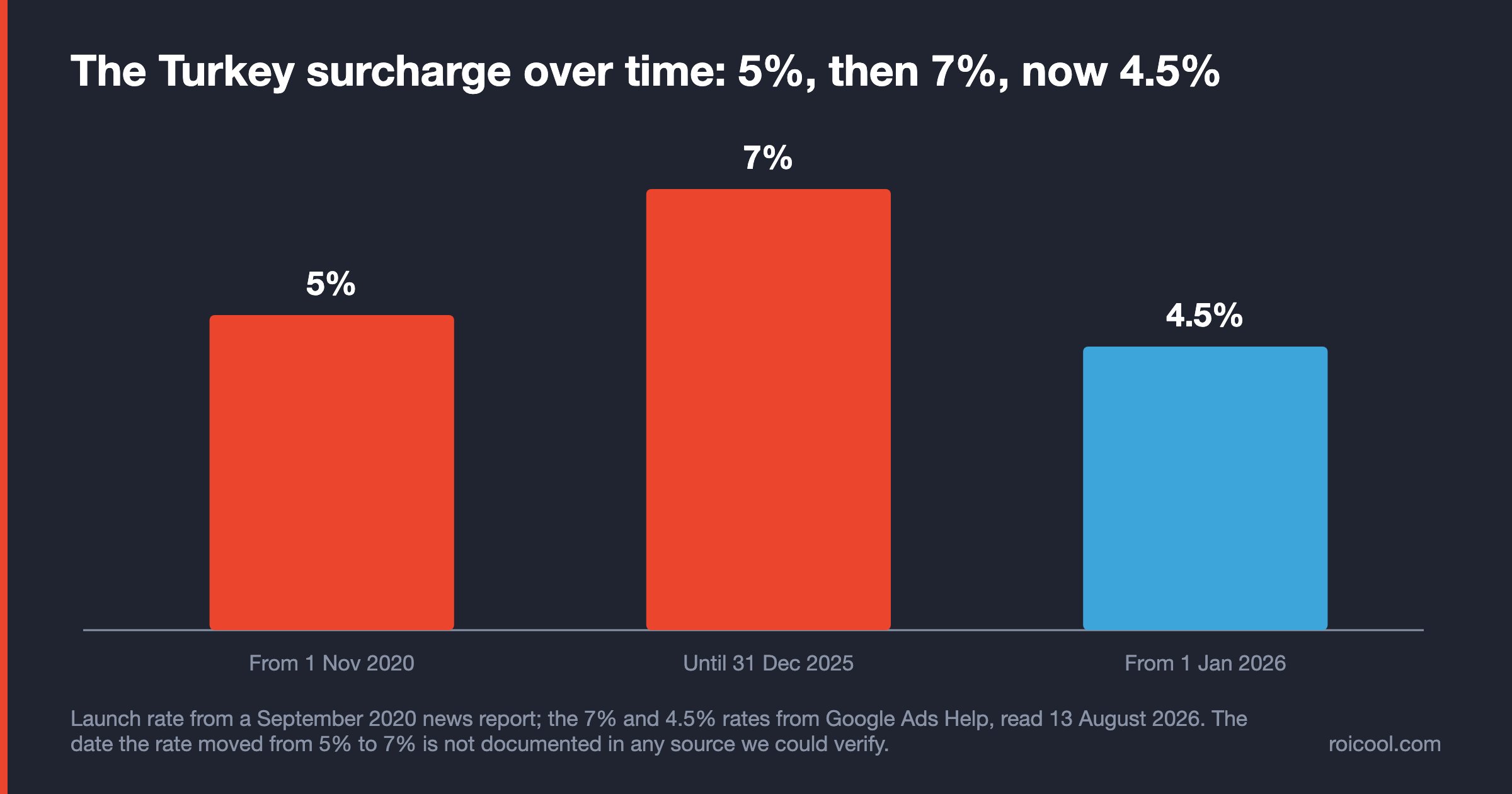
The rate has moved twice. The surcharge launched at 5%, announced on September 2, 2020 ahead of a November 1, 2020 start7. Google dates the cut to 4.5% and publishes the 7% it replaced, but never says when 7% began1.
Where the surcharge appears on your invoice
Open the Billing menu in your Google Ads account and go to Transactions. Google names two places the charge can be found: "In your monthly invoice or statement as a separate line item per jurisdiction", and the Transactions section of the account1. If that line is missing, your ads were not served in a surcharged jurisdiction that month.
On prepaid accounts the charge can arrive late. Google says surcharges may be levied after your payment has been fully spent, leaving an open balance that is deducted from the next prepayment: its example is EUR 7 of accumulated regulatory operating costs meeting a EUR 100 payment, which leaves EUR 93 of credit towards displaying ads1. Budget for the balance, not only for the spend.
Why Google does not call it a digital services tax
Google names the charge differently by country. For France, Spain and Italy it ties the Regulatory Operating Costs to Digital Services Tax legislation, and the Austria and United Kingdom items are named DST Fees. For Turkey it says only that the costs were added "due to significant increases in complexity and cost of complying with regulations in Turkey"1.
Google never uses the phrase for the Turkey line, but Turkey does have a digital services tax, and the advertiser is not the one who pays it. Law No. 7194 covers all kinds of advertising services presented in a digital environment and set the rate at 7.5%9; the taxpayer is the digital service provider rather than its customer9. Presidential Decision No. 10767, published in the Official Gazette on December 25, 2025, reset that rate to 5% from January 1, 2026 and 2.5% from January 1, 20278.
Google's Turkey line moved on the same date, from 7% to 4.5% on January 1, 20261. Two dated facts side by side is all we are putting on the page: Google explains its own charge only by the cost of complying with regulations in Turkey1, and we have no source that connects the two. For a 2027 budget the useful part is that the statutory rate steps down again while Google publishes no scheduled change to the 4.5%.
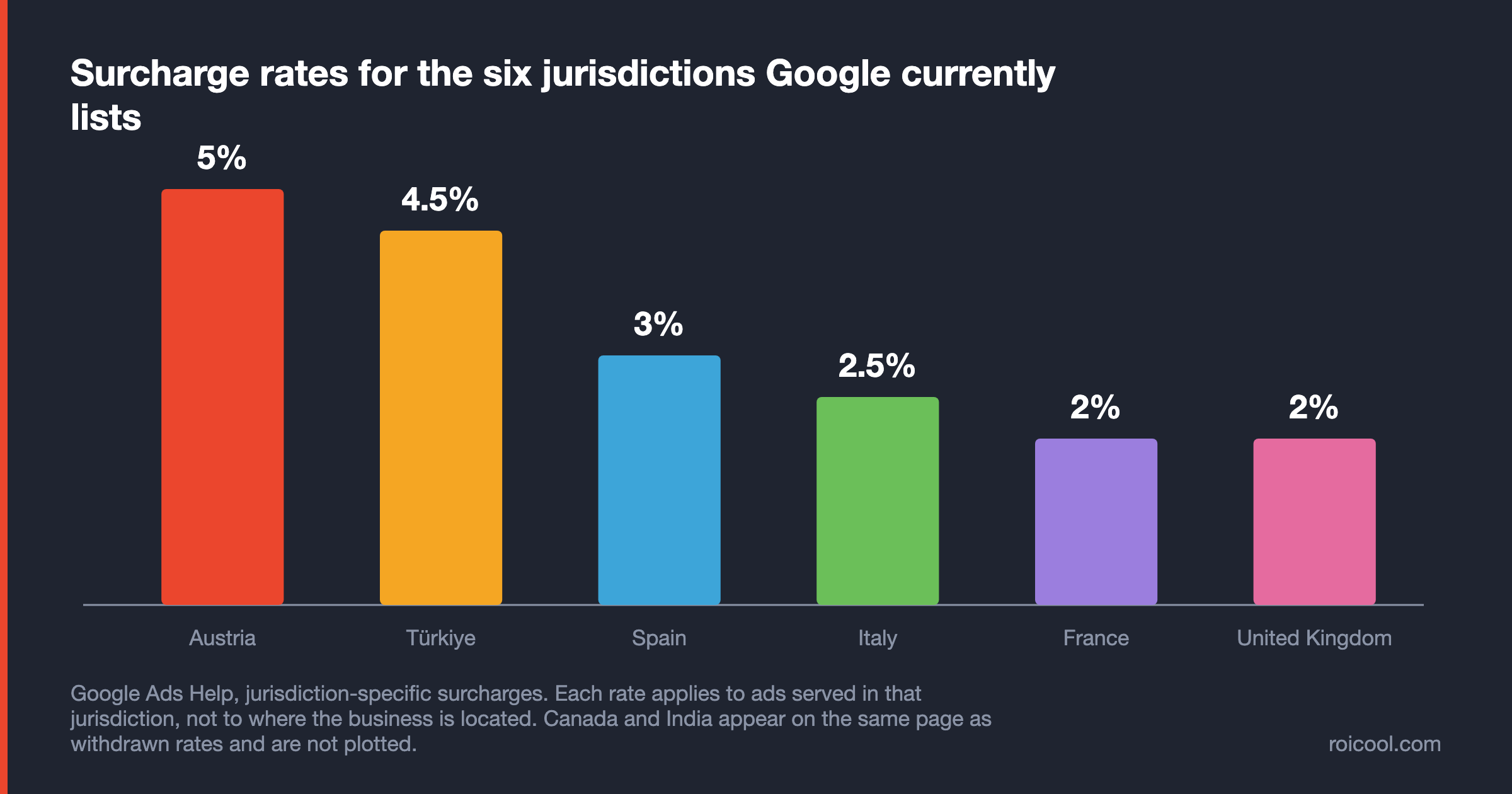
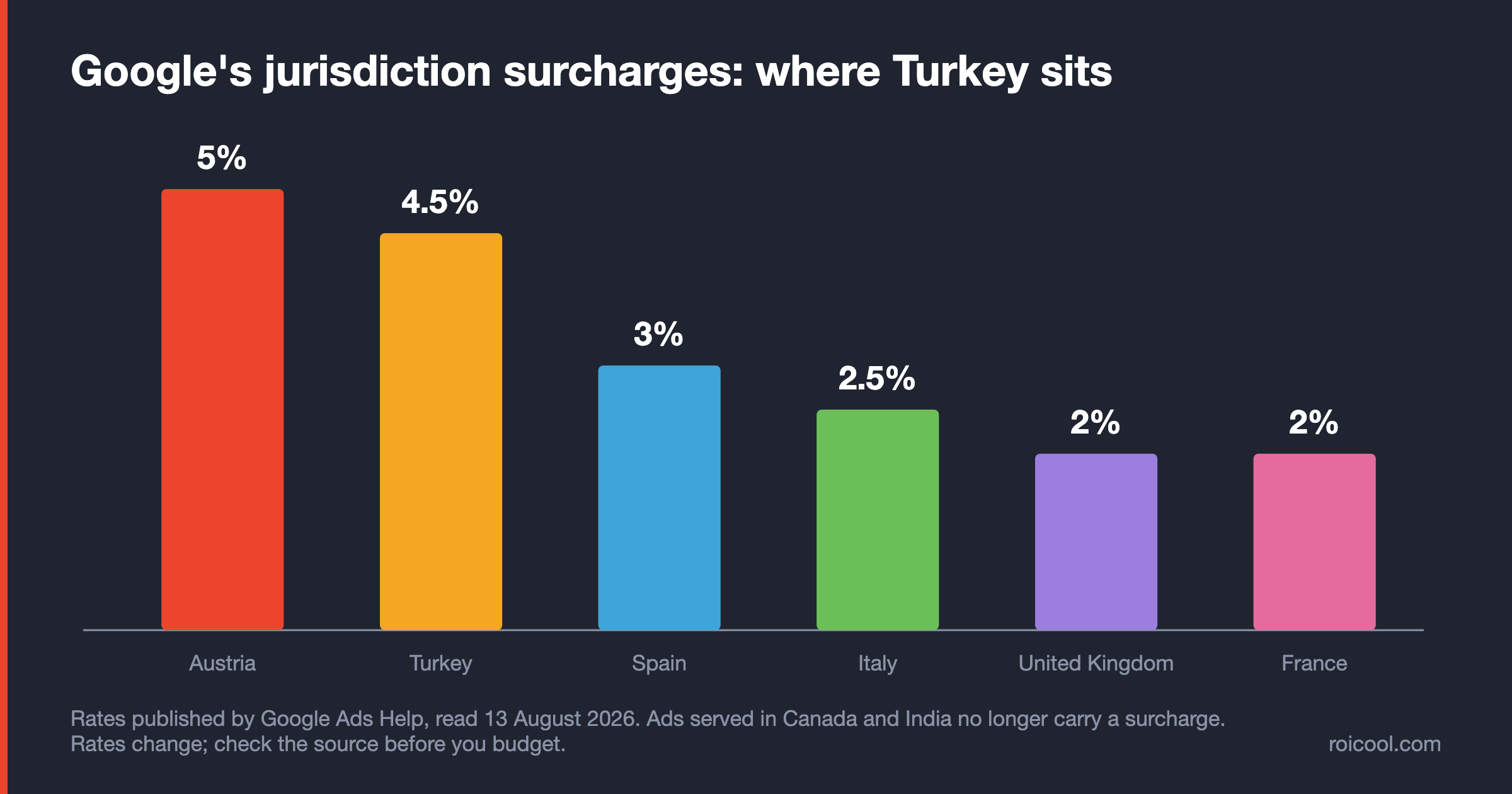
Google's surcharge rates differ by country as well: Austria 5%, Turkey 4.5%, Spain 3%, Italy 2.5%, and the United Kingdom and France 2% each1. Among the seven competitor pages we reviewed in English in August 2026, none states the current 4.5% rate13.
That is the surcharge. Whether tax lands on top of it is a different question with a different rule.
Two Directions, Two Different Answers
Whether you pay the Turkey surcharge is decided by where your ads are served. Whether you owe Turkish VAT and withholding tax is decided by where you pay tax. Two independent rules, so two advertisers can get two different correct answers to one question.
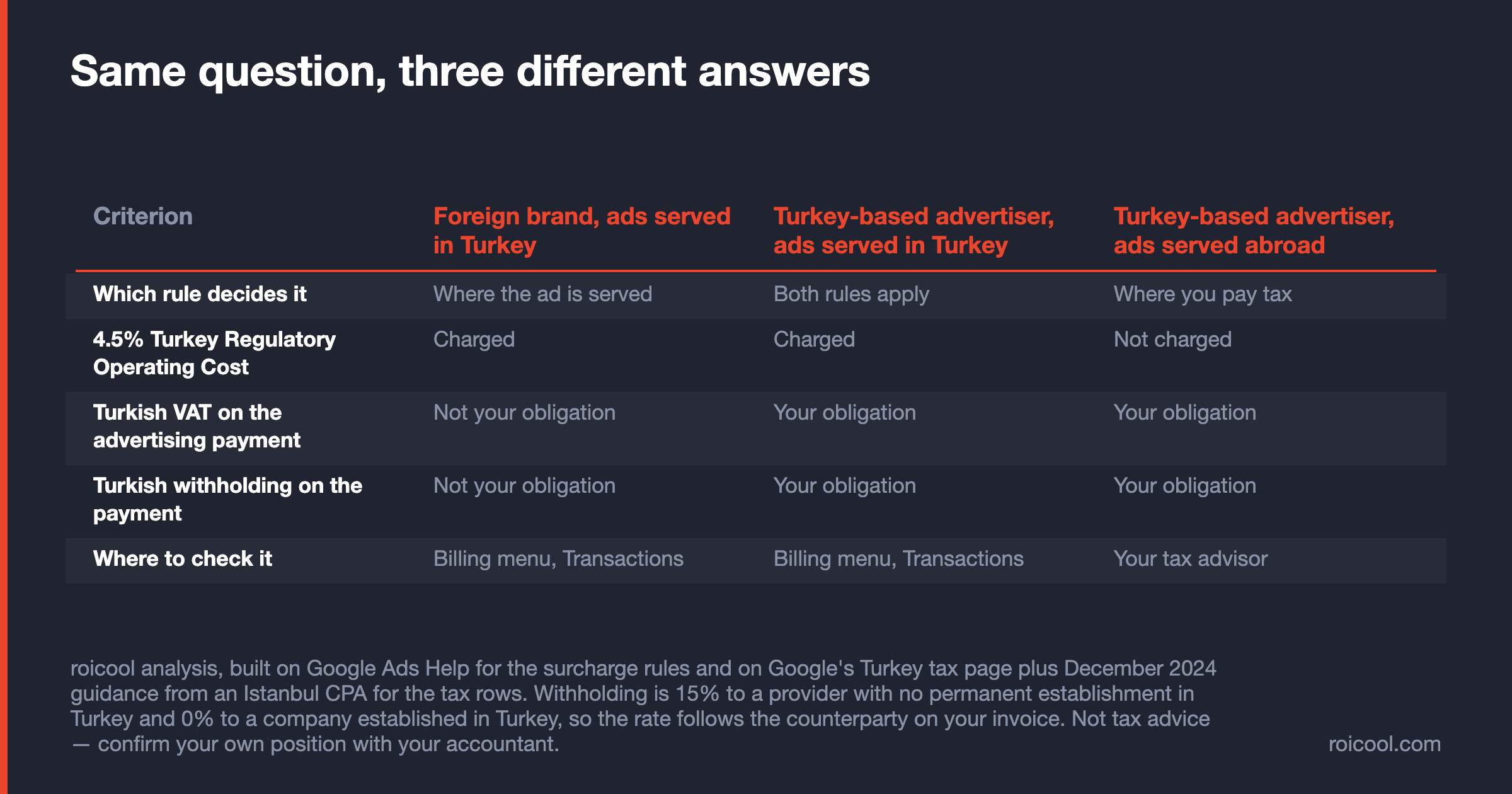
| Criterion | Foreign brand, ads served in Turkey | Turkey-based advertiser, ads served in Turkey | Turkey-based advertiser, ads served abroad |
|---|---|---|---|
| Which rule decides it | Where the ad is served | Both rules apply | Where you pay tax |
| 4.5% Turkey Regulatory Operating Cost | Charged | Charged | Not charged |
| Turkish VAT on the advertising payment | Not your obligation | Your obligation | Your obligation |
| Turkish withholding on the payment | Not your obligation | Your obligation | Your obligation |
| Where to check it | Billing menu, Transactions | Billing menu, Transactions | Your tax advisor |
Read the columns as three people. The foreign brand pays the surcharge and owes no Turkish tax. The Turkey-based advertiser serving Turkey meets both rules at once. The Turkey-based advertiser running ads abroad escapes the surcharge and keeps the tax. The withholding row carries a condition the table cannot hold: the rate is 15% or 0% depending on your counterparty3.
If you are a foreign brand advertising into Turkey
You pay the surcharge. Google's rule ignores your company's address: "This applies every time an ad is served in specific jurisdictions, regardless of where your actual business is located"1. A clinic in Germany advertising to people in Turkey accrues the same line as a company in Istanbul. Turkish VAT and withholding are not your obligation: they attach to the taxpayer making the payment, not to the ad.
If you are based in Turkey and your ads run abroad
No Turkey surcharge accrues, because none of your impressions land in Turkey: "If you advertise in several jurisdictions, you’ll only be levied a surcharge when ads have been served to people in the impacted jurisdictions"1. Other markets charge their own, and the list moves: the 2.5% DST fee on ads served in Canada ended on July 1, 2025, and the 2% cost in India on September 1, 20241.
An Istanbul clinic whose healthcare advertising is served only in Germany and Italy sees no Turkey line on its invoice, and an Italy line instead1. The tax side does not travel with the ads: a Turkish taxpayer paying the invoice keeps its VAT and withholding obligations wherever the impressions landed.
The spillover trap: surcharges you did not plan for are not refunded
A campaign can serve ads in a jurisdiction it never targeted; Google's own example is a user in the United Kingdom seeing your ad because your business is a location of interest to them. Google then states plainly that it "will not refund the Regulatory Operating Costs or DST Fees that were levied as a result of legitimate clicks and impressions served according to your campaign target settings"1.
Keeping targeting correct is the advertiser's responsibility, so audit your location settings before you audit your invoice and exclude unintended jurisdictions explicitly. It belongs with the other common Google Ads mistakes that quietly raise what an account costs.
Is VAT Added? It Depends on Who Your Counterparty Is
Your account is served by Google Ireland Ltd. unless you receive a notice referring to Affected Products, in which case Google Turkey becomes your counterparty for those products2. That sentence decides whether Turkish VAT arrives on the invoice Google sends you or is something you declare yourself.
Google Ireland Ltd. or Google Turkey: how to tell which one you are dealing with
Check the counterparty printed on your invoice, and check your notices. Google writes that accounts served by Google Turkey are subject to VAT "at the Turkish standard rate, a rate that can change at the government's discretion"2. It never prints that rate as a number; the general rate has been 20% since July 10, 202310.
20% VAT under the reverse-charge mechanism if you pay from Turkey
As of the most recent professional guidance we could verify, a December 2024 note by an Istanbul CPA, a business paying a foreign-based platform such as Google from Turkey owes 20% VAT under the reverse-charge mechanism, filed on VAT Return No. 24. Reverse charge means the buyer declares and pays the VAT instead of the seller charging it on an invoice.
The counterparty decides more than where the VAT is printed. Google names its Turkish counterparty Google Reklamcılık ve Pazarlama Ltd. Şti2, a company established in Turkey, and Presidential Resolution No. 476 puts withholding at 0% on payments to a company established in Turkey against 15% to one with no permanent establishment here3.
So the notice that changes your counterparty also removes the whole withholding layer described in the next section3. Do not model the two paths as the same number wearing different clothes. Partial VAT withholding and full exemption certificates are separate cases Google handles on request2. This is not tax advice; confirm your own position with your accountant.
The 15% Withholding Tax on Advertising Payments From Turkey
If you pay Google for advertising from Turkey, the most recent professional guidance we could verify, that same December 2024 CPA note, says a 15% withholding tax applies to the payment4. Google neither deducts it nor shows it: the payer in Turkey calculates the amount, declares it and pays it to the tax office.
Resolution 476: 15% to a limited taxpayer, 0% to a company established in Turkey
A January 2021 analysis by a Turkish law firm traces the rule to Presidential Resolution No. 476, dated December 18, 2018 and effective from January 1, 2019, and sets out the rates it created: 15% when the payment goes to a company that has no permanent establishment in Turkey, and 0% when it goes to a company established in Turkey3.
The operational consequence is rarely priced in. Media paid to a provider with no permanent establishment in Turkey sits in the 15% band; a management fee paid to an agency incorporated in Turkey sits at 0%3. Two lines on the same marketing budget, two different regimes.
Whether a given foreign provider has such an establishment is treated as a question, not a settled fact. The tax ruling the same analysis cites is conditional: if the Ireland-resident company has no permanent establishment in Turkey and does not render the service through one, the right to tax belongs only to Ireland3.
Where the law is still contested
The same January 2021 analysis notes that applying 15% withholding to advertising fees paid to providers established abroad "has sparked a debate, especially regarding the Conventions on the Avoidance of Double Taxation"3. It also records where that debate had been landing as of that date: many companies paid under reservation and went to court, and tax courts tended to cancel the withholding on the ground that an establishment is defined as a fixed physical place3.
A tendency recorded in January 2021 is not a rate you can budget on, and it is not a reason to skip a declaration. Take a position with your tax advisor, in writing, before the payment leaves. And if you are not a Turkish taxpayer, this section is not your obligation at all.
Google Ads Cost in Turkey: The Full Invoice Chain From Media Budget to Total
Tax sits on top of the surcharge, not the other way round. Google states it directly: "Any taxes, such as sales tax, VAT, GST, or QST that apply in your jurisdiction will be charged in addition to the new surcharges"1. The surcharge therefore enters the tax base, and the tax never enters the surcharge base.
The default path: Google Ireland Ltd. as counterparty
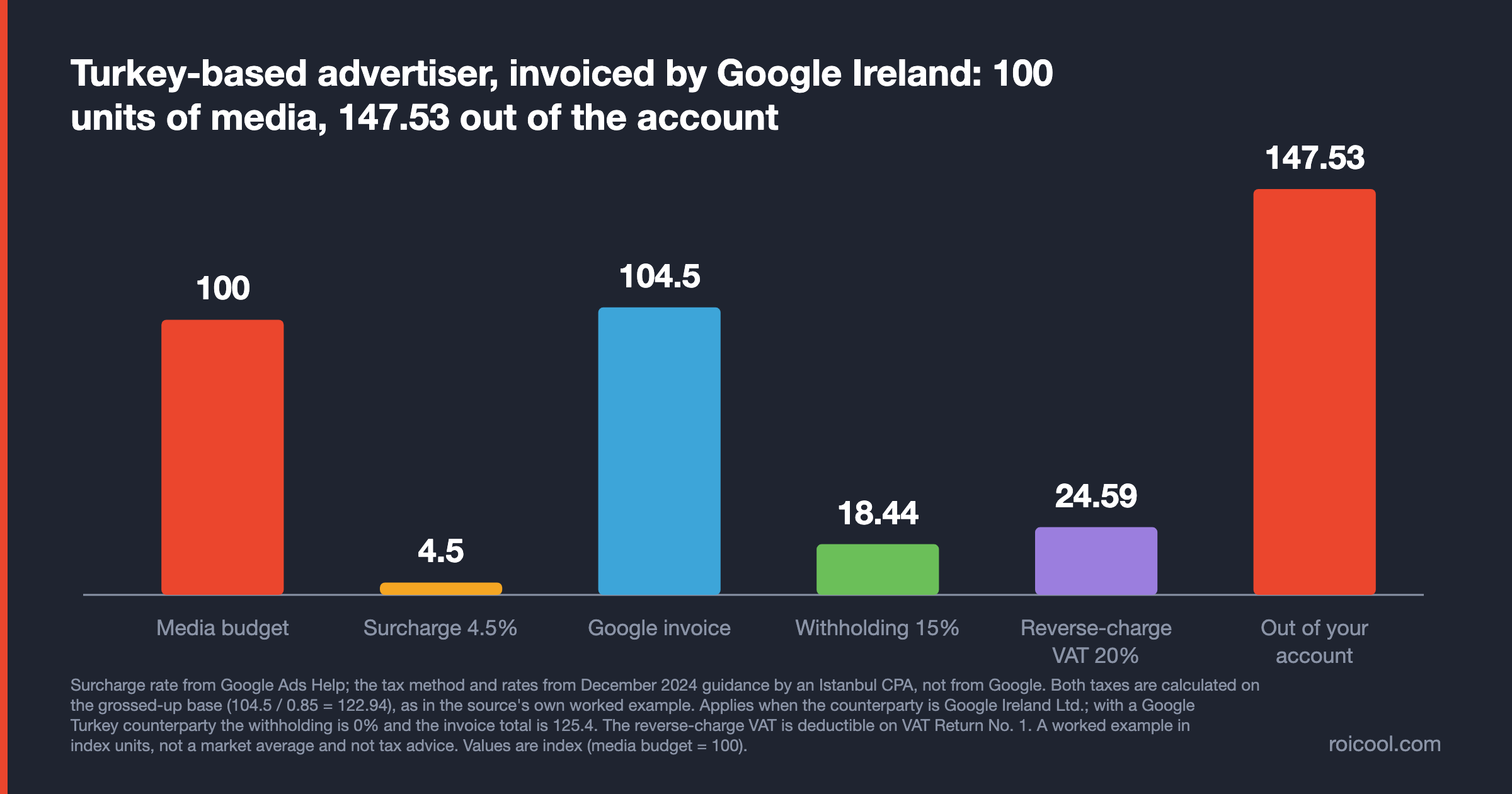
Take a Turkey-based advertiser whose ads are served in Turkey and who has received no Affected Products notice, and set the media budget at 100 index units, because the currency does not change the ratio. The 4.5% surcharge adds 4.5 units, so Google invoices 104.51. The December 2024 guidance does not tax that figure directly: it grosses the amount up first, dividing by 0.85, and calculates both taxes on the grossed-up base4.
On a base of 122.94, withholding at 15% is 18.44 and reverse-charge VAT at 20% is 24.59. You pay 104.5 to Google and 43.03 to the tax office: 147.53 in total4. That chain is our own arithmetic on Google's rate1 and the December 2024 method4, not a figure either source publishes. Run that method on the guidance's own example and a 9,600 TL invoice becomes 13,552.94 TL of total cost4.
| Step | Index units | Who receives it |
|---|---|---|
| Media budget | 100 | |
| Turkey Regulatory Operating Cost 4.5% | 4.5 | |
| Google invoice | 104.5 | |
| Withholding and VAT base (104.5 / 0.85) | 122.94 | calculation base only |
| Withholding 15% | 18.44 | Turkish tax office |
| Reverse-charge VAT 20% | 24.59 | Turkish tax office |
| Total leaving your account | 147.53 |
One of those rows comes back in full, the other only lowers your tax base. The reverse-charge VAT is paid on VAT Return No. 2 and can then be deducted on VAT Return No. 14, while the withholding can be recorded as an advertising expense and deducted from the tax base4. So 147.53 is the cash that leaves the account, not the final cost of the media: the number your cash-flow plan needs and the number your profit and loss carries are different numbers.
If Google Turkey is your counterparty, the chain is shorter
With an Affected Products notice the counterparty changes2 and two things follow. VAT is charged on Google's invoice at the Turkish standard rate instead of being self-assessed2, and the withholding band drops to 0%, because the payment goes to a company established in Turkey3. The same 100 units of media then reach an invoice total of 125.42.
Same media, two totals: 147.53 leaving the account on the default path, 125.4 invoiced on the other. The difference is the withholding layer plus the VAT that grossing up adds on top of it. Check which counterparty your invoice names before you model either number.
The withholding layer sits outside the invoice, not outside the total
Withholding is not a line on the Google invoice, because it attaches to the payment rather than to the media. That is why a chain that stops at the invoice understates what a Turkish advertiser needs in the bank: on the default path the two declared taxes add 43.03 units on top of a 104.5 invoice4. This is a worked example in index units, not a market average and not tax advice. Confirm the calculation with your accountant.
Why This Article Gives You No Turkey Click-Price Table
Our sourcing turned up no independent, measured dataset of cost per click by industry for Turkey, so this article does not publish one. Estimates are a different thing and they do exist: a keyword tool projects what a click might cost from its own sample of queries, while a benchmark dataset reports what advertisers were charged. This section shows you how to produce the estimate yourself, in the tool those numbers come from anyway.
Build your own estimate in Keyword Planner
Set the location to Turkey, pick your Search Network setting, and read the top of page bid columns. Google describes the low range as an approximation of the 20th percentile and the high range as the 80th, based on what advertisers have historically paid in the location and network you selected, with bid statistics covering the last 30 days5. It is a range, not an average.
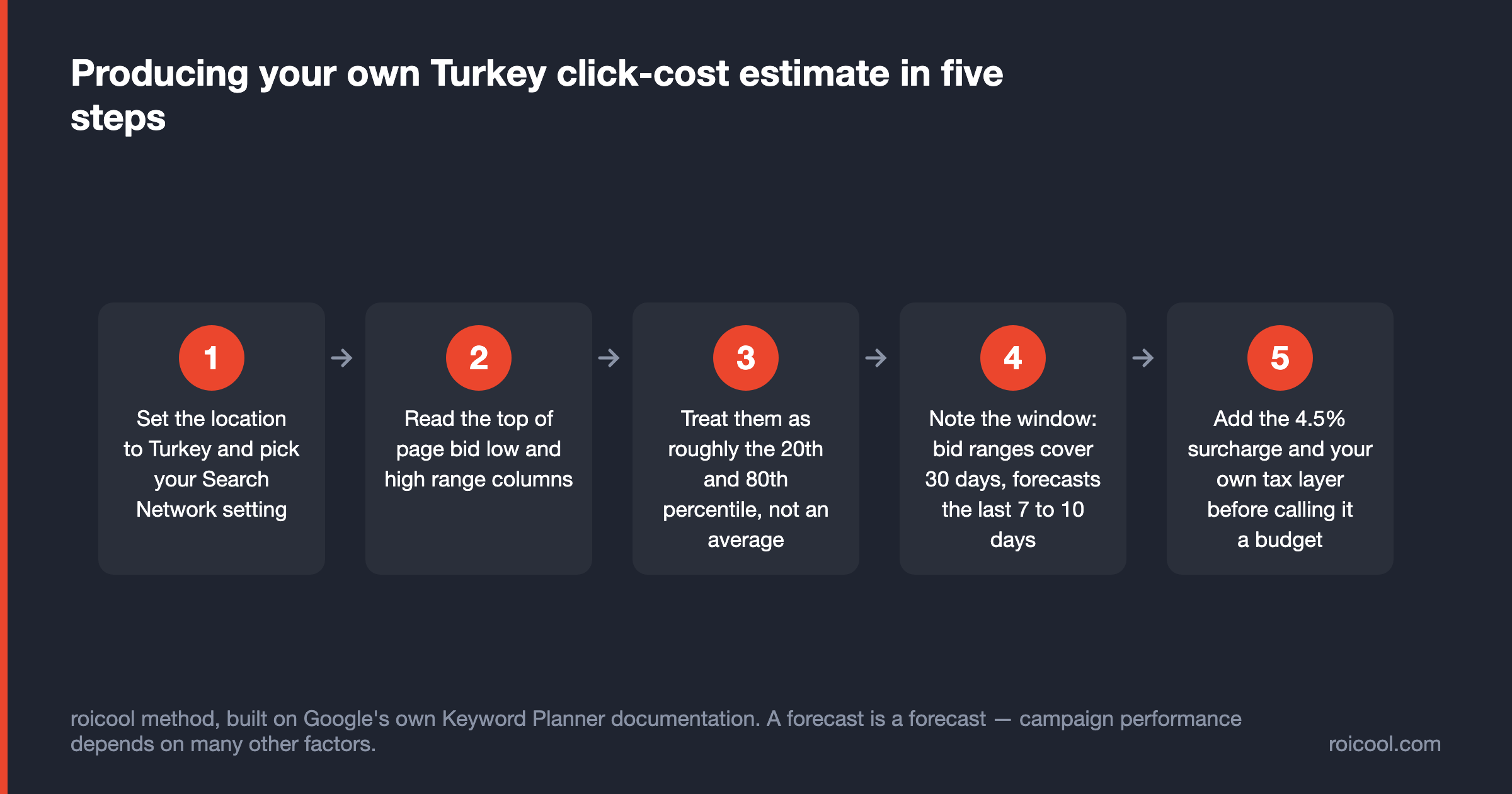
- Set the location to Turkey and pick your Search Network setting
- Read the top of page bid low and high range columns
- Treat them as roughly the 20th and 80th percentile, not an average5
- Note the window: bid ranges cover 30 days, forecasts the last 7 to 10 days6
- Add the 4.5% surcharge and your own tax layer before calling it a budget1
Forecasts are a separate feature with a shorter memory: refreshed daily, based on the last 7 to 10 days, with performance still depending on a variety of factors6. Our companion article handles click prices and daily budget arithmetic and publishes Semrush estimates for the Turkish market by industry; those are tool estimates, and they should be labeled as such in your plan rather than treated as measured spend.
If the real question is channel choice, the SEO versus paid ads cost comparison covers it.
What the imported US benchmark actually measures
The number you meet everywhere is 5.42 US dollars per click, and its label matters more than its value: a median rather than an average, drawn from 13,474 US-based search campaigns running between April 1, 2025 and March 31, 202612, from a dataset that mixes Google Ads with Microsoft Ads across more than 20 industries11.
It says nothing about Turkey. The Turkish figures in circulation are tool estimates rather than a comparable measured sample, so we will not tell you Turkey is cheaper, and we will not tell you it is more expensive either. A US median is a fact about US auctions; moving it into a Turkish plan turns someone else's measurement into your forecast.
What Agency Management Costs in Turkey: Fee Models, Not Price Tags
No neutral fee benchmark for Google Ads management in Turkey came out of that sourcing either, so this section describes how fees are structured rather than what they cost. Structure tells you more than a number anyway: what the agency is rewarded for.
The three fee structures and what each one rewards
- Percentage of media spend: the fee grows with the budget, which rewards scaling and leaves the efficiency risk with you.
- Flat monthly retainer: the fee is predictable and independent of budget, which rewards discipline and leaves the volume risk with the agency.
- Hybrid with a performance component: a smaller base plus a share tied to an agreed metric, which works only if both sides measure that metric the same way.
One detail belongs in the purchasing decision: a management fee paid to an agency established in Turkey and media paid to a provider with no permanent establishment here sit in different withholding regimes, 0% against 15%3. Ask which base your agency fee is calculated on before you compare two quotes.
Five questions to ask before you sign
- Is the fee calculated on media spend before or after the surcharge and VAT?
- Who owns the account and its historical data if we part ways?
- What is included in the fee, and what is billed separately?
- What is the notice period, and what happens to campaigns during it?
- Which metric is the fee tied to, and who measures it?
Those answers separate a priced service from a priced number. Bring the five questions to the free first strategy meeting offered on our Google Ads agency in Turkey page and you will hear ours.