What Is AI SEO? One Name for Two Different Jobs
AI SEO is the common name for two jobs that share almost nothing operationally: using artificial intelligence to do SEO work, and getting your pages cited inside AI answers. Both are real work. Both are sold under the same two words. When a brief mixes them, the budget lands on the wrong side — a tool license when the actual problem was that no AI answer ever names you, or the reverse.
AI SEO covers two things at once. On one side, using AI tools inside the SEO workflow: keyword research, briefs, drafts, technical audits. On the other, making sure your pages are cited as sources in AI answers such as AI Overviews, Microsoft Copilot, ChatGPT and Perplexity. One label, two jobs, two budgets.
Definition: what AI SEO actually refers to
There is no formal definition to appeal to. This is market vocabulary, not a standard: marketers still cannot agree on what to call the work of getting found in AI, and the vocabulary has splintered further over the past year9. Google's documentation does not treat it as a separate discipline either. It describes work aimed at generative AI search as work aimed at the search experience, and therefore still SEO1.
The split is visible in the guides themselves. Of the six English guides we reviewed for this page, one covers only the first job and five cover only the second. None of them separates the two. Names for the second job (GEO, AEO, AIO, LLMO) are mapped further down; this section only fixes what the umbrella contains.
The two axes are easy to tell apart in a proposal. Axis A is production: a model clusters a keyword export, drafts an outline or summarizes a crawl report, and throughput changes while the job stays the same. Axis B is distribution: the target is not a position in a list of links but being the source an AI answer quotes while it writes the reply. Each axis has its own section below, with the documentation that governs it.
Why the confusion is expensive
The two jobs need different budgets, different owners and different proof. Axis A is bought from a tools line and shows up as time saved; nobody outside the team notices. Axis B is bought from an acquisition line and shows up — if it shows up at all — in citation and impression reports that did not exist two years ago. A provider who sells one and reports the other is not lying exactly. They are answering a question you did not ask.
Is AI SEO the Same Thing as GEO? A Direct Answer
In practice largely yes, but the two labels are not interchangeable. GEO names one specific job: being visible inside the answers generative engines write. AI SEO is the looser umbrella that covers that job and the tool-side work as well. Every GEO project counts as AI SEO. Not every AI SEO project is GEO.
What the encyclopedia does with the term
English Wikipedia does not keep a separate article for the term. It redirects to the entry on generative engine optimization, which lists answer engine optimization, LLMO, AIO and AI SEO as other terms for the same concept11. The same entry records that no consensus definition distinguishing these terms had been established in the academic literature as of early 202611. Wikipedia is a tertiary source; here it is evidence of how the market uses the words, and nothing more.
What Google's documentation says
Google recognizes the acronyms without recognizing a new discipline. Its guide spells out AEO and GEO and calls both terms for work focused on visibility in AI search experiences1. The guide itself went live on 15 May 2026, and the announcement stated openly that it contains a section mythbusting common AEO/GEO misconceptions2. So the vocabulary is acknowledged. The claim that the vocabulary describes a separate practice is the part Google declines.
What an independent analyst says
Forrester's reading sits between the two camps: answer engine optimization is significantly, but not fundamentally, different from SEO14. Significantly matters, because the surfaces, the reports and the failure modes genuinely differ. Not fundamentally matters more, because underneath it is still indexing, relevance and content someone wants to quote.
That distinction is worth holding on to when a proposal lands on your desk. Significant differences justify a new report and a new baseline. Fundamental differences would justify a new team, a new budget line and a new vendor — and that is the claim nobody has evidenced yet.
Where this page stops and the GEO guide begins
The GEO guide owns the deep version. The definition, the crawlers, the founding paper and the terminology map all sit in our guide to generative engine optimization, which goes further into each than this page will. What this page adds is a different axis on the same vocabulary — whether Google's documentation defines a term at all, and which of the two jobs it points to — and then the reports that show whether any of it landed.
The Name Map: Six Terms, Who Uses Them, Where They Point
These are competing names for overlapping work, and the difference between them is commercial before it is technical. Which one you use does not change what has to happen to the page. It does change who is allowed to sell you a new product.
Why the vocabulary splintered
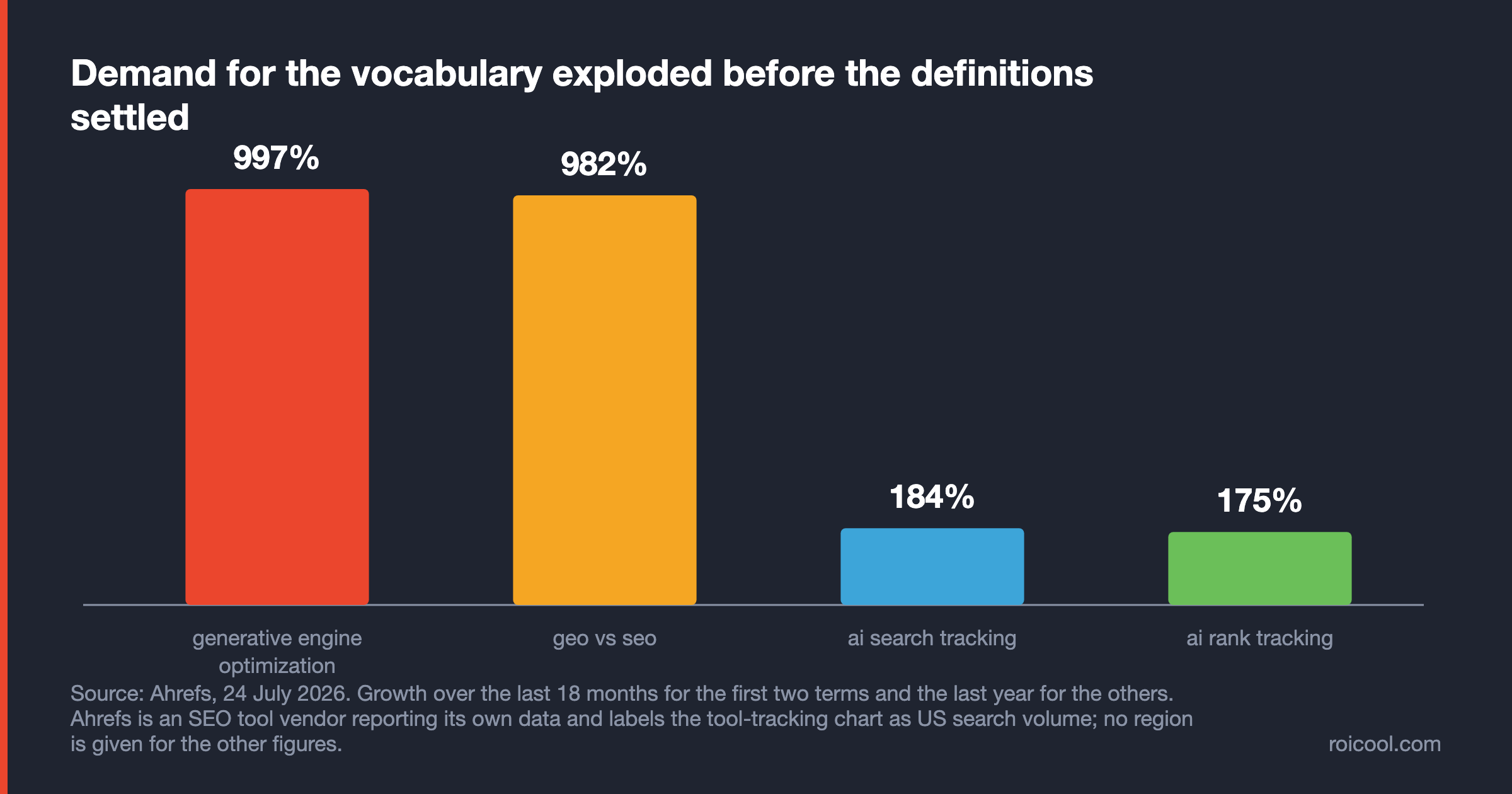
Demand arrived before the definitions did. Ahrefs, an SEO tool vendor reporting its own data, put searches for generative engine optimization up 997% over the last 18 months and geo vs seo up 982%, alongside a wave of comparison queries that barely registered a year earlier9. Tool demand moved with it: ai search tracking up 184% and ai rank tracking up 175% over the last year9. Ahrefs labels the tool-tracking chart as US search volume; no region is given for the other figures.
Which of these names Google's documentation actually defines
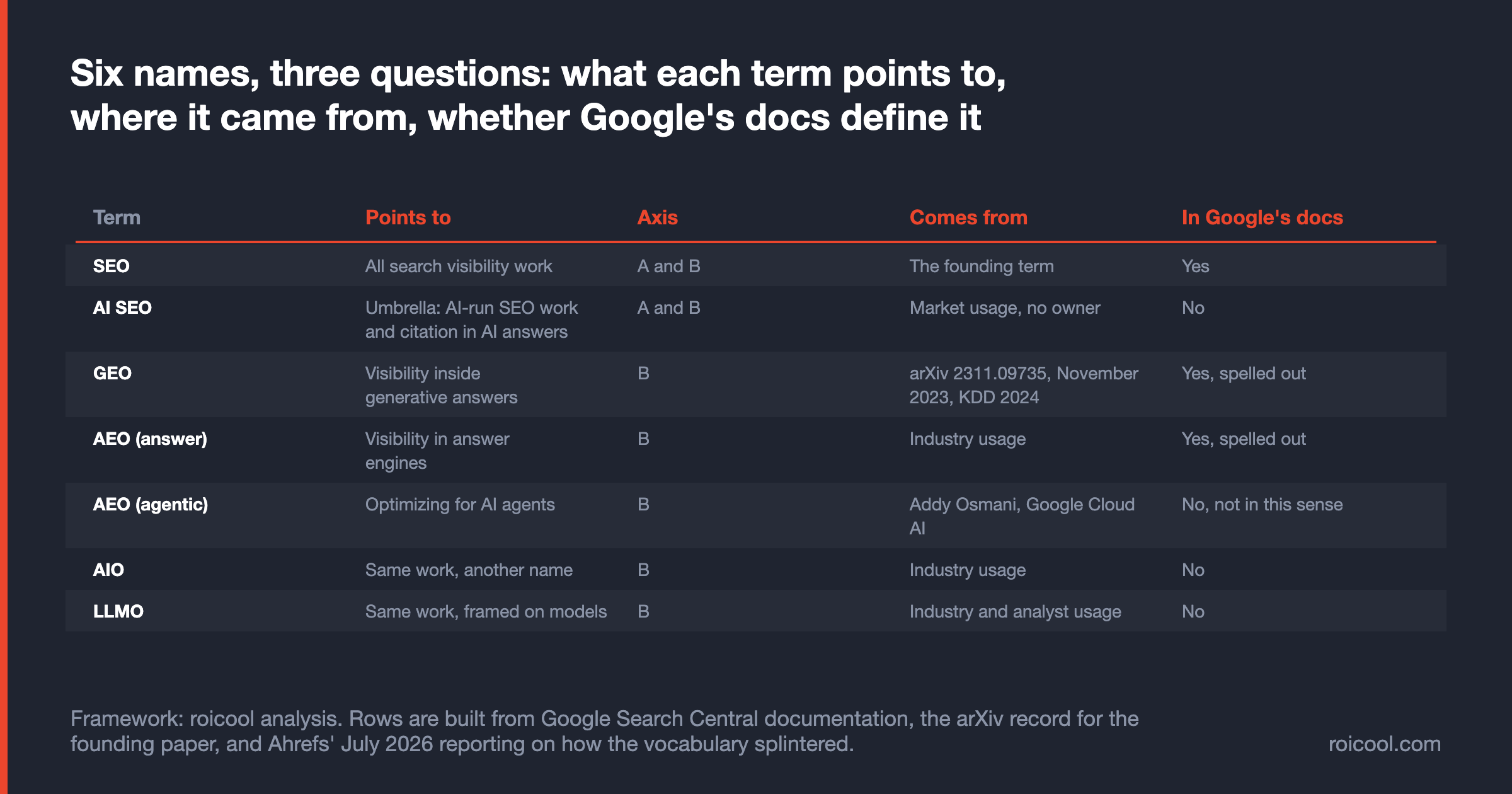
Two of the six names competing with SEO are defined in Google's own documentation and four are not. The two are AEO and GEO, spelled out on the page quoted in the section above; the four are AI SEO, AIO, LLMO and AEO in its second, agentic sense. Google's third-party guidance goes further and names services promising improvements for AI experiences and search formats as what is also known as AEO or GEO tools3.
One of them has an academic paper trail: GEO was introduced in a November 2023 arXiv paper, 2311.09735, later accepted at KDD 20246. That does not make it a better name. It does mean the term did not start in an agency deck, which is more than the rest of the list can say.
| Term | Points to | Axis | Comes from | In Google's docs |
|---|---|---|---|---|
| SEO | All search visibility work | A and B | The founding term | Yes |
| AI SEO | Umbrella: AI-run SEO work and citation in AI answers | A and B | Market usage, no owner | No |
| GEO | Visibility inside generative answers | B | arXiv 2311.09735, November 2023, KDD 2024 | Yes, spelled out |
| AEO (answer) | Visibility in answer engines | B | Industry usage | Yes, spelled out |
| AEO (agentic) | Optimizing for AI agents | B | Addy Osmani, Google Cloud AI | No, not in this sense |
| AIO | Same work, another name | B | Industry usage | No |
| LLMO | Same work, framed on models | B | Industry and analyst usage | No |
Google's documentation acknowledges the founding term and the two acronyms it spells out; every other row rests on market, industry or analyst usage, which tells you who says the word rather than what the word means. The axis column carries the practical part: apart from the umbrella and the founding term, every row describes distribution alone. Swapping one label for another does not move the work behind it.
The same acronym, two meanings
AEO is now ambiguous on its own. Addy Osmani, a director at Google Cloud AI, gave it a second reading — agentic engine optimization instead of answer engine optimization — and the phrase became a breakout keyword9. Forrester's explanation for why this keeps happening is blunt: today's acronyms trade on SEO's currency, and point-solution vendors tend to exaggerate the differences to carve a startup-sized hole in marketers' tech stacks14.
Which name should you use?
Whichever one your team already says. The description of the work does not move when the label does. If you want tactics rather than a map, our answer engine optimization strategies guide is written for that, and the GEO guide linked above carries the deep version of the second job. This page stays on the two questions a name cannot answer: what is actually happening, and what can you measure.
Axis A: Using AI to Do the SEO Work
Using AI to run SEO work does not conflict with Google's policies. Its documentation says generative AI can be particularly useful when researching a topic and when adding structure to original content5. The machine in the workflow has never been the problem. What the machine is asked to replace can be.
Where AI actually earns its place in the workflow
In practice the useful applications are specific and unglamorous: clustering a keyword export into topics, turning a crawl report into a prioritized list, drafting an outline from research you already did, spotting internal linking gaps across a large site. Notice what those share. The model compresses work you could have done yourself and would recognize as correct. None of it requires the model to know something true about your market that you do not.
Where it turns into a policy problem
The line is scale without value. Using generative AI tools to generate many pages without adding value for users may violate Google's spam policy on scaled content abuse5. Read the two halves together: many pages is not the offense, and AI is not the offense. Without adding value is. Google also suggests telling readers how a piece of content was created, on the grounds that it can help give them more context5.
Why you will not find adoption statistics here
We could not find a single published, methodologically transparent measurement of how much AI actually improves SEO output. What comes back is affiliate listicles quoting each other. So this section carries no adoption rate, no share of teams using AI and no productivity multiplier, because we have nothing to base one on. Competitors fill that space with numbers. The honest version of this paragraph is the space itself.
A practical division of labor
The split that survives contact with reality is simple: machines are good at volume and structure, people are good at judgment and first-hand knowledge. Google's own cautions apply to whatever you buy for this. Using a service or tool does not guarantee ranking success3, and third-party tools have no access to Google's internal ranking data, so any predictions they make are their own3.
The failure mode is predictable. Teams automate the part that needed judgment and keep doing by hand the part a machine does better. A keyword export can be clustered by a model in seconds. Deciding which of those clusters your company can credibly write about, and which would be commodity content nobody needs, is not a machine's job.
Axis B: Being Cited in AI Answers, and How Big That Surface Really Is
According to the Reuters Institute's 2026 trends report, Google's AI Overviews now appear at the top of about 10% of search results in the United States16. That report relays rather than measures: its own footnote points to mid-2025 studies on US data that put the rate at 10-15%, Semrush among them16. A tool vendor's range, a year old, quoted at its low end.
It is still the number to hold on to before anyone quotes a revolution at you. The surface is growing, and it is not yet most of search.
How much of search actually shows an AI answer
Direction matters more than the current level. The separate AI Mode tab is now available in 120 markets16, so exposure widens even where AI Overviews are not shown. On the publisher side the same report records an expectation rather than a measurement: publishers expect traffic from search engines to almost halve, by 43%, over the next three years16. That is a survey of what publishers anticipate, and it deserves to be read that way.
What happens to clicks when it does
Where a summary does appear, clicks thin out. Pew Research Center tracked the browsing of 900 US adults through March 20258 and put the click rate on a traditional result at 8% of visits when a summary was present, against 15% when it was not8. Roughly half. That gap is the entire commercial argument for axis B: the visit you used to win by ranking now has to be won by being quoted.
Why the traffic that survives behaves differently
Fewer visits is not the whole story. Semrush, a tool vendor studying its own data, found the average AI search visitor 4.4 times as valuable as an average visit from traditional organic search, measured on conversion rate across digital marketing and SEO topics10. Treat that multiple as a vendor estimate from one vertical, not a benchmark for yours. The mechanism the industry mostly agrees on is simpler: earning a citation is the fast, controllable route into an AI answer, far quicker than hoping to be absorbed into training data9.
Which surfaces this page does not explain
How the summaries are assembled, which crawler fetches what, and what to change on the page are separate questions with separate answers. Google's AI Overview feature has its own guide on this site. What this page adds is the question almost nobody answers afterwards: once the work is done, where exactly do you go to see whether it landed?
That question is where the English-language guides thin out. Of the six we reviewed for this page, not one walks the reader into the reports that would show whether the work landed. The next section does exactly that, and it is the longest part of this guide for a reason.
How to Measure AI SEO: Two Official Reports, Neither Covers Everything
Two official first-party reports exist today: the generative AI performance report in Google Search Console, and the AI Performance report in Bing Webmaster Tools. Between them they cover four surfaces. Together they still do not describe the whole picture, and knowing exactly where each one stops is most of the skill.
What Google Search Console's generative AI report shows, and what it withholds
The Google report covers impressions for AI Overviews and AI Mode, and nothing else4. Start with what an impression is there: how many times links to your site were shown to a user in a generative AI feature on Google Search4. An impression is therefore already an attribution — your link was on the screen.
Three limits travel with it. The report is being rolled out to a subset of website owners rather than to every site4. Its most criticized gap, as Ahrefs reported, is that clicks and queries are not shown — only impression data9. And it is silent about everything outside Google's own surfaces.
None of that makes it optional. Google's advice is to start there whether or not you also pay for something else: it strongly encourages using its first-party tool, Search Console, alongside any third-party tool3. An impression count you can trust beats a score you cannot audit.
What Microsoft opened in Bing Webmaster Tools in February 2026
On 10 February 2026 Microsoft introduced AI Performance in Bing Webmaster Tools, a public preview showing how publisher content appears across Microsoft Copilot, AI-generated summaries in Bing and selected partner integrations12. The headline metric is citations. Microsoft is careful about what that number is not: it reflects how often pages are cited, not page importance, ranking or placement12.
Two details are easy to miss. The grounding queries view shows the phrases the AI used when retrieving your content, but the data shown is a sample of overall citation activity rather than the full set12. And Microsoft describes the release as an early step toward generative engine optimization tooling in Bing Webmaster Tools12. The acronym now sits in a search provider's product roadmap, not only in agency decks.
Why Bing matters here even though Google holds 86.6% of US search
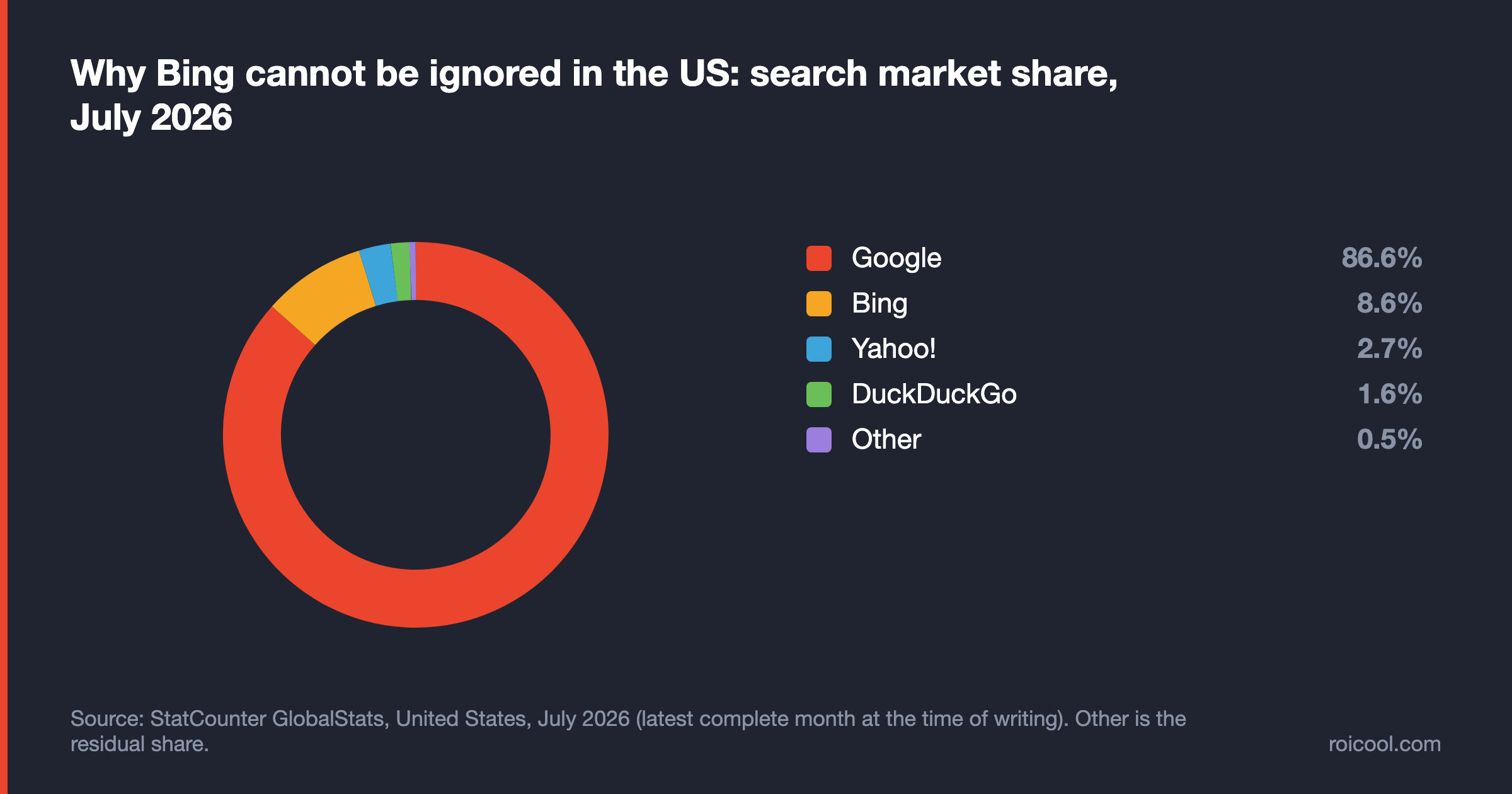
In the United States in July 2026, Google held 86.6% of search and Bing 8.63%, with Yahoo! at 2.66% and DuckDuckGo at 1.58%13. Taken alone, that looks like an argument for ignoring the smaller report. The second link changes the arithmetic: according to Forrester, answer engine optimization depends much more on Bing's index, on which all engines other than Google rely14.
So the Bing report is not a report about 8.63% of searches. It is the only official window onto Copilot and onto the engines sitting on the same index. In markets where Bing's share is negligible the argument weakens, but for English-language search it is the difference between measuring one surface and measuring four.
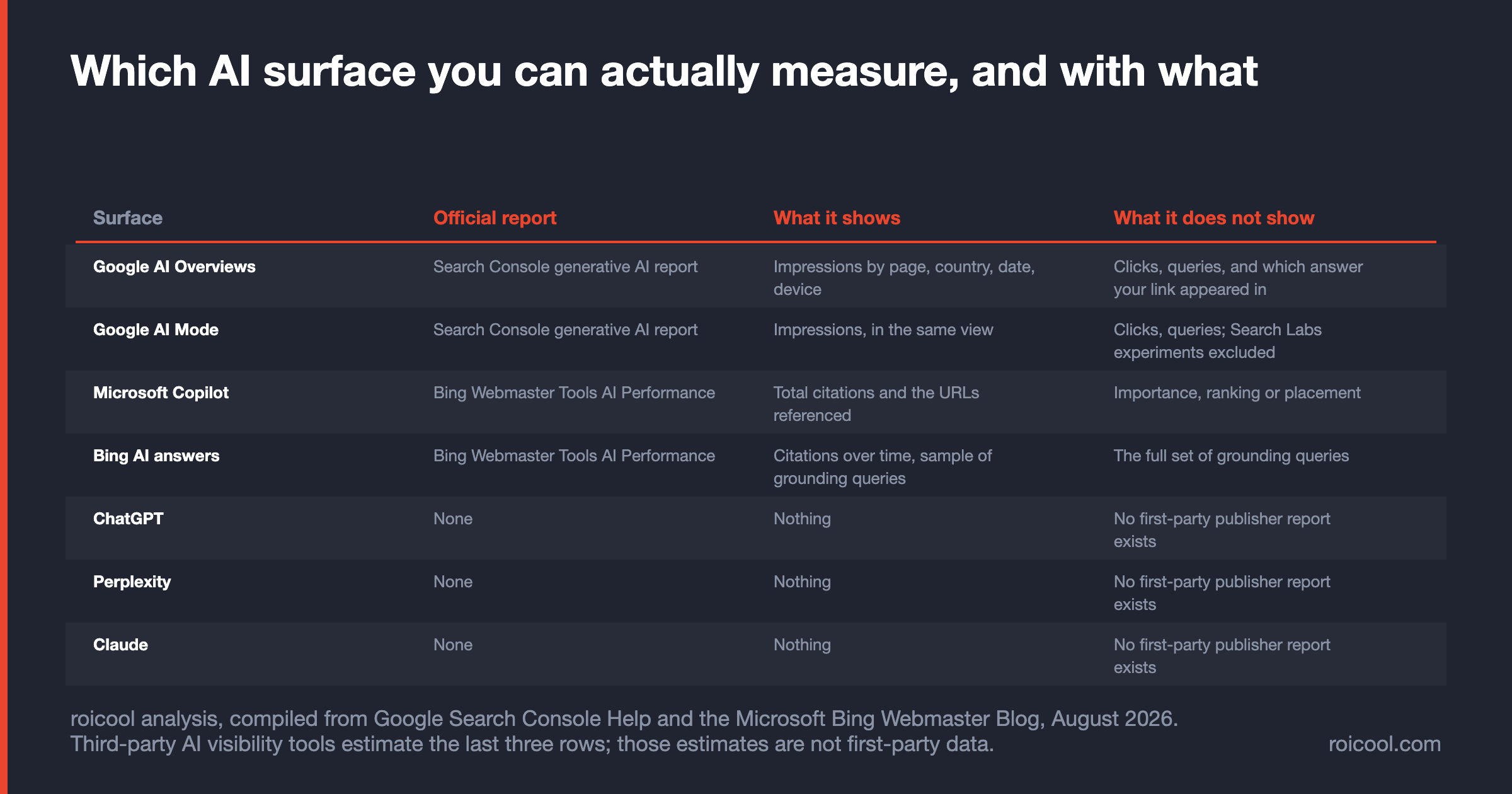
Sorting the surfaces by what you can actually observe makes the gap obvious. Four of them have a first-party report behind them; three have nothing at all. Read the last column first: what a report withholds decides what you are allowed to conclude from it.
| Surface | Official report | What it shows | What it does not show |
|---|---|---|---|
| Google AI Overviews | Search Console generative AI report | Impressions by page, country, date, device | Clicks, queries, and which answer your link appeared in |
| Google AI Mode | Search Console generative AI report | Impressions, in the same view | Clicks, queries; Search Labs experiments excluded |
| Microsoft Copilot | Bing Webmaster Tools AI Performance | Total citations and the URLs referenced | Importance, ranking or placement |
| Bing AI answers | Bing Webmaster Tools AI Performance | Citations over time, sample of grounding queries | The full set of grounding queries |
| ChatGPT | None | Nothing | No first-party publisher report exists |
| Perplexity | None | Nothing | No first-party publisher report exists |
| Claude | None | Nothing | No first-party publisher report exists |
One line in that table is easy to misread. The exclusion of Search Labs experiments is not specific to AI Mode: Search Console leaves out data from Search Labs experiments across the generative AI report, because those experiments are still in active development4. Read it against the AI Overviews row as well.
The asymmetry is the point. Google counts the times your link was shown, then withholds who clicked and what they typed. Microsoft counts how often your pages were cited and shows the URLs it pulled, then refuses to weight those citations12. One report gives you volume without demand; the other gives you attribution without importance. Neither gives you both.
The bottom rows are the ones to remember. For ChatGPT, Perplexity and Claude there is no publisher-side reporting: no impressions, no citations, no query sample. What a dashboard tells you about those three is inferred from outside, through sampled prompts and a vendor's own weighting.
One thing is countable without buying anything, and you can verify it in your own property this week: ChatGPT referrals arrive tagged utm_source=chatgpt.com, so those sessions show up in your analytics as a source you can filter. Treat it as an observation you can reproduce, not a figure anyone publishes.
What neither report can tell you
ChatGPT, Perplexity and Claude publish no first-party publisher report at all. Third-party tools estimate that gap, and an estimate is exactly what they are selling: Google notes that third-party tools have no access to its internal ranking data and that any predictions are their own3. An AI visibility score is a vendor's model of a surface nobody can observe directly. Useful as a trend line, worthless as a fact.
Does Any of It Work? The Evidence, Including the Parts That Disagree
The honest answer is that the evidence is narrow. A 2026 critical survey of 45 studies — an arXiv preprint, not peer reviewed — reports that already-retrieved content can be made more likely to be cited, but that no reviewed technique shows a stable, longitudinal, cross-platform causal effect on organic discoverability or downstream behavior7.
What a review of 45 studies found
The second finding is the one that should worry anyone buying a checklist. The same survey reports that generic heuristics transfer poorly and that citation-oriented rewrites can impair retrieval7. Rewriting a page to look quotable can make it harder to fetch in the first place. Topical relevance and the position of content in context came out as the more reproducible levers.
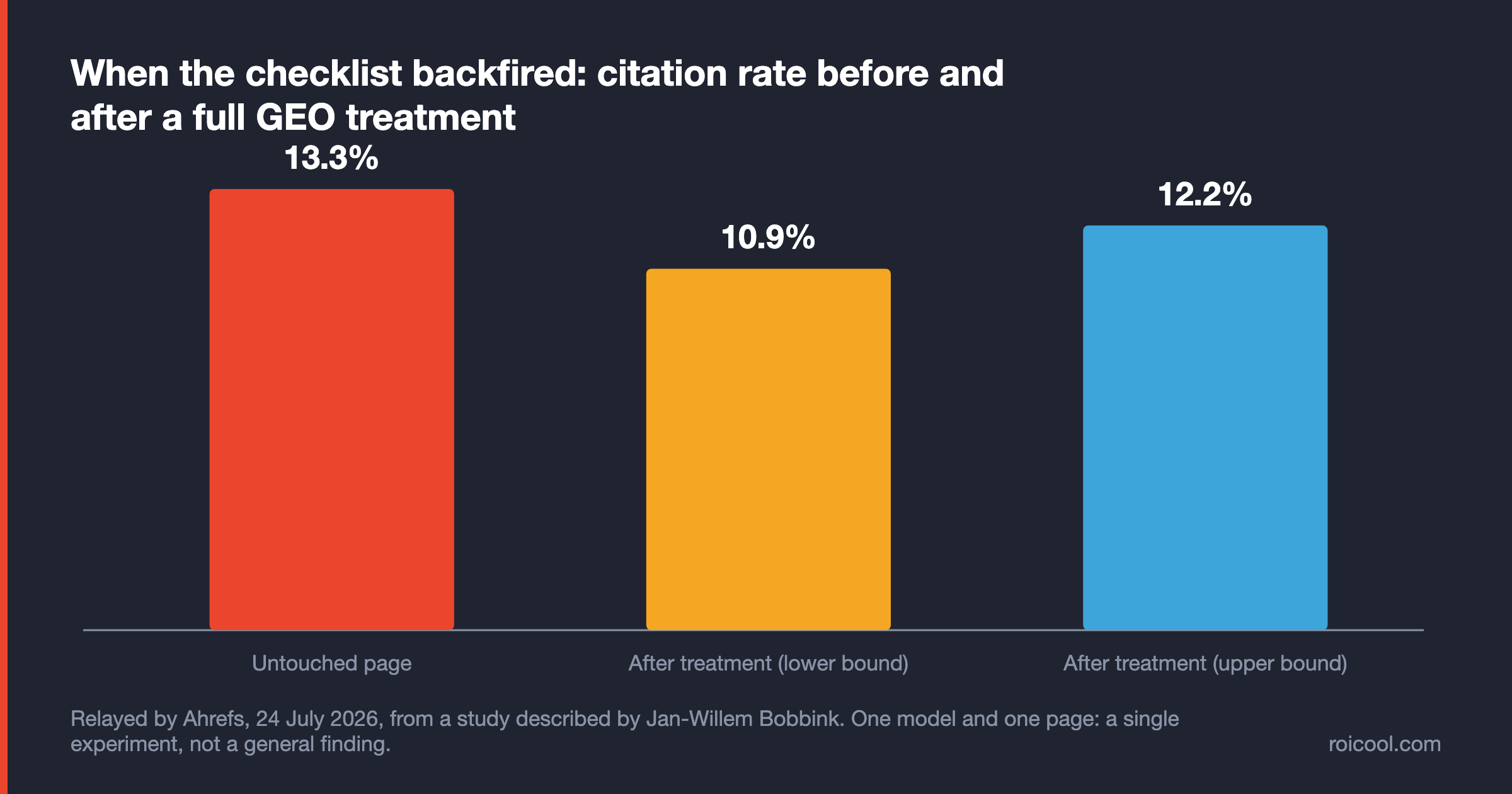
When the checklist made things worse
One experiment shows the mechanism. In a study relayed by Ahrefs and described by Jan-Willem Bobbink, a page was run through a typical GEO checklist: statistics, quotations, source citations, an authoritative tone. On GPT-4o-mini the untouched page was cited 13.3% of the time, while the same page after the full treatment landed between 10.9% and 12.2%9. One model, one page. It does not show that the work fails; it shows that a checklist applied mechanically can cost you.
Forrester versus IDC: hype or a five-fold budget shift
The analysts disagree, and the disagreement is the most useful thing about them. IDC forecasts that companies will spend up to five times more on LLM optimization than on traditional SEO by 202915. That is a forecast about budgets, not a measurement of results, and the two are routinely quoted as if they were the same sentence.
Forrester pushes the other way. The difference is significant but not fundamental14, and point-solution vendors tend to exaggerate it in order to claim a slot in the stack14. We are not going to tell you which firm is right. The position underneath both is Google's: SEO best practices remain relevant because its generative AI features are rooted in its core Search ranking and quality systems1. When the evidence is thin, fundamentals are what is left standing.
Notice what neither firm is claiming. IDC is forecasting spend, which is a statement about what marketers will buy. Forrester is describing incentives, which is a statement about who is selling. Neither is a measurement of whether the work moves a business outcome, and the survey above is the closest thing anyone has to one.
Where to Start: A Decision Frame Instead of a Checklist
Five questions decide most of this, and none of them needs a tool. Three are judgment calls you can make before any work starts; the other two are measurement moves, and the sequence at the end of this section puts them in order. A checklist tells you what to do before anyone has established what is wrong.
First question: which of the two jobs are you buying?
Name the job before you price it. If the answer is AI-assisted production work, you are buying throughput and you should be shown a workflow. If the answer is visibility inside AI answers, you are buying distribution and you should be shown a measurement plan. A proposal that will not commit to one of the two is describing a category rather than a service.
Second question: is the page even eligible?
The unglamorous gate comes first. To be eligible for generative AI features on Google Search, a page has to be indexed and allowed to appear with a snippet, meeting the Search technical requirements1. Beyond that, the site has to be included in Search generative AI features in Search Console at all1. Both are free to check. Both get skipped surprisingly often.
Third question: how does the claim justify itself?
Google publishes a test for advice, and it applies to this page too: good advice either qualifies its claims as opinion based on data or experience, or backs them up by citing official Google Search guidance3. Two notes from the same page. Google does not evaluate third-party services, so any claim of approval deserves suspicion3, and using a tool does not guarantee ranking success3. Every claim here is sourced below, and tool vendor data is labeled as such.
What you can safely skip
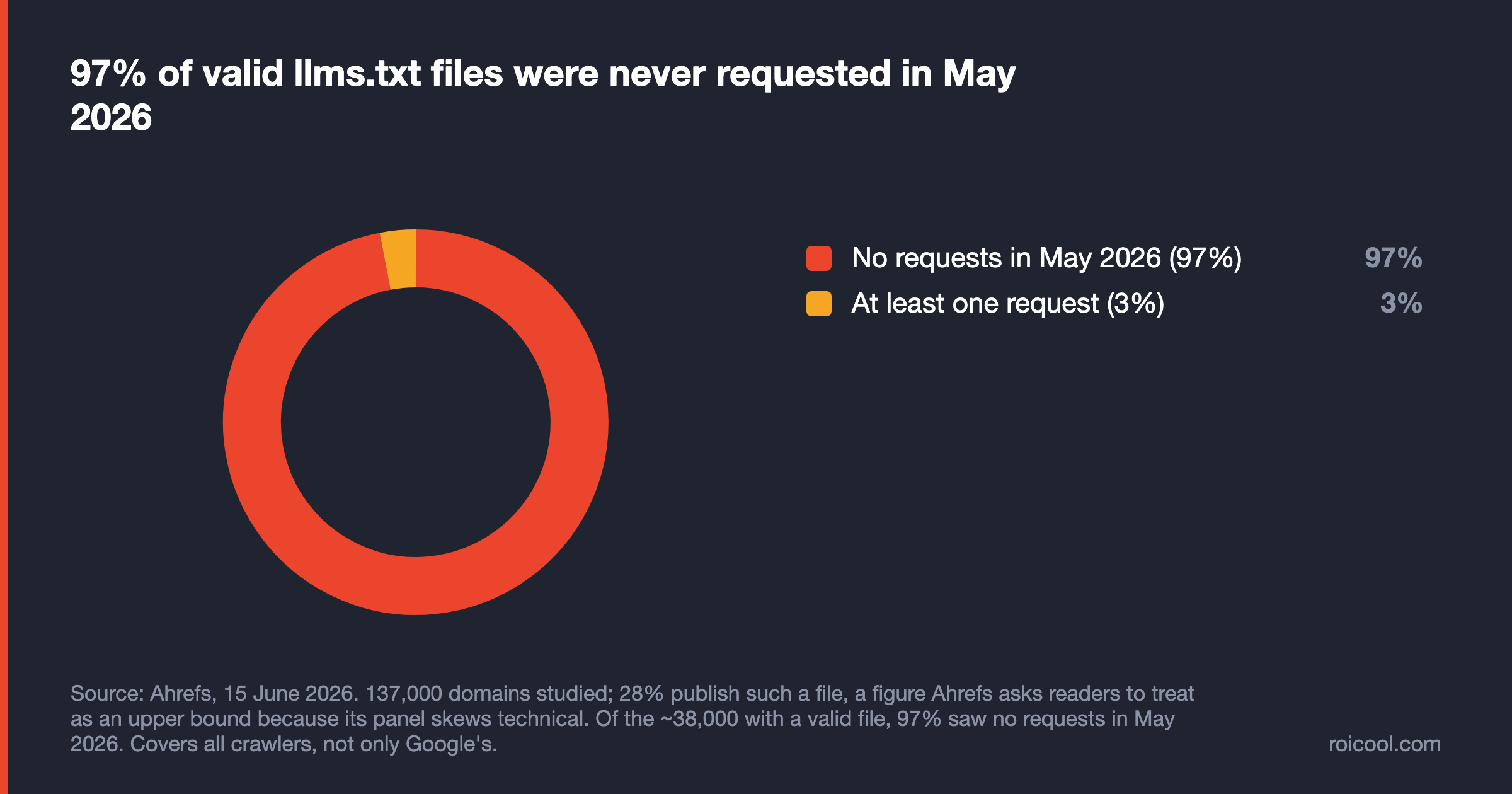
Special files are the clearest example: files such as llms.txt neither harm nor help visibility in Google Search, because Google Search ignores them1 — the longer argument belongs to the GEO guide. Google's own ordering of priorities is blunt about what does move: content people find unique, compelling and useful is likely to influence presence in generative AI search, in the long run, more than any other suggestion in its guide1.
The two questions the sections above did not cover are the measurement ones: which reports you open, and what you write down before anything changes. They belong in the same order as the rest, so here is the whole sequence — work through it before you sign anything, not after the first invoice arrives.
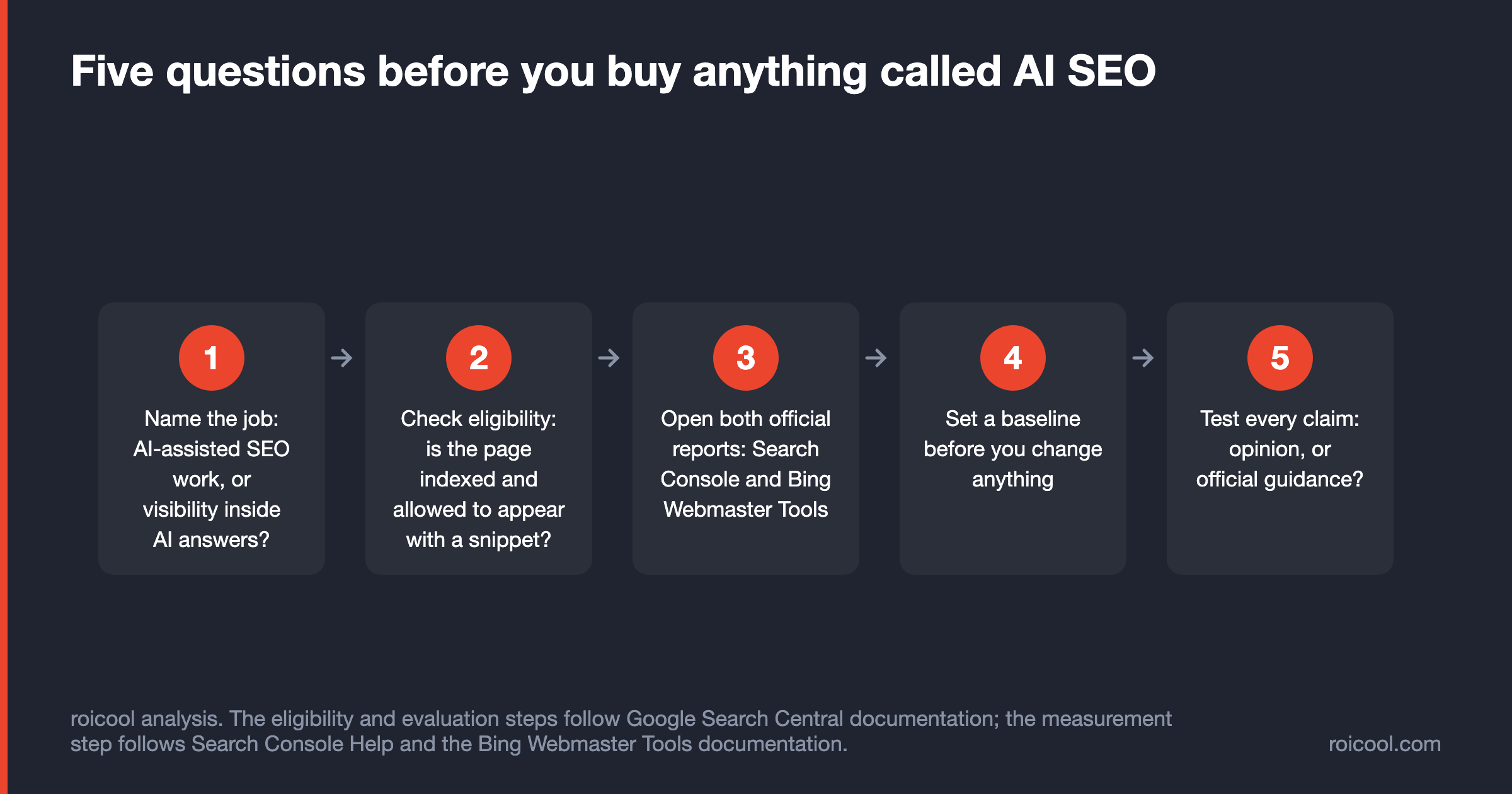
- Name the job: AI-assisted SEO work, or visibility inside AI answers? Decide it in writing before the first meeting ends, because the two answers lead to different suppliers, different metrics and different invoices.
- Check eligibility: is the page indexed and allowed to appear with a snippet? Both conditions are free to verify and they gate everything after them: a page that fails either one cannot appear in a generative answer, whatever is spent on it.
- Open both official reports: Search Console and Bing Webmaster Tools. One shows how often your pages surfaced in Google's AI answers; the other shows how often Copilot cited them. Neither costs anything to open, and the ChatGPT referral tag described above is something you can check in your own analytics in a minute.
- Set a baseline before you change anything. A number recorded after the work started is not a baseline, it is a hope. Export what the two reports say today, with the date on it.
- Test every claim: opinion, or official guidance? Ask that of every recommendation, including the ones on this page. Advice that can be traced back to documentation survives a change of agency; advice that cannot, does not.
The order is what makes the sequence work. Until the first two answers exist, the reports produce numbers nobody can interpret: a citation count means little if you never decided which job you were buying, and an impression trend means nothing without the date you started from. The last step is the one that survives a change of agency.
Who Should Own This Work: Your SEO Team or a Separate AI SEO Agency?
In most cases you do not need a separate agency. You need a separate measurement surface for the team you already have. Indexing, relevance and content worth quoting are what an SEO team already owns; the reports are what changed.
Why 'it's a new discipline' is a weak reason to hire
New discipline is a sales argument before it is a technical one. Google's documentation supplies the test that survives it: Google does not evaluate third-party services, so a claim of approval carries no weight and deserves to be checked against what the provider will actually report3. The question is not whether the label is new. It is whether the offer comes with a report you could open yourself. That is not a reason to avoid hiring anyone. It is a reason not to hire a label.
How to test a provider with Google's own criterion
- Ask them the third question from the decision frame above, word for word, and see whether the answer names a document3.
- Which report will you show me — Search Console, Bing Webmaster Tools or a third-party score — and what does that report explicitly not measure?3
- Which of the two jobs are you quoting for, and what would the other one cost separately?
A provider who answers all three without reaching for a proprietary score is worth a second meeting. One who cannot say what their own report fails to measure is selling the label rather than the work.
How we run it
We measure first and cite everything. Every number in a client report is traced back to the surface it came from: Search Console for AI Overviews and AI Mode, Bing Webmaster Tools for Copilot and Bing answers, third-party tools only where nothing official exists and only with that label attached.
That rule has a price and our own work pays it: our AI visibility case study reports a score measured with a third-party tool, Semrush, because no official report covers the surface it estimates. It is a vendor estimate and it is labeled as one here. The underlying work sits inside our data-driven SEO services. If a number cannot be traced to a report you could open yourself, it does not go in the deck.