Website Design Cost in 2026: The Prices Each Provider Publishes
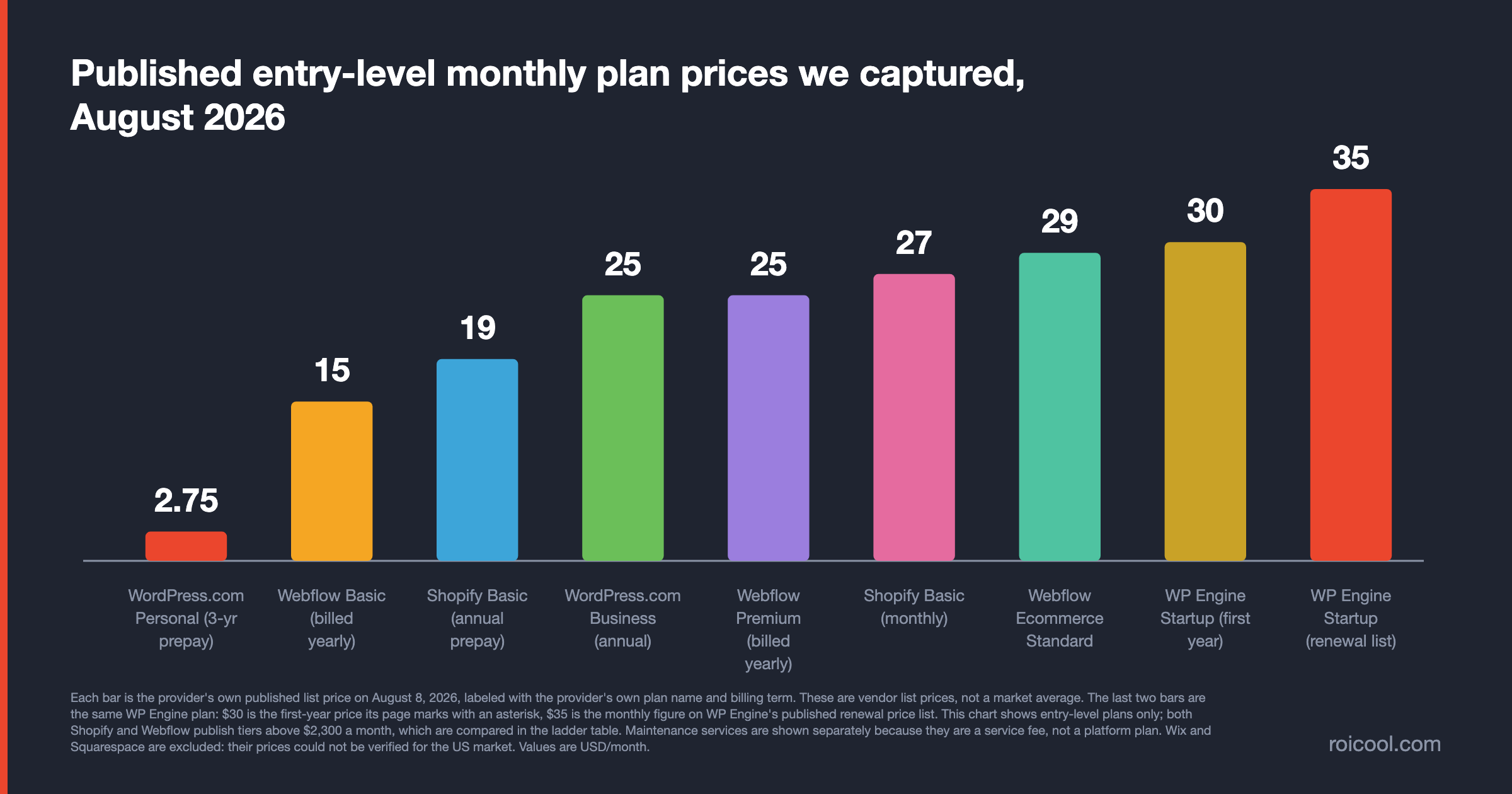
Only one half of website design cost is published anywhere. The monthly plan prices we captured from vendors' own pricing pages on August 8, 2026 run from $2.753 to $89.008. None of those figures is a build fee. They are what it costs to keep a site online: a platform plan, managed hosting, or a maintenance service somebody performs every week. The build is quoted privately, and no provider on our list publishes a price for it.
Website design cost is not a single build fee. It is a one-time build fee plus the platform, hosting, license and maintenance lines you keep paying for as long as the site is live. The advertised number is only the first of those lines, which is why the rest of this article works in 36-month totals.
Read the table below as five separate price lists, not as one market. Each row keeps the provider's own plan name, because that label carries information the price does not: Basic at Webflow and Basic at Shopify describe different products, and neither describes what a design team charges to fill them. We have not sorted the plans into small-business, mid-market and enterprise tiers. Nobody published those tiers, so assigning them would be our invention rather than a finding.
Where these numbers come from (method note)
We captured twelve source documents from ten organizations on August 8, 2026: five of them publish the prices used here, five are reference sources that publish no prices. The price providers are Webflow, Shopify, WordPress.com, WP Engine and WP Buffs. The reference sources are W3Techs, the U.S. Bureau of Labor Statistics, Google's web.dev, Let's Encrypt and Cloudflare. Every price below is what a company publishes about its own product, not a market average and not a survey.
One of those reference sources needs its own date. W3Techs updates daily, so we re-read it on August 12, 2026 and publish that day's shares rather than the August 8 ones. Every price in the table below is still the August 8, 2026 capture.
We also read five guides that rank for this question: WebFX, Elementor, OneLittleWeb, OuterBox and GoDaddy. Those five guides are not sources. We opened them to see where the existing answer stops, and we quote none of their price ranges anywhere in this article. Prices were observed on August 8, 2026; vendors change list prices without notice.
| Provider (source) | The page's own plan name | Published price | Billing term the price requires | Conditions the page itself states | What the price does not include |
|---|---|---|---|---|---|
| Webflow site plans (webflow.com/pricing) | Basic; Premium, badged 'New'; Team | $15/mo1; $25/mo1; $2,500/mo1 | Billed yearly for Basic and Premium | Team: 'Annual contract required'1. Tax: 'All prices in USD, per site, per month, plus applicable taxes at checkout.'1 | Design and build work, content; extra bandwidth is +$20/month billed annually for +50 GB1 |
| Webflow ecommerce plans (same page) | Standard; Plus; Advanced | $29/mo1; $74/mo1; $212/mo1 | Billed yearly, all three | Standard carries a '2% transaction fee'1; Plus and Advanced are '0% transaction fee'1 | Store build, products, content; the Optimize add-on is $299/mo1 |
| Shopify (shopify.com/pricing) | Basic; Grow; Advanced; Plus | $19 or $27/mo2; $54 or $722; $299 or $3992; from $2,300/mo2 | Lower figure requires paying yearly; higher figure is the monthly term | 'There are no setup fees on any of our plans.'2 Plus: 'If you choose a 1- or 3-year Plus subscription, you can cancel when your term commitment expires.'2 | Theme or build work, apps; 2% on third-party payment providers on Basic2 |
| WordPress.com (wordpress.com/pricing) | Personal; Business | Personal $9 / $4 / $3.25 / $2.753; Business $40 / $25 / $20 / $17.503 | Four terms in order: monthly, 12-month, 2-year and 3-year prepay | 'Free domain for one year with annual plans.'3 Tax is not mentioned on the page | Design and build work, maintenance; the free plan has no custom domain, no plugin installation and no ad-free browsing3 |
| WP Engine, first-year price (wpengine.com/plans) | Startup; Professional | 'Starting at $30*' /mo4; 'Starting at $55*' /mo4 | First year, new customers only | '* First year pricing and associated coupons are valid for new customers purchasing Essential plans only. Cannot be used with other offers and is not valid for upgrades, renewals or any other product purchase.'4 Also: 'Taxes and overages may apply during checkout.'4 | The site itself, design, content, plugins and maintenance |
| WP Engine, renewal price (content.wpengine.com) | Startup; Professional | $35/mo11; $65/mo11 | Published as a monthly figure on the renewal list | 'Select your current plan and currency to view the new monthly price, effective your next renewal on or after, March 11, 2026'11 Also: 'Product renewal pricing subject to change.'4 | As above; the page does not state whether the figure applies to the annual or the monthly subscription |
| WP Buffs (wpbuffs.com/plans) | Maintain; Protect | $89.00 USD/Month8; $179.00 USD/Month8 | Published as a monthly fee | The page calls these 'full-priced plans'; the discount banner still on it expired on December 3, 20258 | Hosting, the domain, and the build itself |
One column in that table deserves a second look, because it is easy to get backwards. Two of the five price providers state the tax position on the page itself: Webflow writes 'All prices in USD, per site, per month, plus applicable taxes at checkout.'1, and WP Engine writes 'Taxes and overages may apply during checkout.'4. The other three, Shopify, WordPress.com and WP Buffs, say nothing about tax on their pricing pages.
Scope is a separate warning. A brochure site and a single landing page are different products, and this article puts a price on neither, because we found no independent source for US build fees. We have also not converted these prices onto a common basis. Making the differences between them visible is the job; flattening them would destroy the only information the table carries.
Why 'starting at' rarely means what you will pay
Four kinds of condition sit behind these numbers, and every price in the table carries at least one. A commitment condition: the figure requires paying for a year, or three, up front. A first-year condition: the figure expires and renews higher. A term condition: the plan is only sold on an annual contract. And a floor condition: the words 'starting at' or 'from' mean the number is a floor rather than a price.
WP Engine publishes 'Starting at $30*'4, asterisk included, and that asterisk points at a first-year offer. Webflow publishes every site plan as billed yearly1, which means the monthly figure already assumes a twelve-month commitment. Shopify's Plus tier is quoted as 'from $2,300 /mo'2, a floor. None of these is a trick. But a budget built on the smaller number and paid on the larger one breaks in month 13.
Template subscription or custom build? Not the same row
The table deliberately does not rank these prices from cheap to expensive. WordPress.com Personal at $2.75 a month on a three-year prepay3 is a hosted subscription. Webflow Basic at $15 a month billed yearly1 is a platform plan. WP Buffs Maintain at $89.00 a month8 is a service with people behind it. Lining those up on one axis produces a number that means nothing. What they share is that all three recur, and recurrence is the axis the next section uses.
The 3-Year Total: What a Website Actually Costs to Own
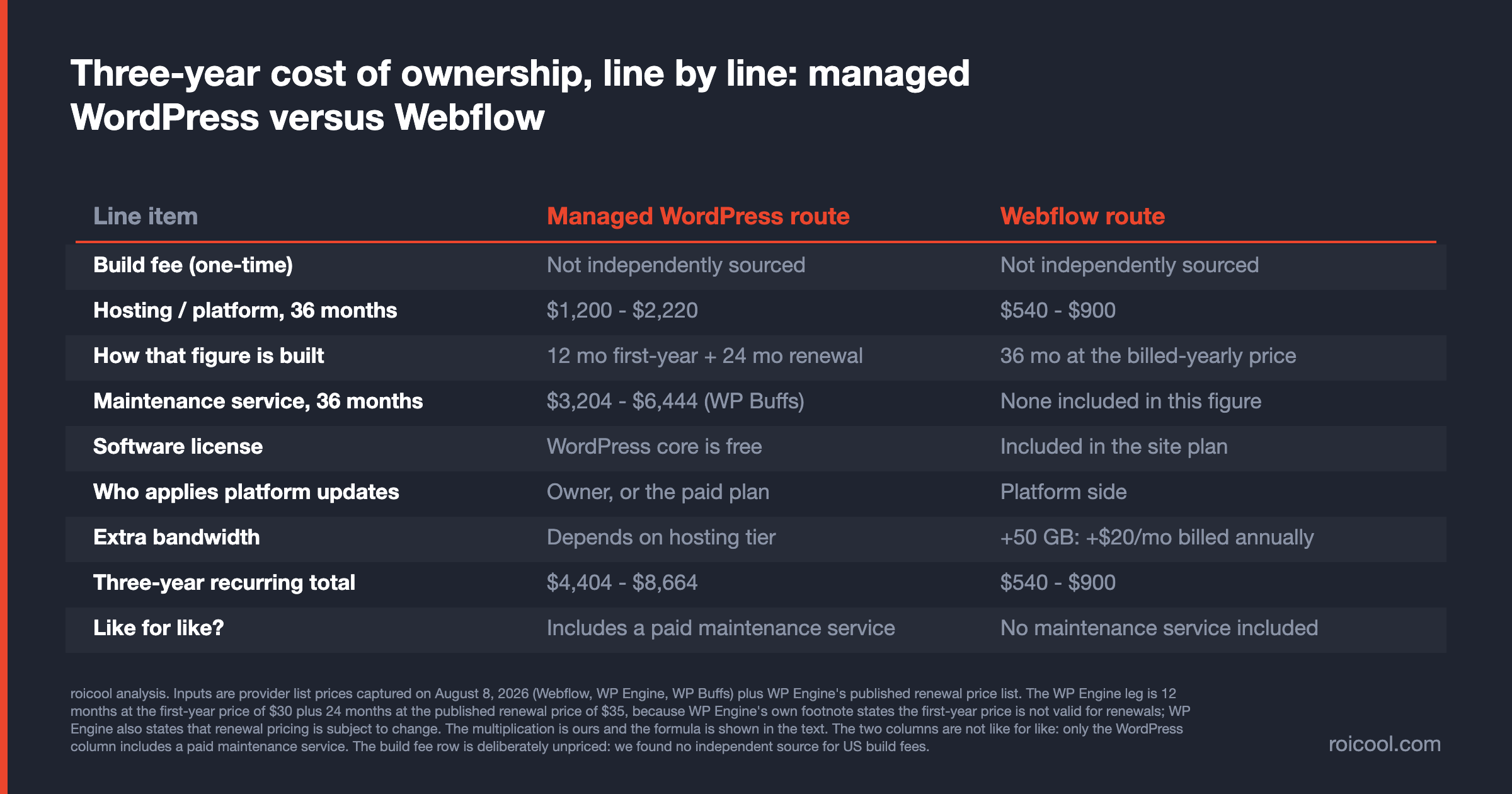
Over 36 months the recurring base is $540 to $900 on a Webflow site plan1, and $4,404 to $8,664 on managed WordPress hosting with a published maintenance plan4. Those two ranges are not like for like: only the WordPress figure contains a paid maintenance service, and the Webflow figure contains none. Hosting against hosting, which is like for like, it is $1,2004 against $5401. No build fee sits in any of these numbers.
The formula fits on one line: three-year total = build fee + (platform or hosting plan x 36 months) + (maintenance x 36 months) + licenses + domain. Every input below carries the source it came from. The multiplication is ours and we say so each time; the prices going into it belong to the providers, published on their own pages.
Scenario A: WordPress on managed hosting with an agency maintenance plan
WP Engine publishes 'Starting at $30*' a month for the plan it calls Startup4. That asterisk is not decoration. The page's own footnote reads: '* First year pricing and associated coupons are valid for new customers purchasing Essential plans only. Cannot be used with other offers and is not valid for upgrades, renewals or any other product purchase.'4 So the $30 figure can be multiplied by twelve months, and no further.
For months 13 to 36 we use WP Engine's own published renewal list, which frames itself in these words: 'Select your current plan and currency to view the new monthly price, effective your next renewal on or after, March 11, 2026'11. On that list the Startup plan is $35 a month11. WP Engine also states that 'Product renewal pricing subject to change.'4 That sentence is part of the record: months 13 to 36 are not contractually fixed at $35.
WP Engine does not state on that page whether the renewal price applies to the annual or the monthly subscription, so we treat it as the published renewal list price and nothing more. That gives a 36-month hosting figure of $1,200: twelve months at $30 plus twenty-four months at $354. It is an example scenario, not a US average, and it is deliberately not the figure you would get by multiplying the promotional price by 36.
Maintenance is the second line. WP Buffs publishes $89.00 USD/Month for Maintain, the tier it describes as standard site maintenance8. Over 36 months that is $3,2048. Added to the hosting figure, the recurring base for this route is $4,4044, and the build fee still has not been counted. That is one provider's list price, not an industry maintenance rate.
The same shape one tier up: WP Engine Professional is 'Starting at $55*' in the first year4 and $65 a month on the renewal list11, which is $2,220 over 36 months4. WP Buffs Protect at $179.00 a month8 is $6,444 over the same period8. Total, $8,6644, maintenance service included. Both lines fall due every month whether or not anyone touches the site.
Scenario B: a Webflow site plan
Webflow publishes Basic at $15 a month billed yearly1 and Premium at $25 a month billed yearly1. Over 36 months that is $5401 and $9001. Neither figure includes a maintenance service, because Webflow does not sell one and the platform applies its own updates. Webflow's Workspace prices, Freelancer at $16 a month1 and Agency at $351, are not in this calculation. They are the builder's cost, not the site owner's.
The first-year price is not the three-year price
Year one and year two are different invoices on the WordPress route. Hosting plus maintenance in the first year is (12 x $30) + (12 x $89.00) = $1,4284. In the second and third years the same two lines are (12 x $35) + (12 x $89.00) = $1,488 a year11.
So $1,4284 is a first-year figure and not an annual price, and a three-year budget built on it lands short. The Webflow side has no equivalent step, because the site plan price does not change after year one.
What this calculation includes, and what it cannot
Here the arithmetic turns against the comfortable story, so we will state it plainly. On the Webflow side the recurring line is small, which means the build fee is the large share of the three-year total. On the managed WordPress side the recurring stack on its own reaches the size of a whole build project. That does not weaken the case for thinking in totals. It is the case. The question worth asking is never whether the build is cheap, it is what three years cost.
One row in the comparison below is deliberately unpriced. We found no independent source for US build fees, and the guides that publish ranges are the object of comparison here rather than a source we cite. So the row reads 'not independently sourced' instead of carrying a number we invented. An empty cell is a finding: the largest line in most website budgets has no published benchmark to check a quote against.
That gap is not something we invented for this article. Of the five guides we reviewed for this article, as captured on August 8, 2026, none multiplies the recurring lines by the years and adds them to a build fee13. Elementor's comparison table carries a 'Total Estimated Year 1' row whose value cells hold a dash instead of a number. OuterBox asks about up-front versus over-time cost in a heading and stops before the total, and GoDaddy gives a single year.
OneLittleWeb comes closest of the five: it puts build cost and annual cost in the same table, which is more than the others do, and still leaves the multiplication to the reader. WebFX lists the two separately. That statement covers those five pages on that date and nothing beyond them.
Ecommerce runs on the same arithmetic. Shopify Basic at $19 a month on annual prepay2 is $684 over 36 months2; the identical plan at $27 billed monthly2 is $9722, a $288 difference2 produced by nothing except the billing term.
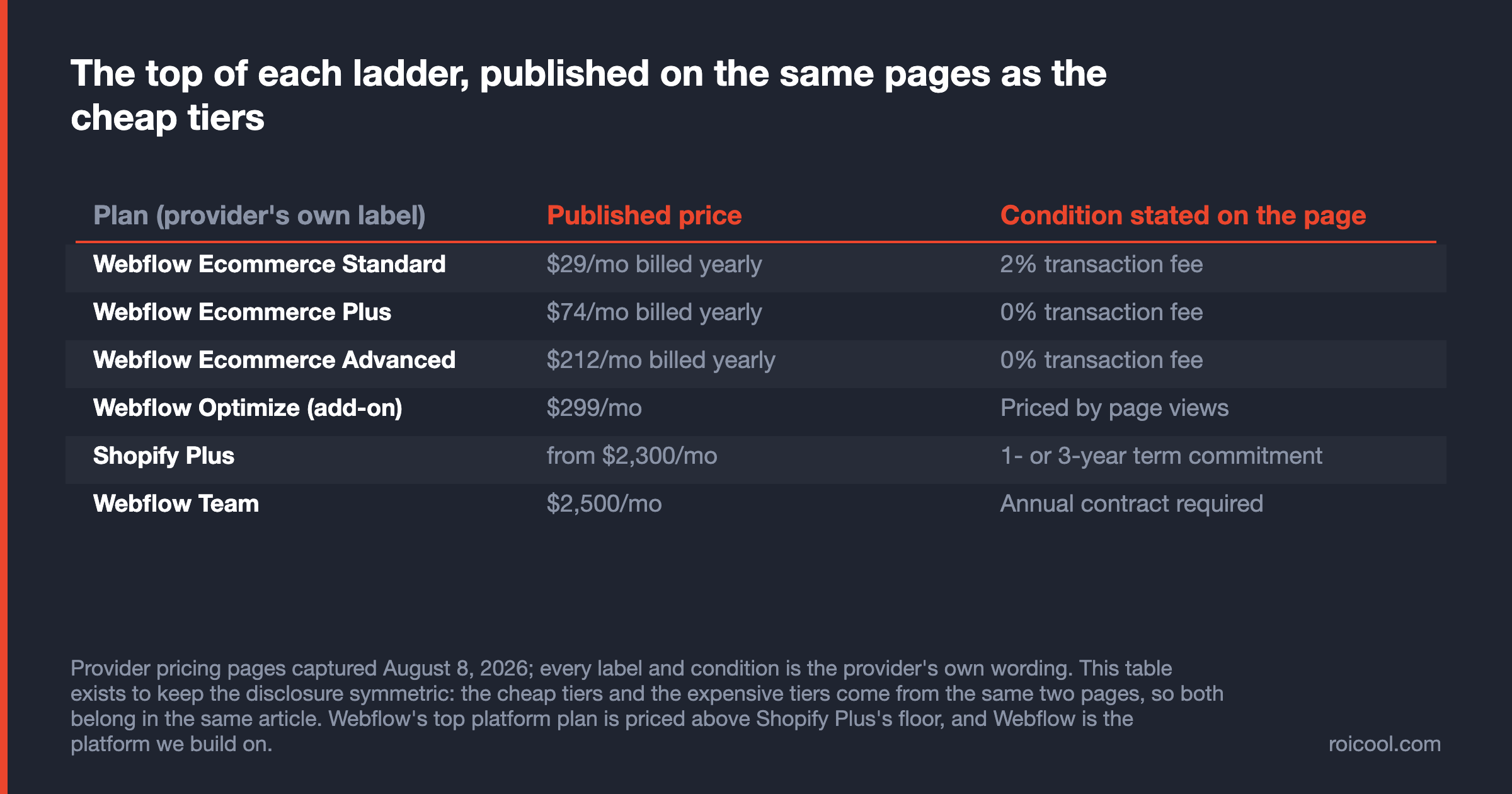
Both ladders have an expensive top step, and the honest move is to publish both. Shopify Plus starts 'from $2,300 /mo'2, which over 36 months is at least $82,8002; 'from' is a floor, so the total is a floor too. Shopify also states that 'If you choose a 1- or 3-year Plus subscription, you can cancel when your term commitment expires.'2
Webflow's Team plan sits on the same page as the $15 one, at $2,500 a month with 'Annual contract required'1: $90,000 over 36 months1. Webflow's top platform plan is therefore priced above Shopify Plus's floor, and Webflow is the platform we build on. That comparison is not flattering to us, which is exactly why it belongs in the body rather than in a footnote.
Why the Same Website Gets Two Very Different Quotes
The gap between two quotes for the same brief is usually not negotiating room. It is the number of professional hours inside the project, and what an hour of that work costs the company selling it. Wages are public information. That makes labor the one part of website pricing you can check against an official source instead of a vendor's marketing page.
What a week of professional time actually costs
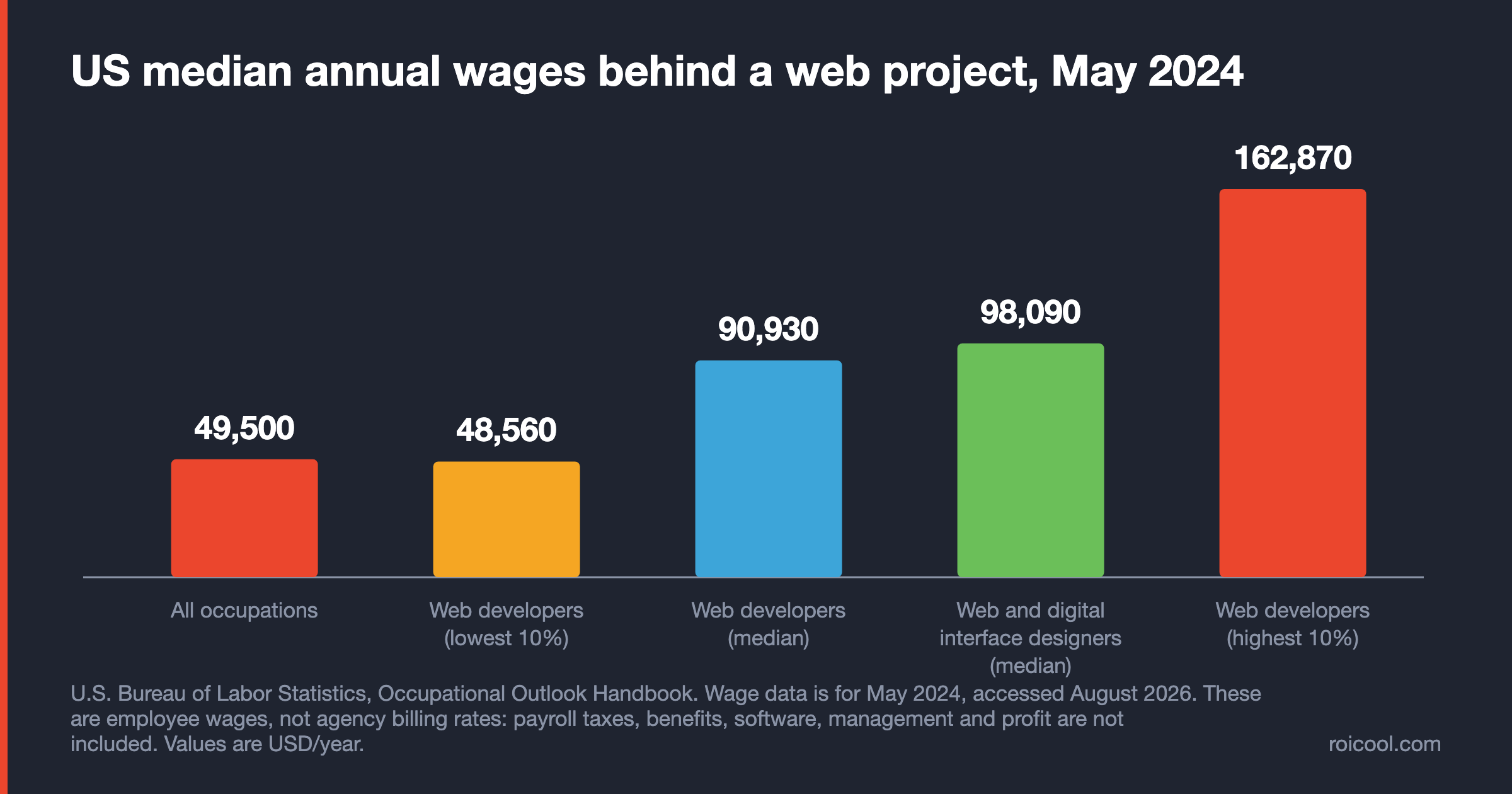
The U.S. Bureau of Labor Statistics puts the median annual wage for web developers at $90,930 in May 20247, and for web and digital interface designers at $98,090 in May 20247. The median for all occupations in May 2024 was $49,5007. Inside the developer figure the spread is wide: in May 2024 the lowest 10 percent earned less than $48,560 and the highest 10 percent more than $162,8707.
Divide the developer median by 52 weeks and one week of that person's time is about $1,749 in gross salary7; across 2,080 working hours it is about $43.70 an hour7. Salary only. That figure excludes payroll taxes, benefits, hardware, software, project management and profit, and it is not an agency billing rate. We publish no agency hourly rate in this article, because we found no independent source for one. BLS measures what employees earn, not what clients are invoiced.
Four weeks of one developer's time therefore carries roughly $7,000 of salary7 before a designer, a copywriter or a project manager is involved. Set that beside a quote that promises design, content, build, testing and launch for less. The difference is not a discount on identical work. It is a different quantity of work, and usually a different definition of the word finished.
Scope is the variable, not the discount
These wages are not drifting downward. BLS projects employment of web developers and digital designers to grow 7 percent from 2024 to 20347, against 3 percent for all occupations7, on a base of 214,900 jobs in 20247. In advertising, public relations and related services, the sector closest to agency work, the median for these designers was $74,510 in May 20247. That is still a salary, not what a client pays for the hour.
So when a quote drops, something else drops with it. Fewer unique page designs and more template reuse. Content written by the client instead of a writer. Two revision rounds instead of an open-ended process. No performance work before launch. Each of those is a legitimate trade, and experienced buyers make it deliberately. It becomes a problem only when the trade is invisible in the proposal, and the checks that make two quotes comparable are set out below.
DIY Builder, Freelancer or Agency: Where the Money Actually Goes
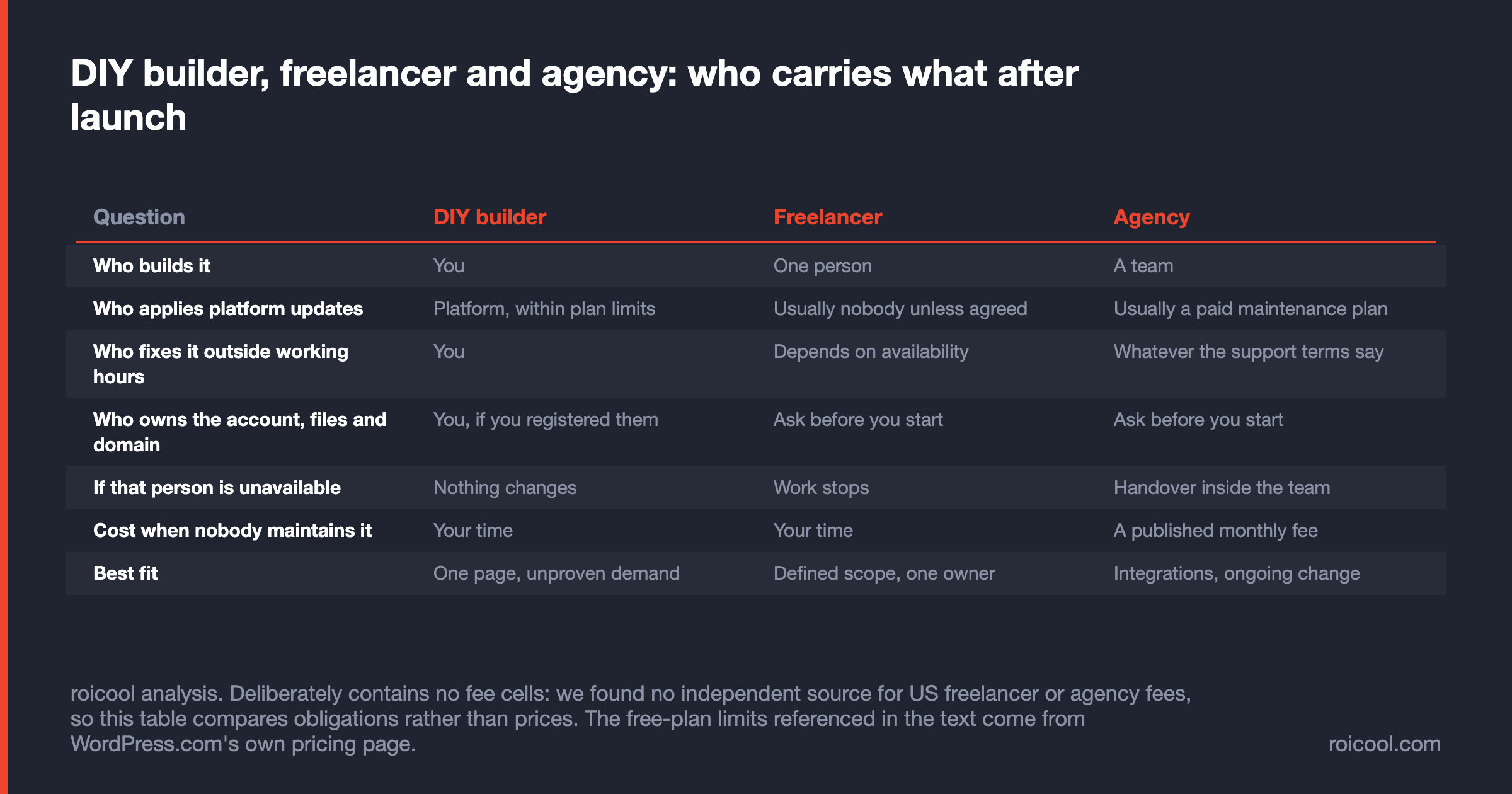
The difference between the three routes is mostly not price. It is who carries the site once it is live, and that obligation turns into either an invoice or your own evenings, every month, for as long as the site exists. Quotes rarely spell this out, which is why two proposals with similar totals can describe very different years.
So compare the routes on obligations rather than on fees. Who builds it. Who applies platform and plugin updates. Who answers when the site is down outside working hours. Who owns the files, the account and the domain. What happens when that person becomes unavailable. What it costs to change direction in year two. We publish no freelancer or agency fee figures here, because we found no independent source for them.
Who owns maintenance after launch?
Maintenance is a service with a published price. WP Buffs lists Maintain at $89.00 a month and Protect at $179.00 a month on its own plans page in August 20268. That is one provider's list price rather than an industry rate, but it is a real number attached to real work: weekly updates, backups, uptime monitoring, security. When nobody is paid to do that work, it does not stop being work. It becomes your time, priced at whatever your hour is worth.
This is where the three routes separate. The agency route puts the obligation in a contract with a monthly figure next to it. The freelancer route usually leaves it unwritten unless you ask for it in advance. The DIY route hands it to you, together with the decision about which update to apply on a Friday afternoon.
Who owns the account, the files and the domain
Ownership is the cheapest clause in any proposal and the most expensive omission. Ask, before work starts, who registers the domain, whose email address the platform account is attached to, and who holds the design files and the repository after handover. On the DIY route the answer is you, provided you registered everything yourself. On the other two routes it is whatever you agreed, and silence is not an agreement.
When DIY is the right answer
Sometimes DIY is the right answer, and pretending otherwise would cost us more credibility than the project is worth. WordPress.com's free plan does not include a custom domain, plugin installation or ad-free browsing for visitors3, and full plugin access starts on the Personal plan at $2.75 a month billed every three years3. Those limits are the honest test. If one page, an unproven offer and no budget describe your situation, a builder is the right answer.
There is a second cost that never appears on any quote: the cost of a decision nobody owns. On a site with no named maintainer, small problems simply wait. A broken form waits until somebody notices. An expired integration waits until a customer complains. That waiting is not free either. It is invoiced to the business in inquiries that never arrive, rather than by a supplier at the end of the month.
DIY stops being the right answer at a predictable point: when the site carries revenue, when more than one person needs to change it, or when an outage costs more in a morning than a maintenance plan costs in a year. At that point the question stops being what a website costs and becomes what an hour of downtime costs.
What the Advertised Price Leaves Out: Domain, SSL, Content and Maintenance
Some of the lines that sit outside the advertised price are genuine costs. Others are a seller's margin on something that is free, or close to free, somewhere else. Telling the two apart is worth real money over three years, and it takes about ten minutes of checking against the providers' own pages.
SSL does not have to be a line item
Let's Encrypt is a certificate authority run by the nonprofit Internet Security Research Group, and it issues TLS certificates free of charge6. It describes itself as providing those free certificates to more than 700 million websites6. Most hosting platforms wire it in automatically. So when a proposal carries a separate annual charge for an SSL certificate, the fair question is not whether HTTPS matters, because it does, but what that charge buys which a free certificate does not.
Domain: what you pay for and what you pay a margin on
Cloudflare Registrar states that it does not mark up domain prices at all, and that customers pay only what registries and ICANN charge for registration and renewal10. That page publishes no dollar figure, so we quote none, and we found no independent source for what a domain costs per year, so this article names no domain price either. What the statement does establish is that domain pricing contains a margin decision, and different registrars decide it differently.
Maintenance: the line nobody quotes until year two
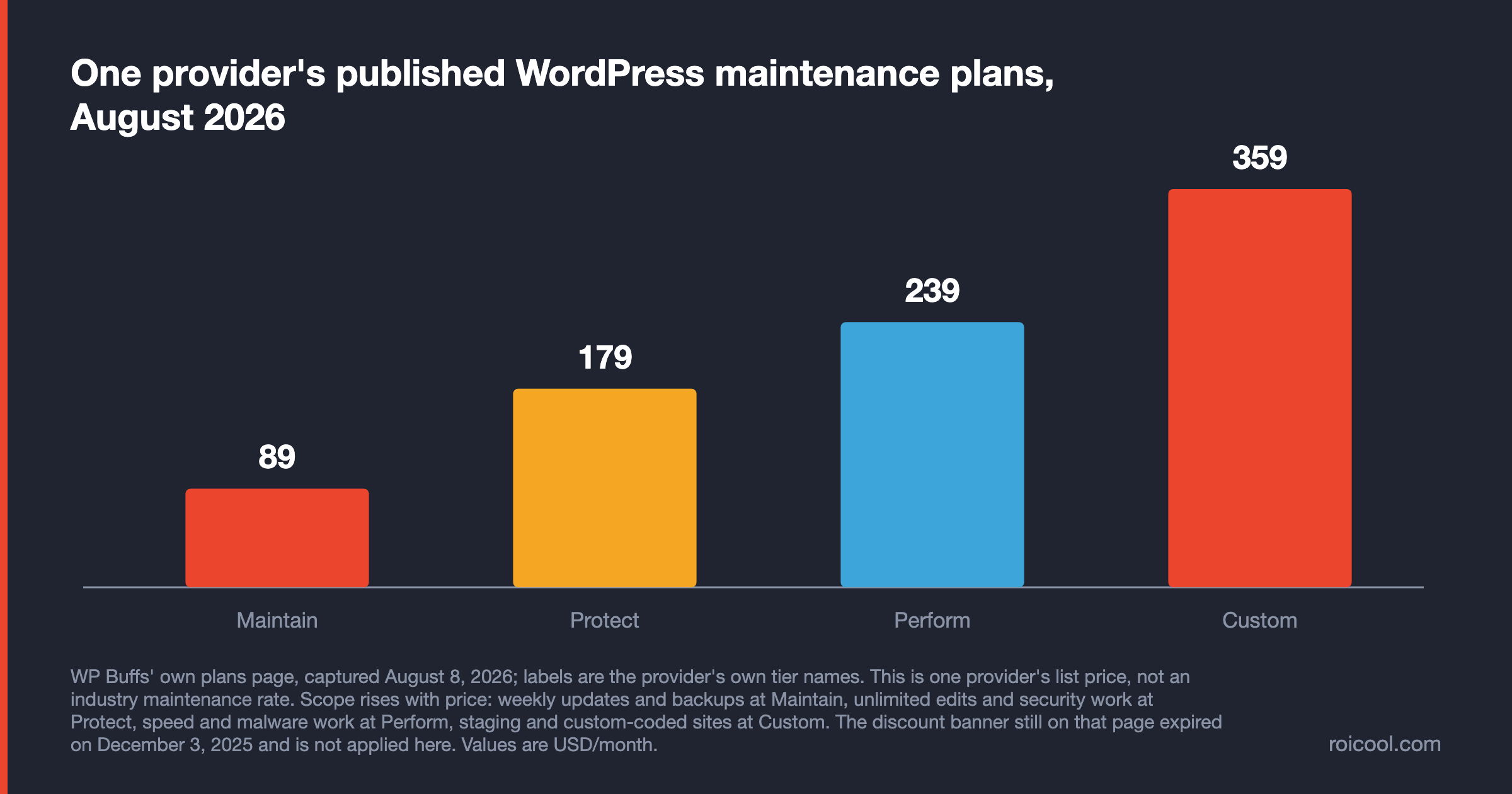
On WP Buffs' own plans page in August 2026, Maintain is $89.00 a month and covers weekly WordPress updates, 24/7 emergency support, uptime monitoring and cloud backups four times daily8. Protect is $179.00 and adds unlimited edits and security optimization8. Perform is $239.00 and adds speed optimization, plugin management and malware removal8. Custom is $359.00 and covers safe updates on staging and custom-coded sites8.
Read that ladder as a description of scope, not as a market rate; it is a single provider's list price, and the discount banner still sitting on that page expired on December 3, 20258. What the ladder shows is that maintenance is not a vague duty of care. It is a defined set of tasks with a price attached to each level. A quote that omits it has not made the work disappear; it has moved the work to month 13 and left the price blank.
Content and languages are separate lines again. Webflow prices Localize Essential at $9 a month and Localize Advanced at $29 a month, both scaled by the number of locales1; that covers the machinery of a multilingual site, not the writing or the translation. We have no verified unit price for content work, so this article publishes none.
The same page carries add-ons that are easy to leave out of a budget, and we are not leaving them out just because Webflow is the platform we sell. Optimize is $299 a month, priced by page views1. Analyze is $9 a month1. On the Premium plan, an extra 50 GB of bandwidth is $20 a month billed annually and $30 a month billed monthly1. A successful site is a more expensive site, and that belongs in the plan.
Finally, launching a site does not make it findable. Being found is a separate budget line with its own economics, which is why we treat the cost of ranking on Google as its own subject rather than folding it into a build quote. A budget that assumes visibility is included usually discovers the omission somewhere around the third month.
Platform Choice and What It Does to Your Budget
Platform choice is not a matter of taste. It decides the shape of the cost: where you pay once, where you pay every month, and which of those lines grows when the business grows. Two companies can spend the same money on a website and end up with completely different obligations in year three.
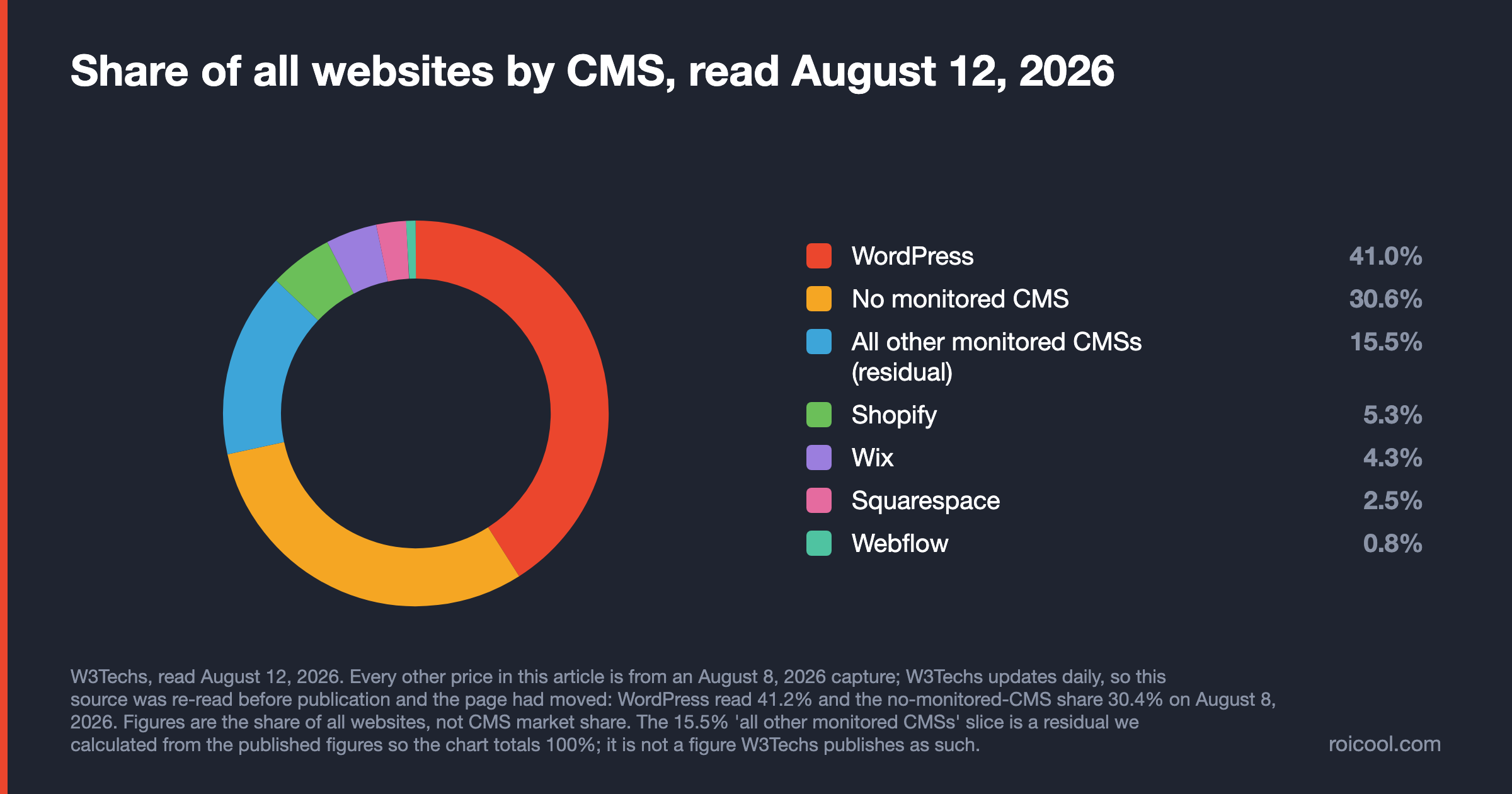
Read on August 12, 2026, W3Techs reports WordPress on 41.0% of all websites, a content management system market share of 59.0%5. Shopify is on 5.3%5, Wix on 4.3%5, Squarespace on 2.5%5 and Webflow on 0.8%5. Meanwhile 30.6% of websites use none of the systems W3Techs monitors5, and every other monitored system shares the remaining 15.5%5. W3Techs updates that report daily, so treat these as one day's reading rather than a fixed fact.
Webflow is the platform we build on, and it holds 0.8% of the web5. We are recommending the small side of the market, and the reason has to be the cost shape, not popularity. Where the cost shape does not fit, the honest answer is a different platform. If the term itself is new, start with what Webflow is, then look at how we work as a Webflow agency.
WordPress: free software, paid everything else
The core software is free, and 41.0% of all websites ran on it when we read the figure on August 12, 20265. The cost is not in the license, it is in keeping the thing standing. Managed hosting is published as 'Starting at $30*' a month on WP Engine's Startup plan for the first year4, and $35 a month on WP Engine's published renewal list11. A standard maintenance plan is $89.00 a month on WP Buffs' own page8. Free software, paid everything else.
WordPress.com and self-hosted WordPress are also different products, and the distinction changes the budget. WordPress.com sells hosting and software as one subscription. The self-hosted route runs, in WordPress.com's own words, on a 'server, which you pay for and manage separately.'3 If you are choosing between the two, read what WordPress is first; this article only prices the lines.
Shopify: the platform where the fee scales with the business
Shopify Basic is $19 a month paid yearly and $27 paid monthly2; Grow is $54 or $72, and Advanced $299 or $399, on the same two terms2; Plus starts 'from $2,300 /mo'2. Shopify is explicit about how Plus is sold: 'If you choose a 1- or 3-year Plus subscription, you can cancel when your term commitment expires.'2 The plan fee is only half of the comparison.
The fee charged on third-party payment providers falls as the plan rises: 2% on Basic2, 1% on Grow2 and 0.6% on Advanced2. Past a certain revenue that commission gap swallows the plan gap entirely. Shopify also states: 'There are no setup fees on any of our plans.'2 Worth knowing before a builder quotes one.
Webflow: small market share, and a ladder that goes to $2,500 a month
Webflow publishes Basic at $15 a month and Premium at $25 a month, both billed yearly1, and on the same page Team at $2,500 a month with 'Annual contract required'1. The ecommerce range runs Standard $29, Plus $74 and Advanced $212, all billed yearly1. Webflow's top platform plan is priced above Shopify Plus's floor of $2,3002. That is not a comfortable sentence for a Webflow agency to write, and it is true.
One distinction keeps Webflow from looking artificially expensive. Workspace and seat prices are the builder's cost, not the site owner's: Webflow's Freelancer workspace is $16 a month and its Agency workspace is $35, both billed yearly1. Those lines belong on our invoice, not in a site owner's three-year total. One more warning for anyone comparing against older articles: the CMS and Business site plans are gone, and Premium now carries a 'New' badge1.
Two 2% fees that are not the same fee
Both Webflow and Shopify publish a 2% transaction fee12, and the two are not the same fee. Webflow's applies to the Ecommerce Standard plan's sales with no payment-provider condition attached1, and the only way out of it is the next plan up: Plus at $74 a month carries a 0% transaction fee1, as does Advanced at $2121.
Shopify's 2% is conditional2. The page states: 'Third-party transaction fees may apply when you use a third-party payment provider (instead of Shopify Payments). The rate depends on your plan.'2 A store using Shopify Payments pays no such fee at all2. So one of these percentages disappears for free and the other costs $45 more a month to escape1. Reading them as the same rate is how a store ends up on the wrong platform.
One thing this section does not do is price Wix or Squarespace. Their shares of all websites are cited above from W3Techs, but we could not verify their US list prices from their own pages, so we publish neither figure. An unverified price is worse than no price at all, because it looks checkable and invites a budget to be built on it.
Why 'Starting at $2.75' Is Not $2.75: Billing Terms and First-Year Prices
An advertised 'starting at' price is usually one of two things: the monthly equivalent of the longest commitment on offer, or the price of the first year. In neither case is it the number you pay in month 13. Nothing is hidden here. The conditions sit on the same pages as the prices; they are simply never carried into the quote you receive.
The same plan, three prices
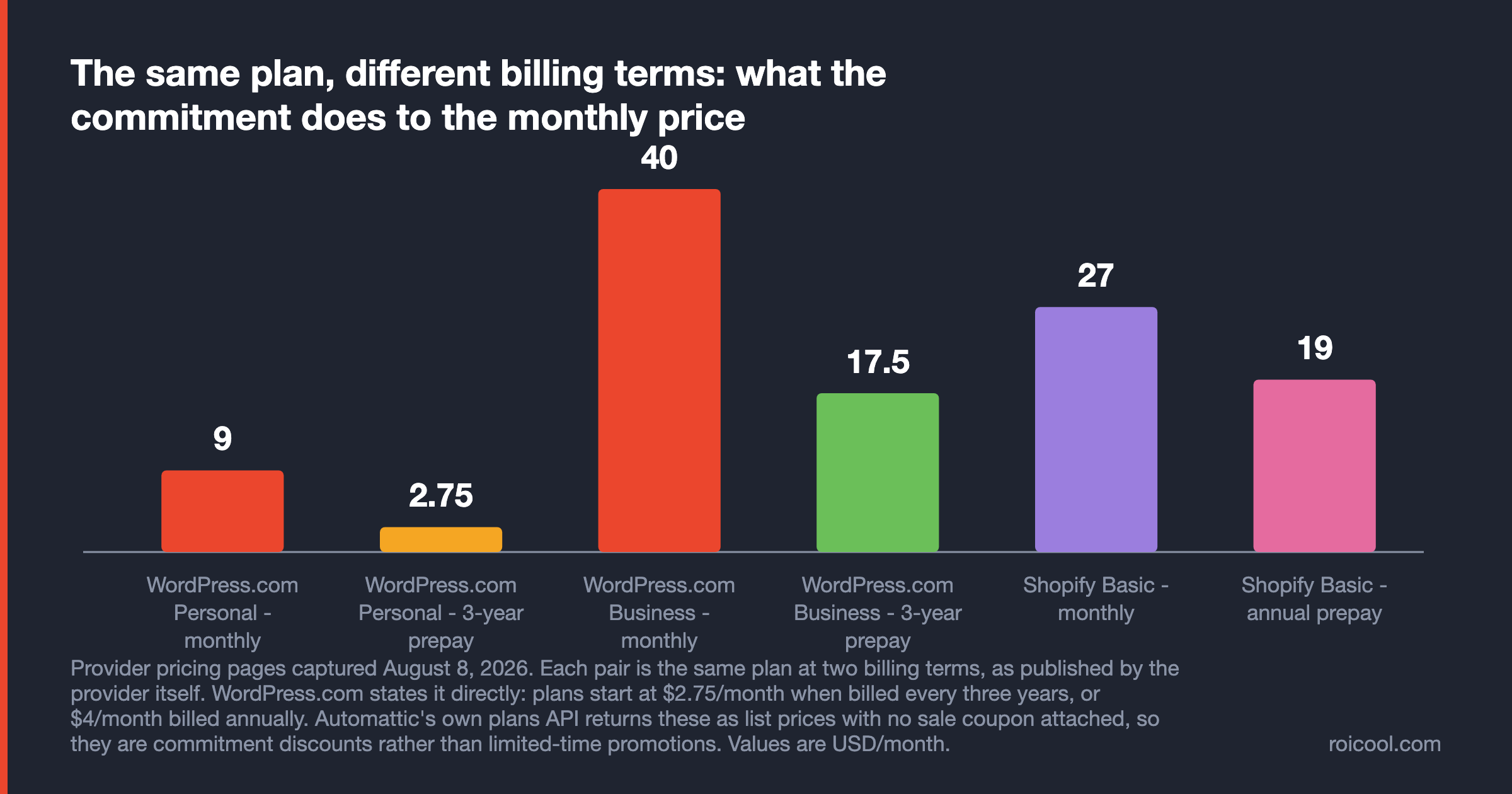
WordPress.com sells its Personal plan at $9, $4, $3.25 and $2.75 a month, moving from a monthly term to twelve-month, two-year and three-year prepay3. Business runs $40, $25, $20 and $17.50 across the same four terms3. The page states it directly: 'WordPress.com plans start at $2.75/month when billed every 3 years, or $4/month billed annually.'3 A Personal customer paying monthly pays about 3.3 times the three-year rate3.
That is a commitment discount, not a promotion, and it is checkable. Automattic's own public plans API returns the same figures with no original price and no sale coupon attached to them12. The distinction matters, because the next example is the opposite case: a price that expires.
Shopify does the same with two terms instead of four: Basic is $27 billed monthly and $19 paid yearly2. The page also advertises three days free and then $1 a month for three months2, and it says what happens next: 'After your trial, most plans start at just $1 per month for the first 3 months, then switch to standard monthly pricing.'2 A three-year budget built on the promotional figure is wrong from month four onwards.
Webflow publishes its site plans as billed yearly across the board1, and the effect surfaces in the add-ons: an extra 50 GB of bandwidth is $20 a month billed annually and $30 a month billed monthly1. Webflow's monthly-term site plan prices are not in the page we captured, so we do not publish them. The page advertises 'Yearly (Save up to 40%)'1, and 'up to' is a ceiling rather than a rate to reverse-engineer.
First-year price, renewal price
WP Engine takes a third approach. Its plans page publishes 'Starting at $30*'4, and the asterisk goes to the page's own footnote, which states that the first-year pricing 'is not valid for upgrades, renewals or any other product purchase'4. WP Engine also publishes a renewal price list on a separate page of its own site, where the same Startup plan is $35 a month11.
The difference is $5 a month, or $120 across the twenty-four months that fall at the renewal price11. On its own that is trivial. As a pattern it is not: meet the same shape in a host, a CDN and an email tool at the same time and you have the explanation for why a budget that worked in year one no longer works in month 13.
Note also the shape of the disclosure. WP Engine does publish the renewal price, just not on the page you land on first, and WordPress.com states on its pricing page that plans auto-renew. The gap is not secrecy, it is distance, and distance is enough for most budgets to miss it.
So the habit is small and mechanical: when you write a plan price into a budget, write the billing term next to it and whether it is a first-year price.
Does a Cheap Website Cost More Later? Tie the Budget to a Measurable Threshold
The claim that a cheap site costs more later only means something when it is attached to a measurable threshold. Google publishes three, so the sentence can become an acceptance criterion instead of an argument between a buyer and a supplier. That single move changes what is being bought: not a look, but a result that can be demonstrated on delivery day.
The three numbers to put in the contract
Google's good thresholds are these: Largest Contentful Paint within 2.5 seconds of the page starting to load9; Interaction to Next Paint at 200 milliseconds or less9; and Cumulative Layout Shift of 0.1 or less9. The detail most proposals miss is how they are assessed: at the 75th percentile of page loads, segmented across mobile and desktop devices9. An average passes easily. A 75th percentile does not.
Written into a contract, those three replace the vaguest clause in web design, which is 'fast loading'. The question to put to a supplier is not how many pages are included, but whether they will commit to the thresholds at the 75th percentile on delivery9. If page load time is unfamiliar territory, it is worth reading up before the negotiation rather than after the invoice.
There is a second reason to write thresholds down instead of adjectives. Performance is measured on real page loads from real devices, so it cannot be settled by opinion in a meeting. Either the delivered site meets the agreed numbers on the agreed measurement or it does not, and both sides are reading the same report when they find out.
Rebuild cost is the real risk
Google does not publish the cost of reaching those thresholds, and we will not tell you that a slow site costs a fixed percentage of your revenue. We have no source for that figure, and neither do most of the people quoting it. What we can point at is the invoice that arrives instead. A site that misses the thresholds is either rebuilt or it buys optimization as a service: on WP Buffs' own page, the Perform tier at $239.00 a month includes speed optimization8.
That is what expensive later actually means. It is not a metaphor about quality; it is a line item with a published price, running every month until the underlying build is fixed or replaced. The same logic governs an SEO-friendly website: structure decided during the build is cheap, and structure retrofitted in year two is a second project with a second budget.
Before You Sign: Five Conditions to Check in Any Website Quote
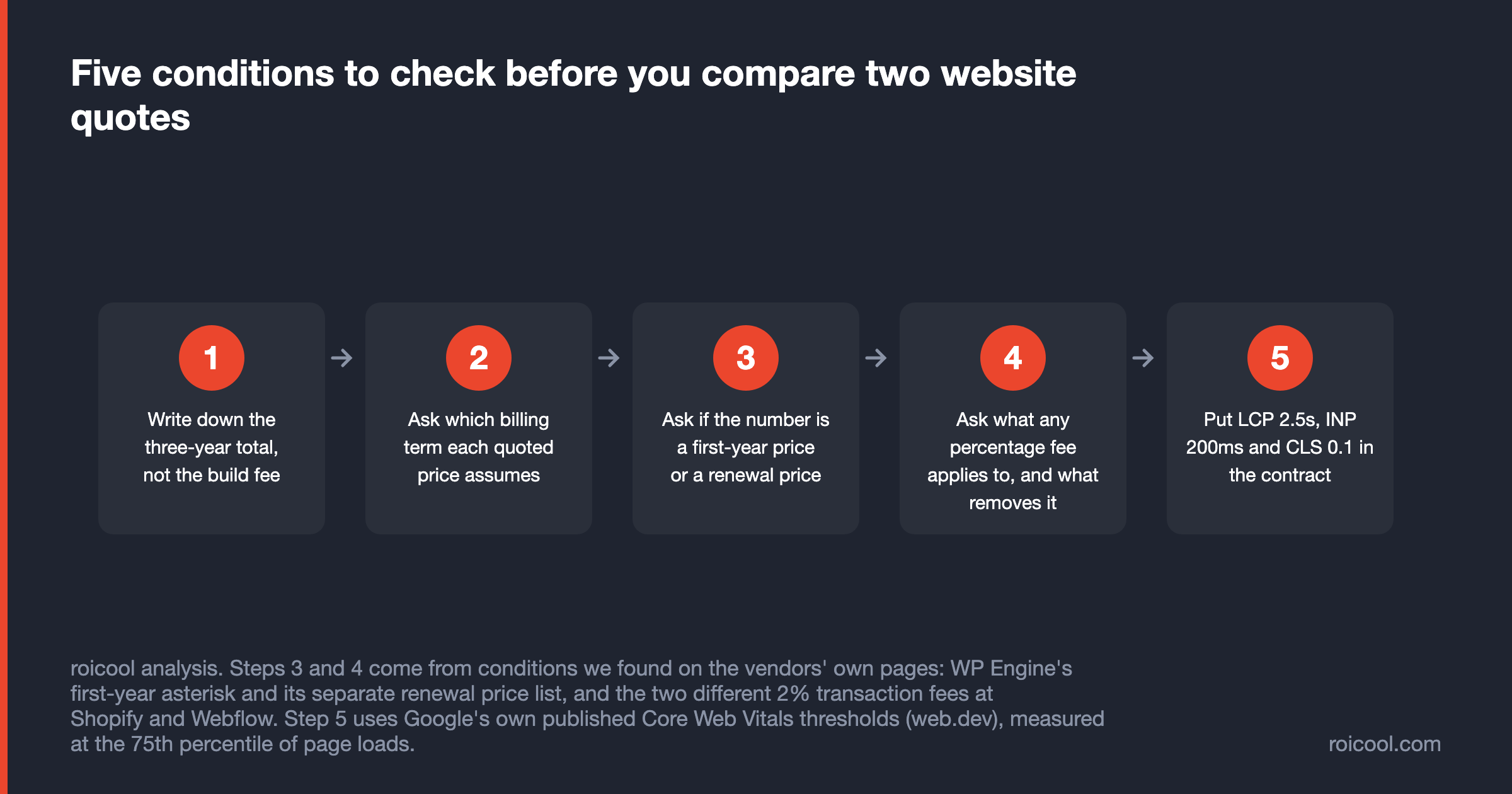
Two quotes can only be compared when they describe the same scope, the same period and the same conditions. Putting the totals side by side is not a comparison; it is a coin toss with extra paperwork. The five checks below take about an hour, and each one comes out of a condition we found on a provider's own page rather than out of instinct.
- Write down the three-year total, not the build fee: build + (hosting or platform x 36) + (maintenance x 36). On the published prices above that is $540 to $900 on one route and $4,404 to $8,664 on the other14, and only the second range includes a maintenance service.
- Ask which billing term every quoted price assumes. The same Shopify Basic plan is $19 or $27 a month depending only on that answer2, and WordPress.com Personal moves between $2.75 and $9 for the identical plan3.
- Ask whether the number is a first-year price or a renewal price. WP Engine's Startup plan is 'Starting at $30*' in year one4 and $35 on its published renewal list11; the same question applies to every host, CDN and email tool in the quote.
- Ask what any percentage fee applies to, and what makes it go away. Shopify's 2% applies only to third-party payment providers2; Webflow's 2% applies to the Ecommerce Standard plan's sales and only disappears on the $74 plan1.
- Put the performance thresholds in the contract as acceptance criteria: LCP within 2.5 seconds, INP of 200 milliseconds or less and CLS of 0.1 or less, measured at the 75th percentile9.
One warning about the first step. A three-year total is not a prediction: list prices move, and WP Engine says so in writing, scope changes, and businesses change their minds. It is a comparison device. Run both quotes through the same formula, over the same term and on the same assumptions, and the two routes stop looking interchangeable. The ranking that comes out is often not the one the build fees suggested.
None of this is adversarial and none of it asks anyone to discount. It asks a supplier to be specific, which the good ones prefer, because vague briefs are exactly what force them to price defensively in the first place. If the scope conversation stalls, agree first on what a professional website has to achieve for the business, then price the answer to that question.
What roicool Charges, and Why We Publish It This Way
We publish two numbers, and they measure different things. Our top-tier Webflow projects average around $4,00014; an average is not a ceiling, and scope moves it up. Projects that need custom code, a custom CMS or AI integrations start at around $6,00014. roicool is positioned as a premium agency, and both figures are set on that basis.
One comparison is worth making explicitly, because this article invites it. The $7,000 figure above7 is four weeks of one US employee's wage, taken from BLS data. Our $4,000 average14 is a price, set from a different cost base in a different labor market, on a platform that already carries part of the build work. The two are not like for like, and neither is evidence about the other.
Those are our own figures, published here as a declaration and not as an independent market survey. The first is an average across a group of projects. The second is a floor for a narrower kind of work. They are not the two ends of one range, and reading them that way would produce a number we have never charged.
We publish no sample size and no date range for either figure, and neither appears in any chart or calculation above. A number published without the scope it belongs to is only half a number, which is why we quote after the scope conversation rather than before it. That conversation covers how many unique designs, who writes the content, how many revision rounds, who owns the accounts and the files, and who maintains the site in month 13.
It is the same standard we applied to every provider above: a price published by the company selling the thing is evidence of what that company charges, and nothing more. Our web design services page explains how we work and what a project includes, and a premium Webflow build shows what the top tier looks like in practice. If you are pricing a project now, bring the three-year total from this article into the conversation.