What Is Generative Engine Optimization (GEO)?
Generative engine optimization (GEO) is the practice of structuring content and its surrounding signals so that generative AI systems retrieve it, cite it and reuse it accurately in their answers. It targets the answer itself rather than a position on a results page. Success is counted in citations inside AI-generated responses, not in blue links.
Definition: what GEO actually means
A generative engine answers a question by pulling material from several sources and synthesizing it with a large language model. GEO works on the two moments in that pipeline a publisher can still influence: whether your page is retrieved into the model's context, and whether the answer that follows credits and represents you correctly.
That is a narrower job than the marketing suggests. Nothing here gives you control over the model. You are working on retrievability and on the quality of the material the model finds, which is why most of the discipline turns out to be measurement rather than magic.
Where the term came from: arXiv 2311.09735 and KDD 2024
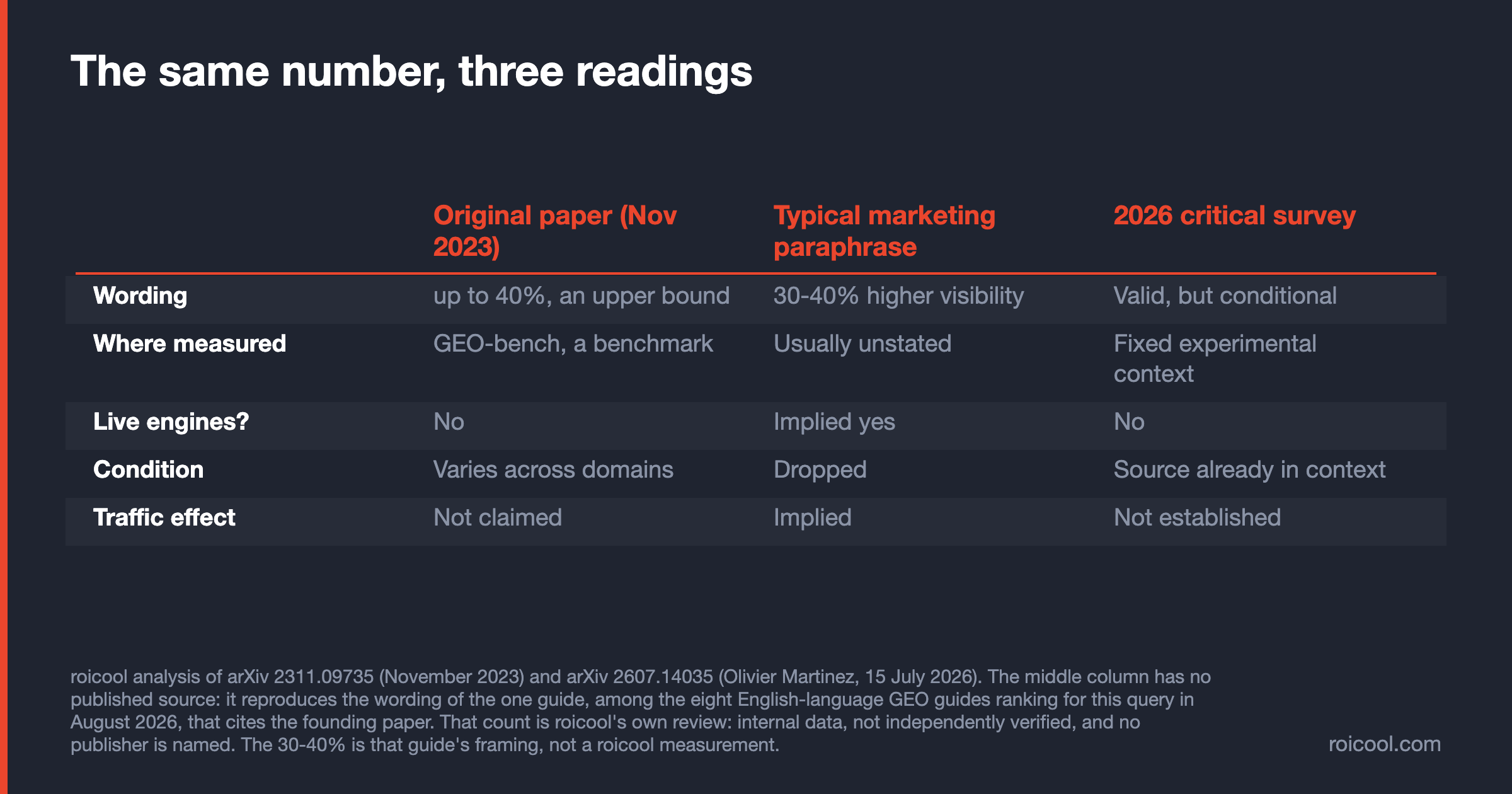
GEO was introduced in November 2023 by Aggarwal, Murahari, Rajpurohit, Kalyan, Narasimhan and Deshpande, and the paper was accepted to KDD 20241. It reported that its methods can boost visibility by up to 40% in generative engine responses: an upper bound, measured on GEO-bench, a benchmark the authors built for the study1.
That single figure is now the most repeated sentence in the category, and it usually travels with its conditions removed. We put them back in the next section, because the conditions are the whole story.
What counts as a generative engine
Google's AI Mode is one. It uses a query fan-out technique, issuing multiple related searches concurrently across subtopics and multiple data sources, then bringing those results together into a single response15. ChatGPT search, Perplexity and Claude do comparable work with different retrieval stacks.
The structural consequence matters more than the vendor list: one user question is no longer one search. A page can be pulled into an answer through a sub-query you never targeted, which is why GEO cannot be reduced to a single keyword.
What GEO is not
- It is not a ranking system. There is no GEO index, no GEO position and no leaderboard to climb.
- It is not a file format. No new machine-readable file makes a page eligible for an AI answer.
- It is not an official Google program. Google's own guidance, last updated 10 July 2026, frames optimizing for generative AI search as still SEO4.
- It is not a rename of answer engine optimization. The two terms overlap without an agreed boundary, and a terminology map appears later in this article.
Two of those exclusions carry weight. Google says the work on its own surfaces is still ordinary search work, and no vendor has published a ranking system to optimize against. What remains is real, but it is distribution and measurement work. That is the thesis this article defends.
Why GEO Emerged: What Measurably Changed in Search
GEO emerged because the answer began to occupy the space the result list used to hold. That is a measured change in behavior rather than a marketing claim, and two independent datasets describe it from different directions: one from panel browsing data, one from referral logs.
Clicks fall when an AI summary appears
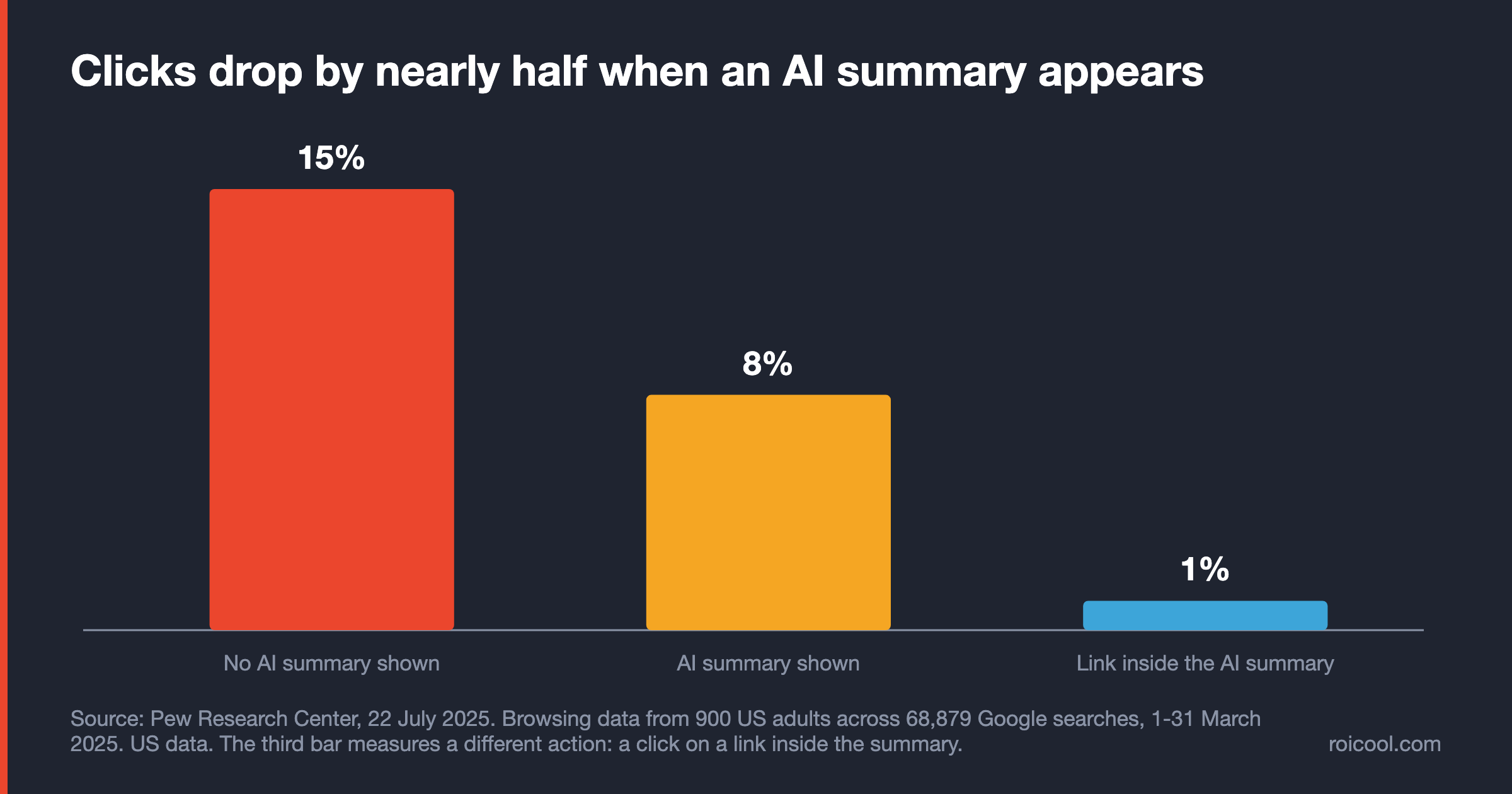
Pew Research Center analyzed the browsing behavior of 900 US adults across 68,879 Google searches recorded between 1 and 31 March 202510. Users who encountered an AI summary clicked a traditional search result in 8% of all visits10. Users who did not encounter one clicked nearly twice as often, in 15% of visits10.
The third number is the one to keep. Clicks on a link inside the summary happened in just 1% of visits to pages that showed one10. Appearing in a summary, being clicked from a summary and being cited by one are three different events, and the rest of this article is built on that distinction.
A separate estimate points the same way. Ahrefs put the click loss associated with AI Overviews at around 58% in July 2026, on its own modeling13. Different method, different dataset, same direction of travel.
How much traffic AI search actually sends
Less than the discourse implies. As of March 2025, across roughly 35,000 sites, AI sent 0.1% of total referral traffic12, and Google sent 345 times more traffic than the three main AI products combined12. We found no comparable measurement since, so treat this as a historical baseline rather than the current split.
The counter-argument is quality rather than quantity. Semrush's own July 2025 study found the average AI search visitor 4.4 times as valuable as an average traditional organic visit, measured on conversion rate14. It is Semrush's study of Semrush's data, and it is the strongest verified figure of its kind we could find.
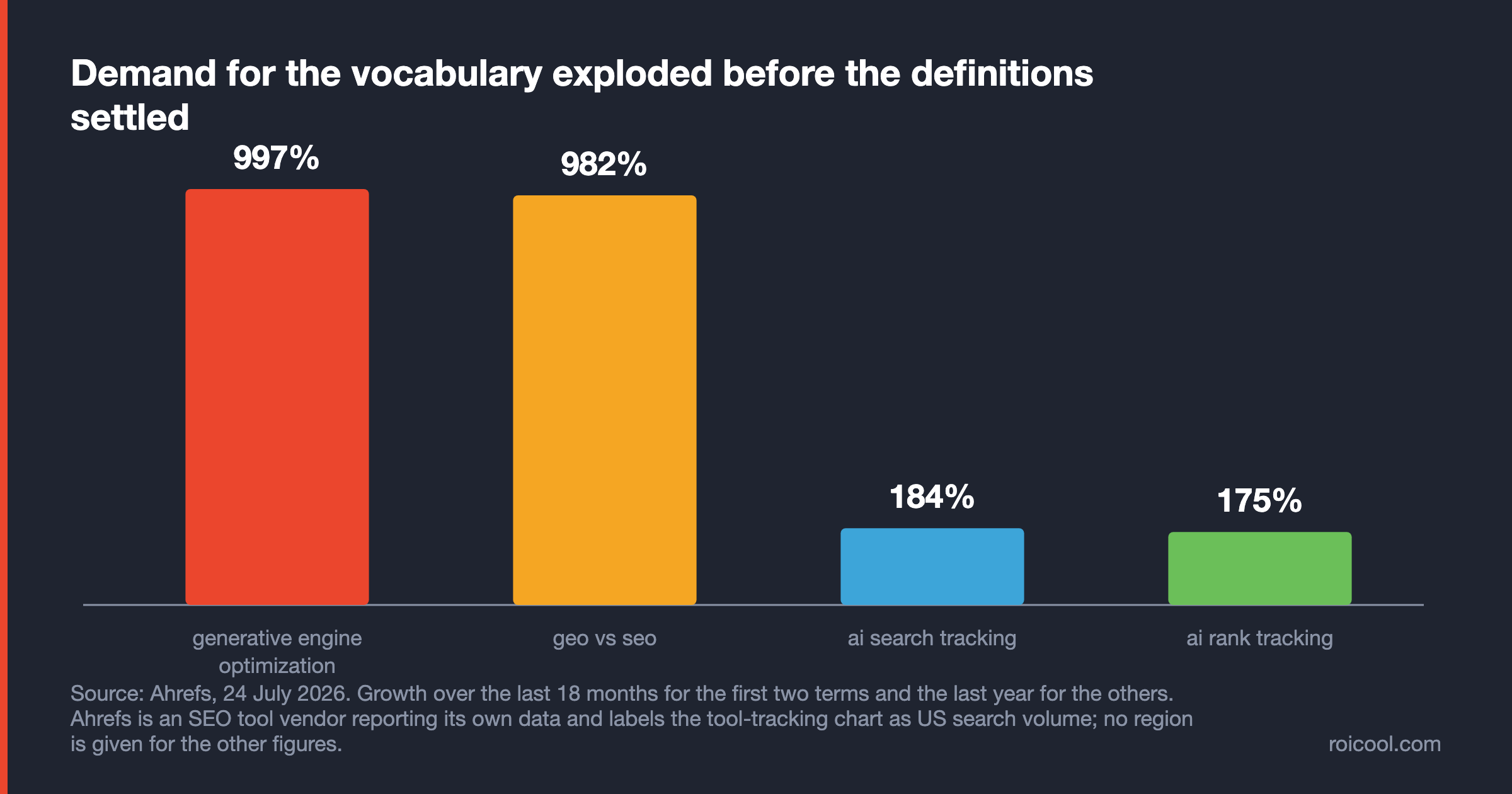
Interest is growing faster than traffic. Ahrefs reported search demand for the term generative engine optimization up 997% over the 18 months to July 202613. That is a growth rate, not a volume. Nobody publishing today can tell you the absolute numbers.
One surface among several: where AI Overviews fit
AI Overviews are the largest of these surfaces; in March 2025 Google said the feature was used by more than a billion people15, and we found no newer figure from Google. ChatGPT search, Perplexity and Claude run alongside it with their own retrieval, their own citation behavior and their own crawlers.
This article does not unpack how AI Overviews are generated. That mechanism has its own page, and our Google AI Overview explainer covers it in detail. What matters here is that it is one surface among several, and that a GEO program has to watch all of them at once.
The 'Up to 40%' Number: What the Founding Study Actually Says
The founding paper reports gains of up to 40%, which is a ceiling rather than an average, and the measurement was made on GEO-bench, a benchmark the authors built, not inside live generative engines1.
What the 2023 paper measured, and where
GEO-bench is described in the paper as a large-scale benchmark of diverse user queries across multiple domains, together with the web sources needed to answer them. The experiment therefore starts from a fixed pool of candidate sources. The question it answers is what happens to a source that is already in the running.
The strategies tested are content-level edits applied to sources already in that pool. That is a meaningful result about presentation. It is not a result about being found, and the difference between those two things is the whole argument of this article.
The paper also states the limit of its own finding: the efficacy of these strategies varies across domains, and the authors call for domain-specific optimization methods1. A method that works in one category is not promised to work in another.
Up to is a ceiling, not an average
An upper bound describes the best observed outcome under the study's conditions. It does not describe the typical outcome, and it does not describe your site, in your category, on a surface the researchers never tested.
This is where the retelling goes wrong, and the error is one of framing rather than arithmetic. Presenting a ceiling as an expected result converts a careful research finding into a promise nobody can keep.
What a 2026 review of 45 studies adds
In July 2026 Olivier Martinez published a critical survey, arXiv 2607.14035, reviewing 45 studies selected under a November 2023 to July 2026 publication window2. Its assessment of the founding paper is the most useful sentence written about GEO so far.
The foundational paper's widely cited gains are valid within its experimental setting but conditional on a source already being present in a fixed context; they establish neither organic discoverability nor durable traffic effects.2
Read it twice. The gains are real inside the experiment. They apply once a page is already present in the model's context. They say nothing about whether an engine finds you in the first place, and nothing about durable traffic.
The same review carries a warning that rarely survives the trip into agency decks: topical relevance and context position are the most reproducible levers, generic heuristics transfer poorly, competition can erode individual gains, and citation-oriented rewrites can impair retrieval2. Optimizing a page to look quotable can make it harder to fetch.
How the number gets retold
We read the eight English-language GEO guides ranking for this query in August 2026. Seven carry no source list at all. One cites the founding paper and restates its ceiling as a 30-40% visibility gain: a range, with the words up to and the benchmark both dropped18. The count is ours, taken on eight pages and not independently audited. The 30-40% is that guide's framing, reported here as the example, not a figure we measured.
That is the whole mechanism of the drift. A conditional experimental result loses its conditions and becomes a flat percentage anyone can promise. The figure itself is not wrong; its conditions were the finding. Our rule here: name the ceiling, name the benchmark, promise neither.
One practical consequence follows. If a claim about GEO performance does not tell you which surface, which query set and which measurement window produced it, the claim is decorative.
Visibility Is Not Citation: Four Vectors of AI Visibility
Appearing in an AI answer and being cited by one are different events, and they have to be measured separately. Most reporting collapses them into a single visibility score, which is how programs end up celebrating movement that produced nothing.
The four vectors: discoverability, citation, absorption, economic outcome
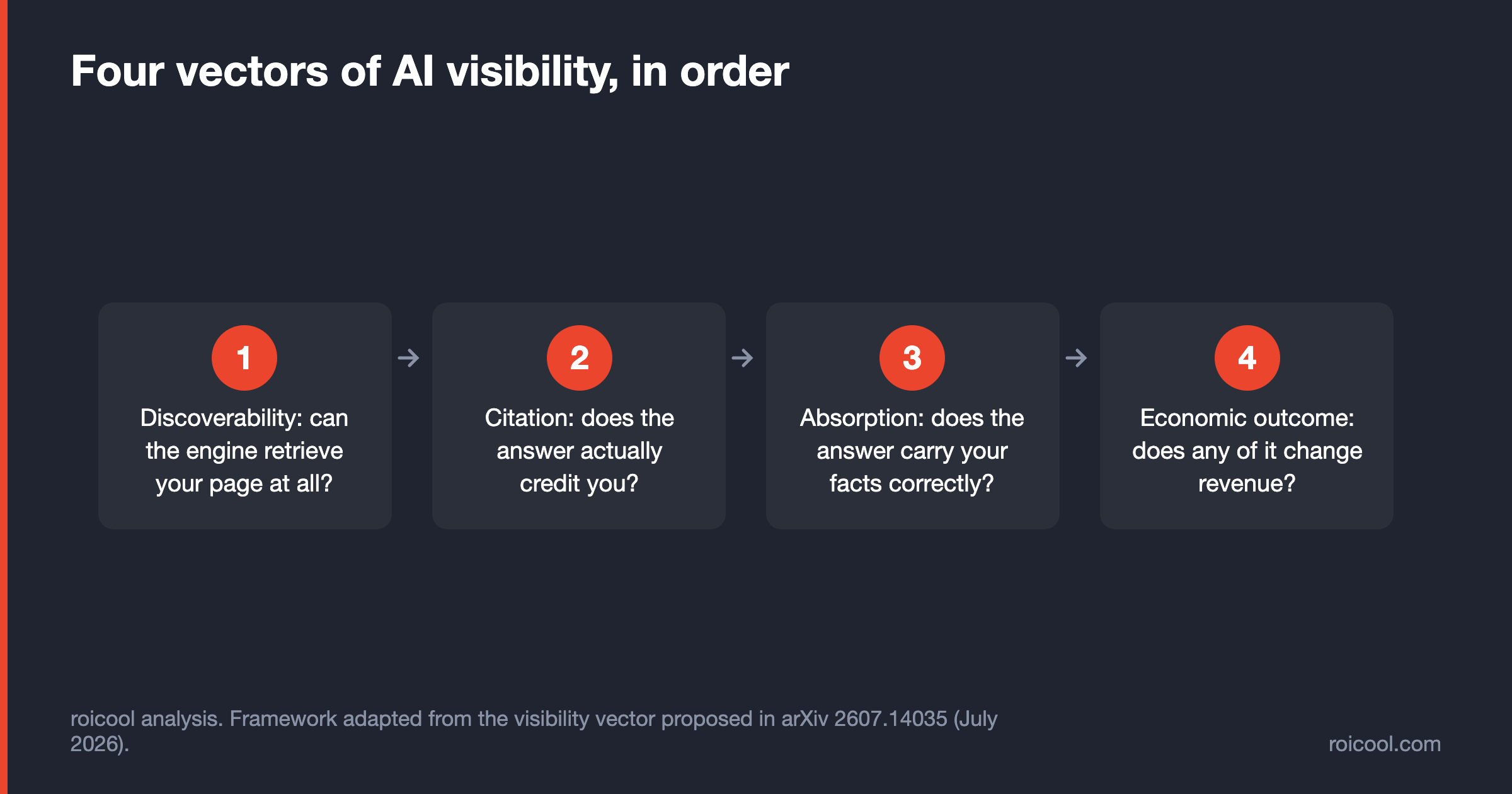
The 2026 critical survey proposes a visibility vector separating discoverability, citation, absorption and economic outcomes2. Treating those four as one number is the most expensive mistake available in this field, because three of them can move in opposite directions inside the same account in the same month.
- Discoverability: can the engine retrieve your page at all? Read it from crawler access in server logs and from presence across a fixed prompt set.
- Citation: does the answer credit you by name or link? Count citations, not appearances; they are not the same row in a spreadsheet.
- Absorption: does the answer carry your facts correctly? Compare what the answer asserts about you with what your page actually says.
- Economic outcome: does any of it change revenue? Read it in your analytics, on assisted conversions, not in a vendor's score.
A field reading: presence went up, citations stayed at zero
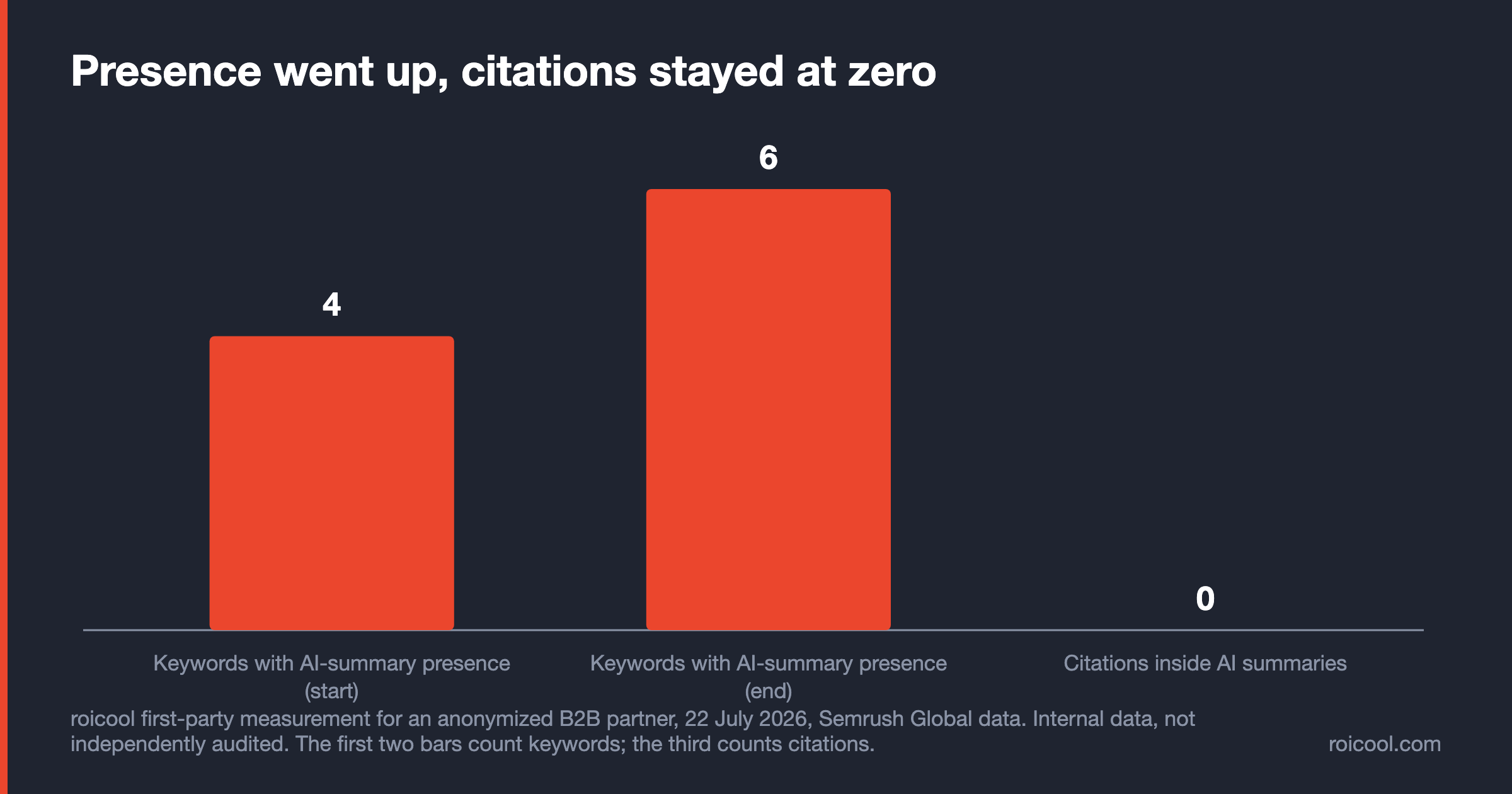
Here is what that separation looks like on a real account. In our own first-party measurement for a B2B partner, using Semrush Global data dated 22 July 2026 and not independently audited, the number of keywords where the partner appeared in AI summaries rose from four to six, while citations inside those summaries stayed at zero across the same period17.
Three vectors behaved differently in one account. Discoverability improved. Citation did not move. Economic outcome was not testable, because there was nothing to attribute. A single blended score would have reported progress and hidden the part that mattered.
What a rising AI visibility score does and does not prove
Second reading, same page. For Modaltrans, a partner in B2B logistics, we built a Webflow site from scratch and an AEO-focused content strategy, and the Semrush AI Visibility score moved from 0 to 24+ in three months16. AI Visibility is Semrush's own score, not an industry standard.
Placed in the four-vector frame, that result sits on discoverability. It is not evidence of citation and it is not evidence of revenue; those need their own instruments. The full write-up is in our AI visibility case study.
One indirect signal explains why the vectors decouple so easily: the pages ChatGPT search cites are frequently not the ones ranking near the top of ordinary organic results14. That relationship, and the reasons to read it as indirect, are unpacked in the GEO vs SEO section below.
Commercial audits reinforce the point, reporting low source overlap between tools, substantial run-to-run variability and persistent fidelity gaps2. If two tools disagree about your visibility, they may both be reporting accurately about different runs.
What Google Officially Says About Optimizing for AI Search
According to Google, optimizing for generative AI search is not a separate discipline. Google maintains an official guide, last updated 10 July 2026, that says so in one sentence, and a narrower documentation page that says the same thing about eligibility.
Still SEO: Google's own framing
The guide addresses the vocabulary head-on, naming both AEO and GEO before drawing its conclusion.
From Google Search's perspective, optimizing for generative AI search is optimizing for the search experience, and thus still SEO.4
The paragraph does not stop there. Google's next sentence tells readers considering third-party AEO or GEO advice or services to review its guidance on evaluating third-party SEO advice4. Apply that test to this article as well: which surface, which query set, which measurement window?
Scope decides how much that sentence is worth. It describes Google Search. It is not a statement about ChatGPT, Perplexity or Claude, and Google does not present it as one. Half of this article's thesis lives inside that sentence; the other half lives outside its scope.
No additional requirements to appear in AI Overviews or AI Mode
The dedicated documentation page on AI features, last updated 10 December 2025, is blunter still: there are no additional requirements to appear in AI Overviews or AI Mode, nor other special optimizations necessary3.
The gate that does exist is unglamorous. To be shown as a supporting link in AI Overviews or AI Mode, a page must be indexed and eligible to be shown in Google Search with a snippet3. Everything else on Google's surfaces is ordinary search work done well.
Mythbusting: five things Google says you do not need to do
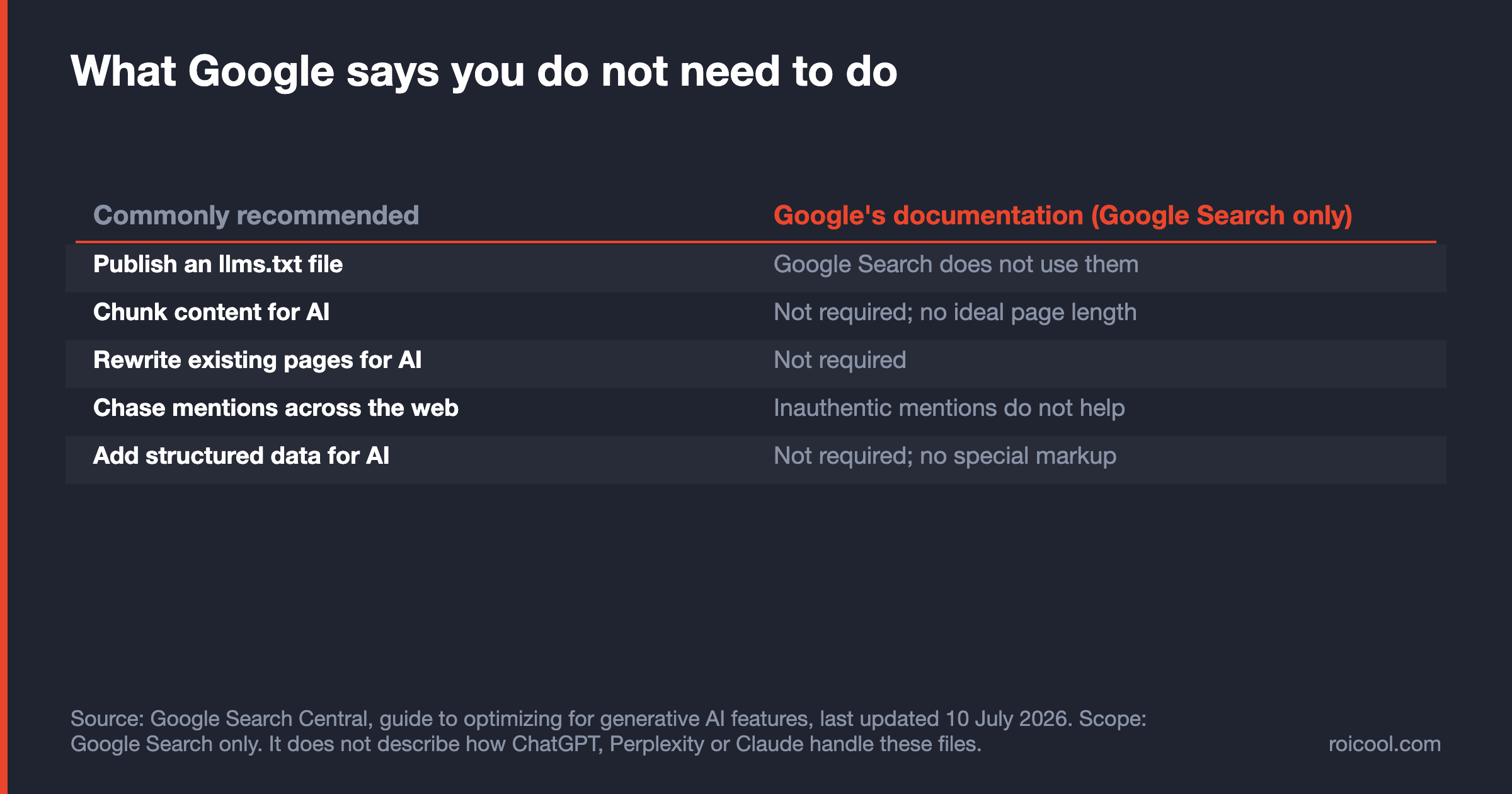
The July 2026 guide includes a section titled Mythbusting generative AI search: what you don't need to do. It lists five practices you can ignore for Google Search4.
- LLMS.txt files and other special markup: Google Search does not use them, and publishing one will neither harm nor help visibility there.
- Chunking content into tiny pieces for AI: not required, and there is no ideal page length.
- Rewriting existing content just for AI systems: not required, because the systems understand synonyms and general meaning.
- Seeking inauthentic mentions across the web: less helpful than it looks, because core ranking and spam systems both feed the AI features.
- Overfocusing on structured data: not required for generative AI search, and there is no special schema.org markup to add.
Every line above is scoped to Google Search, and the scope is not a technicality. Google is describing its own systems. We found no primary statement from OpenAI, Anthropic or Perplexity about how they treat these files, so this list cannot be extended to their surfaces.
The llms.txt reality check
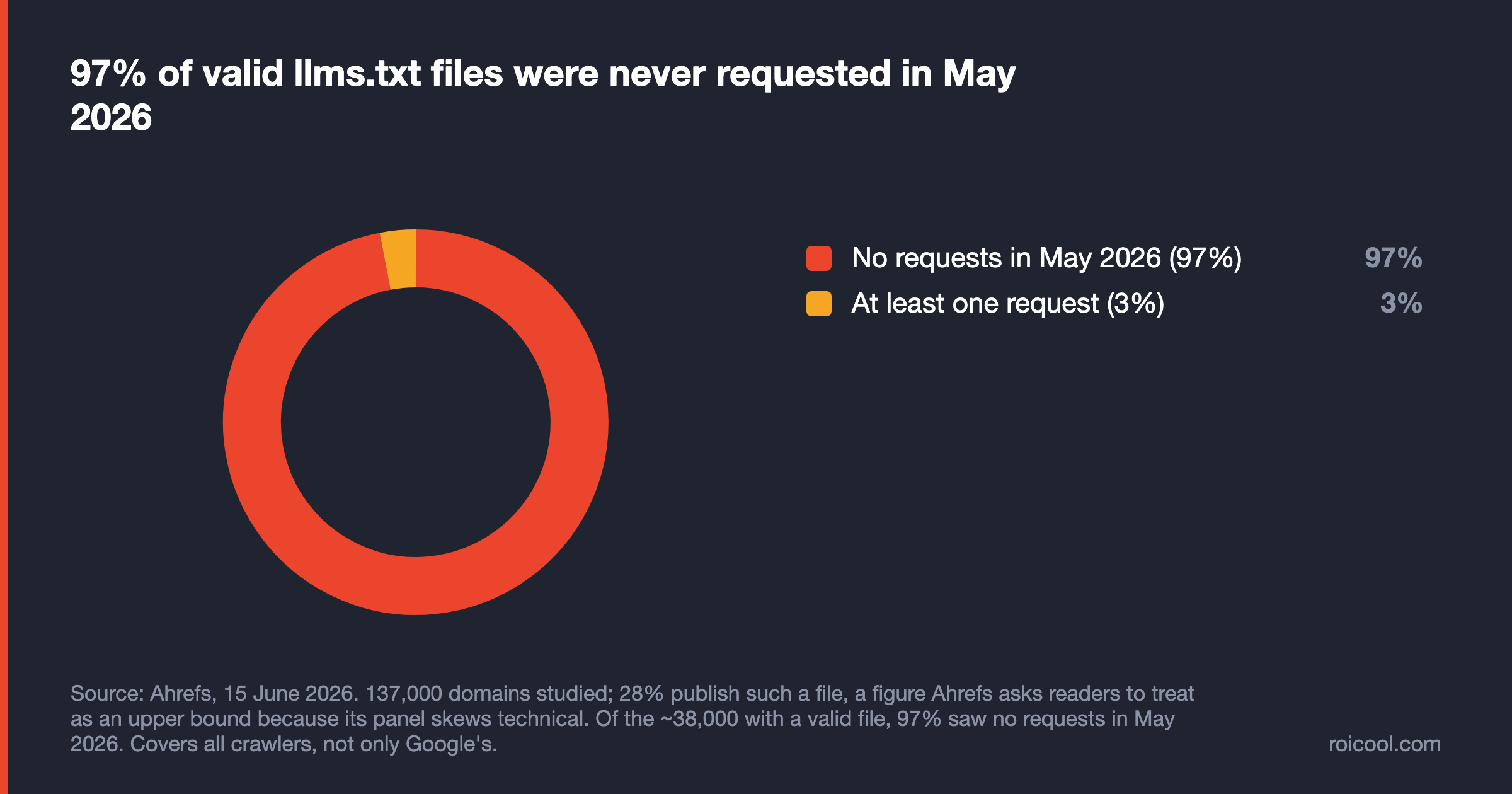
Independent field data points the same way on a wider scope. Ahrefs analyzed 137,000 domains and found that 28% publish an llms.txt file11. That 28% is a panel rather than a random sample of the web: Ahrefs says its own customers skew more technical and SEO-aware than the web at large, and asks readers to treat the adoption figure as an upper bound11.
The second number is not touched by that caveat. Of the roughly 38,000 domains with a valid file, 97% saw no requests for it whatsoever in May 202611. That share is measured inside the panel's own files, on servers that had already chosen to publish one.
That measurement covers every crawler hitting those servers, not only Google's, which is why it is the right evidence for the general question. Google's documentation answers a narrower one. The two agree, but they are not interchangeable, and conflating them is how scope errors get published.
Google also shipped measurement alongside the guidance: a Generative AI performance report now exists in Search Console4. It is one instrument, and it covers Google's surfaces only.
So if the work on Google's surfaces is ordinary search work done well, where is the part that genuinely differs? On the surfaces Google does not control.
GEO vs SEO: A Measurement and Distribution Problem, Not a New Ranking Game
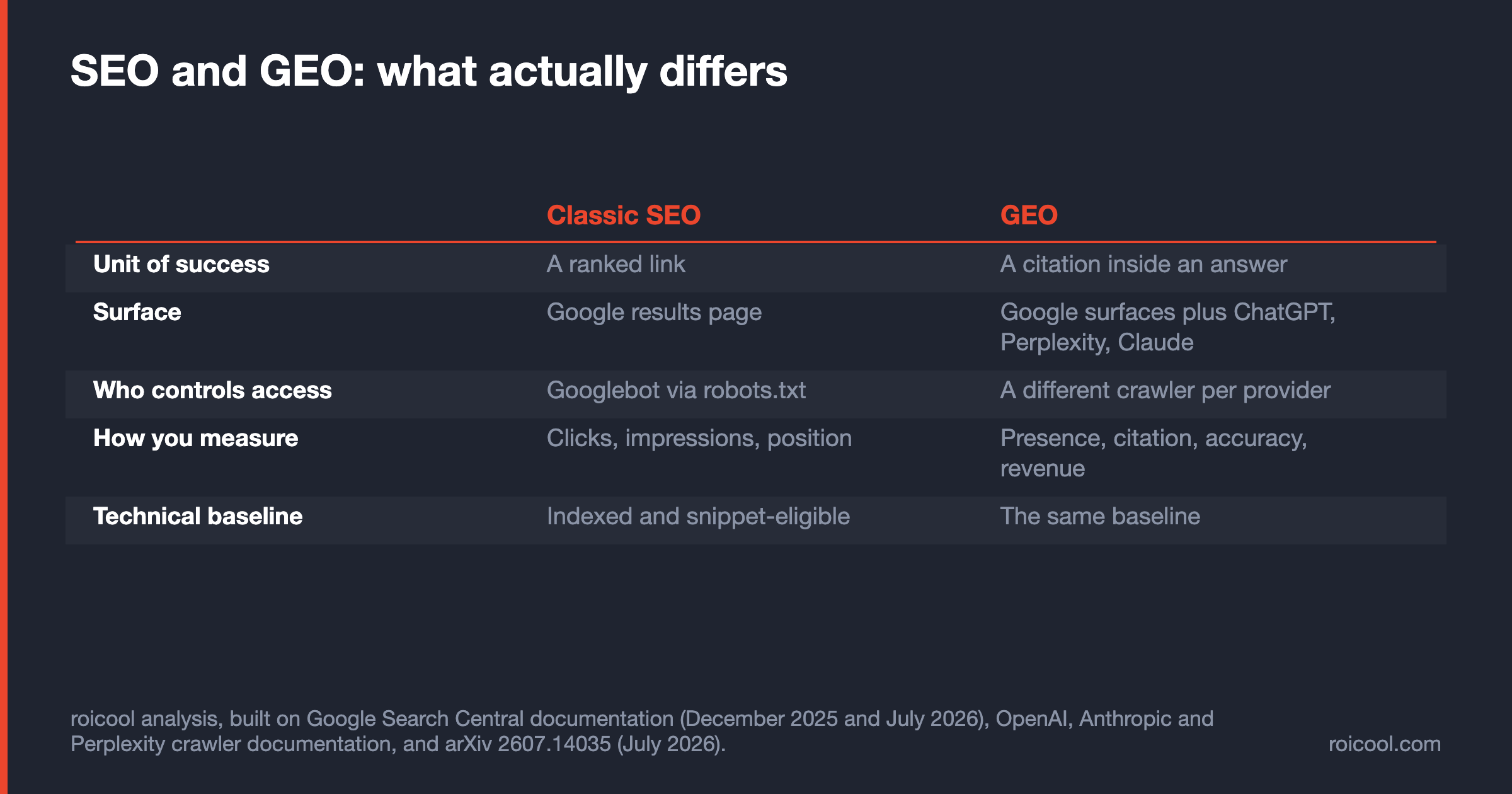
The technical foundation does not change. What changes is the unit of success, which becomes a citation inside an answer rather than a ranked link, and the number of surfaces on which that unit is produced.
What stays the same: indexing and snippet eligibility
Google's eligibility condition for AI answers is the one it has always applied: the page must be indexed and eligible to be shown with a snippet3. If search engine indexing is broken, no amount of AI-specific formatting rescues the page, which is why the foundation of this work still belongs with our SEO services.
Crawl control behaves the same way. Preferences addressed to the Googlebot user agent affect Google Search, including Discover and all Search features5. There is no separate switch for AI answers on Google, and there is no separate index behind them.
The same holds for the content. Nothing in Google's guidance describes a second, AI-specific quality bar. The pages that earn citations in generative answers are the pages that were already eligible, already indexed and already worth quoting.
What changes: citations instead of clicks, on surfaces Google does not control
Google's own documentation says this is still SEO, and on Google's surfaces it is4. The part that is genuinely new is not a ranking trick. It is that your content is now retrieved, summarized and attributed on surfaces Google neither operates nor reports on.
On those surfaces three things differ at once. Access is granted per provider by a different crawler; opting out of OAI-SearchBot removes a site from ChatGPT search answers6, and no Google setting can do that. Citation behavior differs. And measurement differs, because nobody hands you an impressions column.
That is the honest shape of GEO: a distribution and measurement problem, not a secret algorithm. It is also why the work is real. Nothing in your Search Console tells you what Perplexity said about your product last Tuesday.
The most common misreading: GEO is not a ranking system
The most persistent misreading is that GEO means reaching Google's top ten and letting the AI take it from there. The indirect signal runs the other way: Semrush found in July 2025 that pages cited by ChatGPT search usually sit outside the first two pages of ordinary organic results, at positions 21+ for related queries in almost 90% of cases14.
We label that as indirect on purpose. It is one study of one engine in July 2025, and it describes a relationship between two systems rather than a mechanism. It is enough to retire the top-ten assumption. It is not enough to build a strategy on.
The strongest available review is deliberately unexciting here: no reviewed technique shows a stable, longitudinal, cross-platform causal effect on organic discoverability or downstream behavior2. Anyone selling GEO as a replacement for SEO is selling a claim the evidence base does not contain.
Held together, the two halves are consistent. On Google, do search work properly. Everywhere else, do the distribution and measurement work that classic SEO tooling was never built to do.
Which Crawlers Actually Decide Your AI Visibility
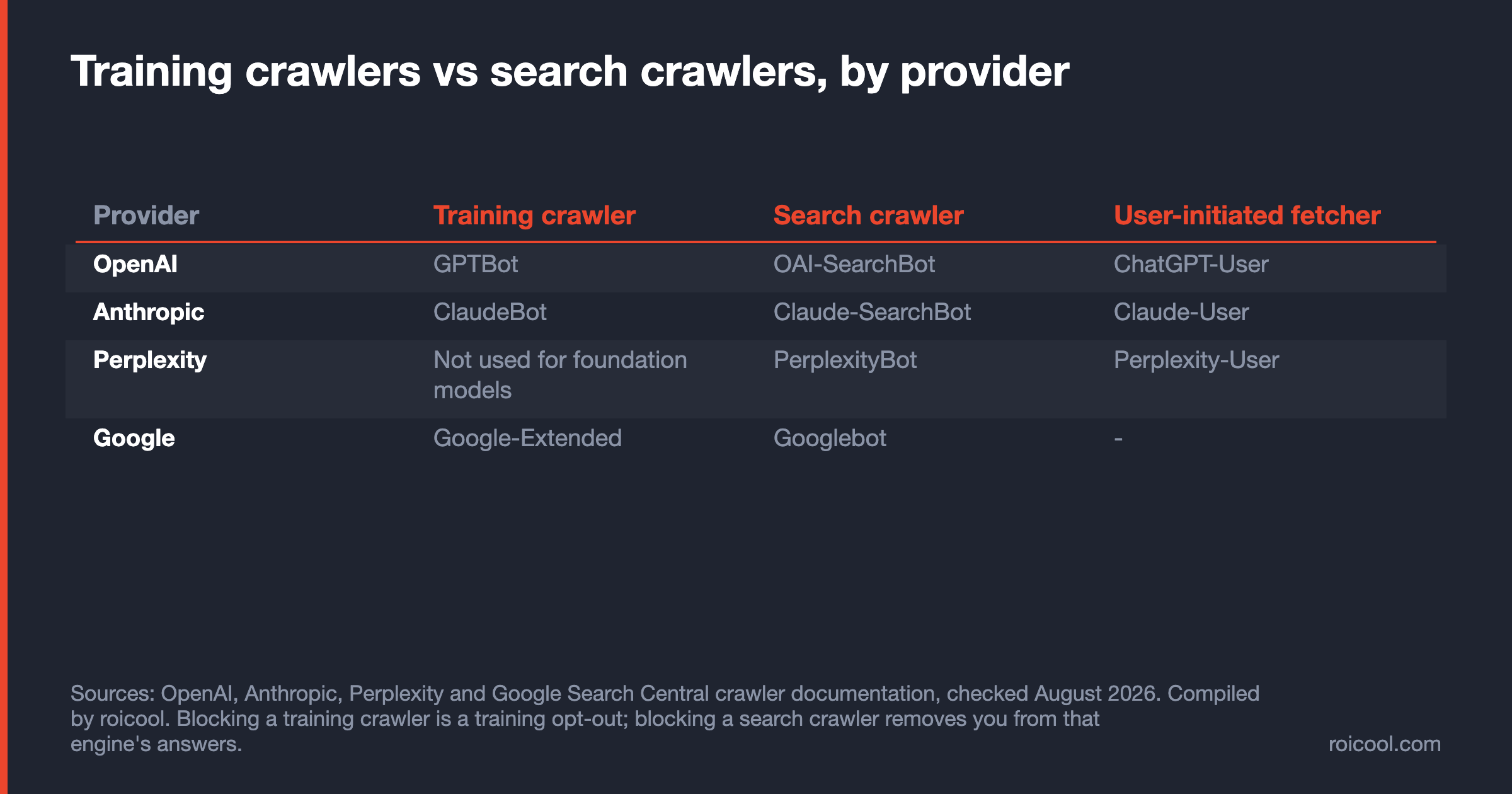
There is no single AI bot to allow or disallow. OpenAI, Anthropic and Google each document a separate training crawler alongside a separate search crawler. Perplexity documents no training crawler at all, and says its own bot serves search results rather than foundation-model training8. In every case the agent that decides whether you appear in an answer is not the one most sites block first.
Training crawlers and search crawlers are not the same thing
The distinction is operational, not academic. Blocking a training crawler is a licensing decision about model training. Blocking a search crawler is a visibility decision that removes you from an engine's answers. Sites routinely make the first choice, believe they made no choice at all, and then wonder why nothing changed.
Get the user-agent names exactly right, including hyphens and capitalization. A robots.txt rule aimed at a name that does not exist is a rule that does nothing, and several widely shared GEO templates still contain them.
OpenAI: GPTBot, OAI-SearchBot, ChatGPT-User
OpenAI documents three agents. GPTBot crawls content that may be used in training its generative AI foundation models, and disallowing GPTBot indicates that a site's content should not be used in that training6. That is a rights decision with no stated effect on visibility.
OAI-SearchBot is for search. Sites opted out of OAI-SearchBot will not be shown in ChatGPT search answers, though they can still appear as navigational links6. OpenAI recommends allowing OAI-SearchBot in your site's robots.txt file6.
ChatGPT-User is the fetcher behind user actions, and OpenAI states that it is not used to determine whether content may appear in Search6. Because those actions are initiated by a person, robots.txt rules may not apply to it. Expect it in your logs; do not read it as a visibility signal.
Anthropic: ClaudeBot, Claude-SearchBot, Claude-User
Anthropic splits the same three ways. ClaudeBot collects web content that could contribute to model training, Claude-SearchBot navigates the web to improve search result quality, and Claude-User accesses sites when a person asks Claude a question7.
One name still circulating in older SEO advice deserves a correction. Claude-Web does not appear in Anthropic's current official documentation, checked in August 20267. We are not claiming it was withdrawn. We are saying a rule written for it today has nothing to match.
Perplexity: PerplexityBot and Perplexity-User
PerplexityBot is designed to surface and link websites in search results on Perplexity, and it is not used to crawl content for AI foundation models8. Perplexity documents no training crawler, so there is no separate training opt-out to make here. That makes blocking PerplexityBot a pure visibility loss: you give up appearing in Perplexity's answers and gain nothing on the training side.
Perplexity-User handles user-initiated fetches, and Perplexity states that because a user requested the fetch, this fetcher generally ignores robots.txt rules8. Blocking it at the firewall is not a visibility decision; it is blocking a person who asked a question about you.
Google: Google-Extended and Googlebot
Google-Extended is a standalone product token publishers use to manage whether content Google crawls may be used for training future generations of Gemini models5. The sentence that answers the fear attached to it is explicit.
Google-Extended does not impact a site's inclusion in Google Search nor is it used as a ranking signal in Google Search.5
Googlebot is the agent that matters for visibility on Google, because crawl preferences addressed to it affect Google Search and all of its features5. Training opt-out and search visibility are separate levers here too.
What the crawl-to-referral ratios looked like between January and July 2025
Cloudflare measured how many pages each platform crawled for every visit it referred. Between January and July 2025, Anthropic's ratio fell from 286,930 pages per referred visit to 38,0659, OpenAI's edged down from 1,217 to 1,0919, and Perplexity's rose from 54 to 1959.
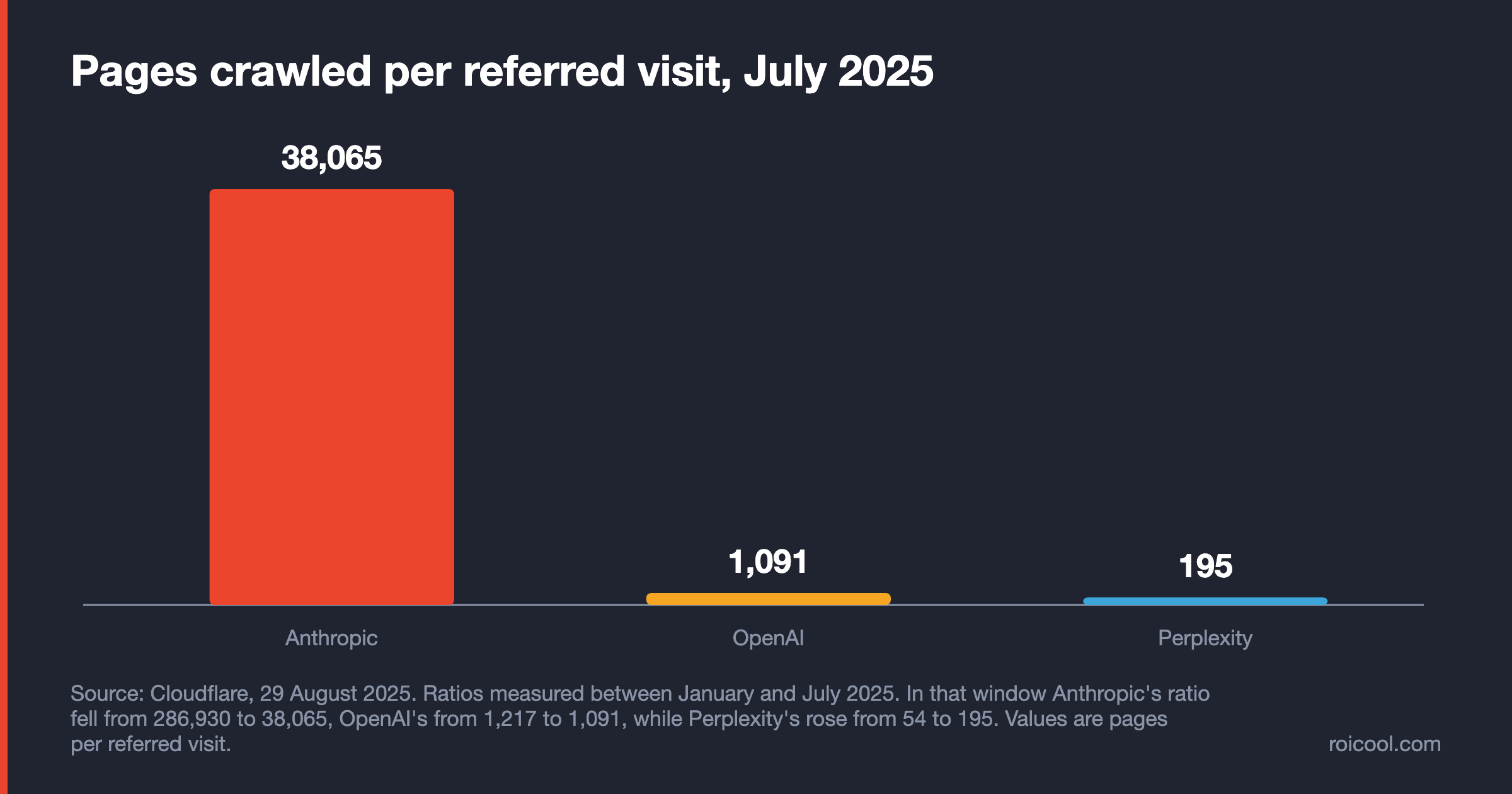
Those are ratios from that window, not current figures, and we have found no equivalent update. What they establish is the shape of the exchange: at that time AI crawlers took far more than they returned, and the gap between providers spanned several orders of magnitude.
The direction of travel shows up elsewhere. Ahrefs reported in July 2026 that Cloudflare's chief executive had said agentic traffic, meaning bots, crawlers and agents, had passed the 50% mark for the first time13. Crawler policy is becoming an audience decision rather than a server-admin footnote.
GEO, AEO, AIO and LLMO: A Terminology Map Without Consensus
GEO, AEO, AIO and LLMO are competing names for overlapping work, and no accepted boundary exists between them. Anyone who tells you otherwise is describing their own product taxonomy, not an industry standard.
Why the terms have not settled
The research base is young and still forming. The 2026 critical survey selected 45 studies under a November 2023 to July 2026 publication window2, which is a short literature facing a very loud market. No standards body owns any of these acronyms.
In practice the usage splits like this. GEO comes from the research literature, where the object of study is visibility inside a generated answer. AIO and AI SEO are used loosely as synonyms for the same work. LLMO usually points at the model layer rather than the search layer. AEO describes being the answer itself, on whichever system produces it.
How we use them in this article
In this article GEO means the measurement and distribution work across generative surfaces: retrieval, citation, factual accuracy and outcome. We use AEO here only to place it on the map; the working definition and the playbook live in our AEO strategies guide, which owns the term on this site.
Our earlier work framed AEO through featured snippets and People Also Ask boxes. That framing is not wrong; it is the earlier surface set, written when those were the answer surfaces that existed. The four-vector view2 extends it rather than replacing it.
The practical advice is unromantic: pick the definitions you will use, write them down, and keep them stable long enough to measure something. A program that renames its own goal every quarter cannot produce a trend line.
How to Measure GEO Without Fooling Yourself
The first rule of GEO measurement is never to trust a single run of a single prompt. The second is to measure the four vectors separately, because a blended score can rise while the thing you actually wanted stays at zero.
Turning four vectors into four measurement families
Each vector needs its own instrument, and none of the four is optional if you intend to report honestly to a board.
- Discoverability: server logs filtered for OAI-SearchBot, Claude-SearchBot, PerplexityBot and Googlebot, plus presence tracking across a fixed prompt set.
- Citation: a count of answers that name or link you, recorded separately from the count of answers you merely appear in.
- Absorption: a periodic accuracy audit comparing what the answers assert about you with what your pages actually say.
- Economic outcome: assisted conversions and pipeline from AI referrers, held to the same evidential standard as any other channel.
Google Search Console now includes a Generative AI performance report4. It covers Google's surfaces, so it belongs in the set without replacing it: nothing in it describes what Perplexity or ChatGPT did.
Why single-run checks mislead
Commercial audits show low source overlap between tools, substantial run-to-run variability and persistent fidelity gaps2. That is why asking a chatbot once and not seeing your brand is an anecdote rather than a measurement. Fix the prompt set, fix the cadence, log every run and read the distribution.
There is a second reason to measure before acting. The 2026 review reports that citation-oriented rewrites can impair retrieval2. An unmeasured intervention can move you backwards on the vector you care about most while feeling like progress.
Set a baseline before you change anything
Baselines are what made the partner reading earlier in this article legible: presence rose from four to six keywords while citations stayed at zero17. Without a starting point, that account would have been written up as a win.
A workable baseline is boring. A fixed list of prompts. A fixed list of engines. Crawler access confirmed in logs rather than assumed. A date. Everything after that is a comparison, and comparisons are the only thing in this field that survives contact with reality.
The tactical build-out, meaning content structure, entity coverage, internal linking and schema where it earns its place, is a separate job with its own page. Our AEO content guide for SaaS covers the implementation detail this article deliberately leaves out.
So, Does GEO Work? An Honest Answer
Partly, and the boundary is precise. Content that has already been retrieved can be made more likely to be cited and reused. What has not been demonstrated is that any technique reliably improves organic discoverability.
What the evidence supports today
Two findings survive scrutiny. The first is the conditional the founding paper attached to its own result: gains hold once a source is already in the model's context, and they settle nothing about being found in the first place2. The second is methodological. Splitting visibility into the four vectors2 produces numbers you can act on.
What it does not support yet
No reviewed technique has shown a stable, cross-platform causal effect on discoverability2, and generic heuristics transfer poorly between domains2. Anyone promising a GEO ranking outcome is describing something the literature does not contain.
Which returns the argument to where Google left it: on its own surfaces this is still SEO4, and what genuinely separates sits on the surfaces Google does not control. That is the work behind our answer engine optimization service: distribution across generative surfaces, and measurement you can defend in a board meeting.