What is medical tourism SEO?
Medical tourism SEO is organic search work that makes a clinic or facilitator in Turkey findable by patients who search from other countries, in their own language. In Google's terms it covers two kinds of site at once: a multilingual website offers content in more than one language, and a multi-regional website explicitly targets users in different countries5. A clinic that treats patients from abroad has to plan for both.
The second layer is trust. Google's systems give even more weight to content with strong E-E-A-T on topics that could significantly impact people's health, and Google's rater guidelines call such topics "Your Money or Your Life", or YMYL67. A treatment page read by someone weighing surgery in another country is a health decision page, and it is judged by that stricter bar.
The term health tourism SEO means the same thing; "health tourism" is also the literal English for the Turkish "sağlık turizmi". Both terms refer to organic results, not paid ads. The general principles of search engine optimization still apply underneath; what changes is who is searching, from where, and in which language. The healthcare SEO case study shows this work on a health tourism site. Beyond organic search, roicool's health tourism digital marketing work also covers ads and web design.
How it differs from local SEO for a clinic
Local SEO serves people near the clinic, such as someone in Istanbul looking for a dentist in their district. Medical tourism SEO serves someone in another country, usually reading in another language, who is making a health decision that also involves travel. Three variables change together: the searcher's location, the page language and the level of trust the topic demands. The basics of local SEO still matter for patients who live nearby, but they were built for a searcher who can walk in.
What the evidence says about patients and demand
Health tourism visitors to Turkey, 2023-2025
Health tourism visitor numbers to Turkey fell in 2025. USHAŞ, the Ministry of Health company that publishes the series, reports 1,398,580 people in 2025, against 1,506,442 in 2024 and 1,538,643 in 20231. It names the Turkish Statistical Institute (TurkStat) as the source of the figures1.
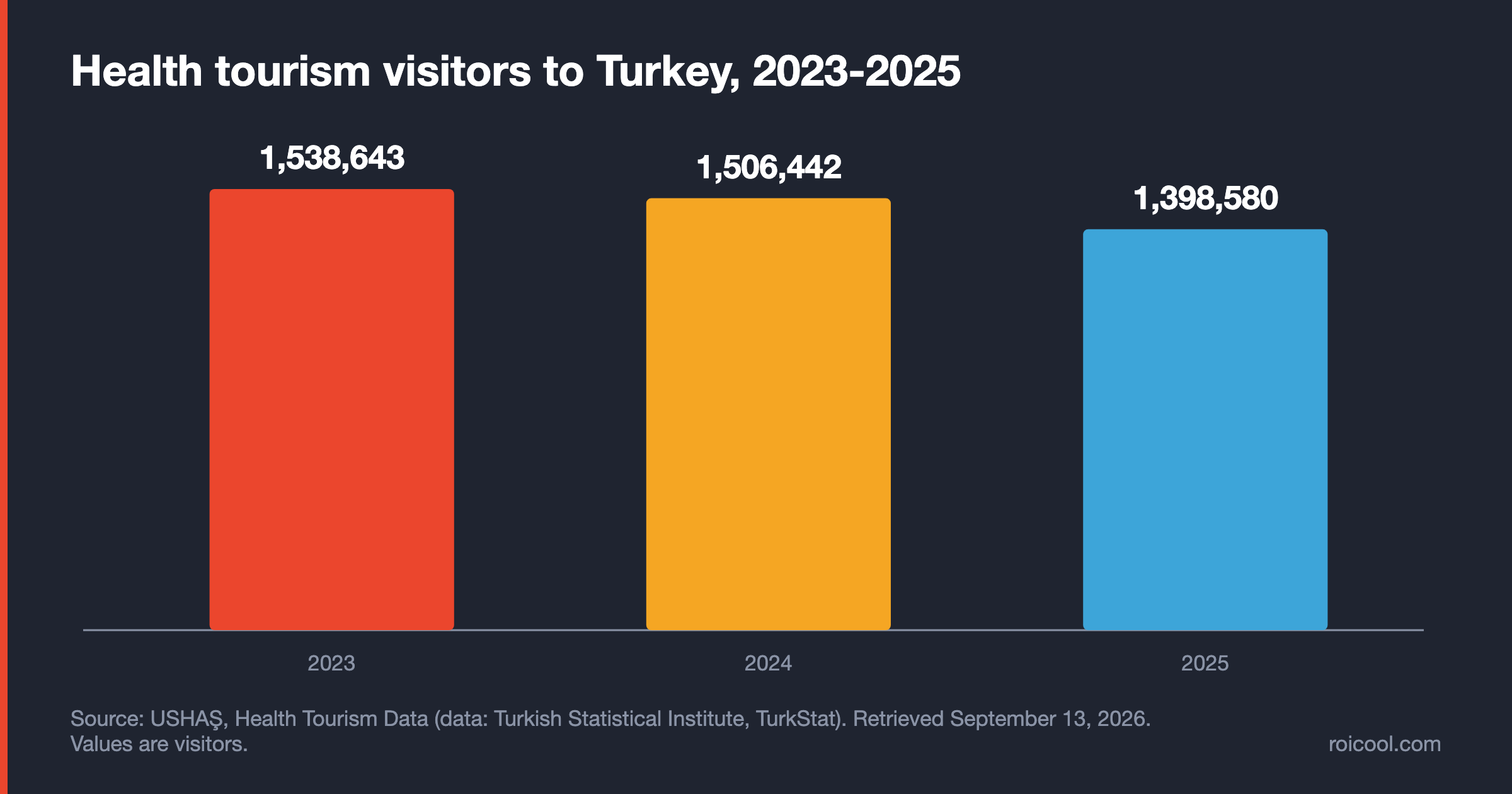
In USHAŞ's figures, revenue barely moved over the same three years: USD 3,006,092 thousand in 2023, USD 3,022,957 thousand in 2024 and USD 3,022,452 thousand in 20251. The source gives no reason for the drop in visitors, and this article does not supply one. Visitor counts have not risen since 2023. Whatever the sector trend, a clinic's plan should rest on its own inquiry data rather than on sector headlines.
How international patients research a clinic abroad
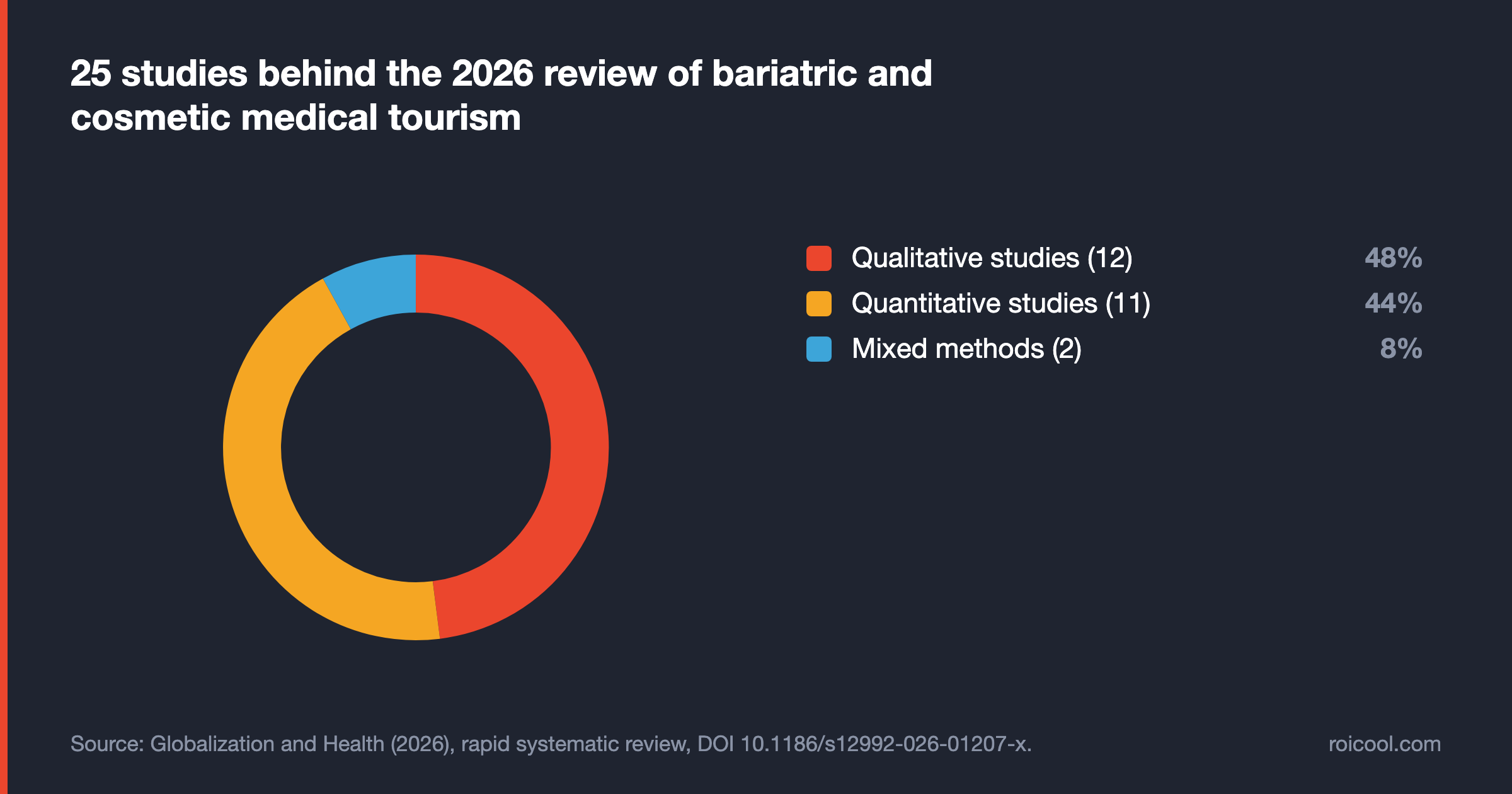
Measured evidence on how medical tourists search is thin. The one recent systematic review we found, published in Globalization and Health in 2026, covers bariatric and cosmetic medical tourists only. Its 25 studies were 12 qualitative, 11 quantitative and two mixed-methods13. It found that bariatric and cosmetic medical tourists rely heavily on anecdotal information, especially from online communities13, and its quantitative data on them indicated cost as the primary motivator13.
For bariatric and cosmetic medical tourism, the same review identified quantitative research gaps, particularly around information-seeking behavior13. The studies covered patients from countries with universal healthcare, and the review says nothing specific about hair transplant or dental patients, so it should not be stretched to cover them. That gap is why round figures such as "most patients start their search on Google" should be read with caution: we found no peer-reviewed study that supports them.
An older qualitative study of Canadian medical tourists, published in 2012, is useful as historical context. Its participants relied on patient testimonials and word of mouth from former medical tourists more readily than on the advice of their family physicians14. Neutral third-party information was limited, so they also relied on medical tourism facilitators and industry websites14.
What Turkish law requires on a health tourism website
Article 13(2) of Turkey's 2025 health tourism regulation sets three website duties for authorized health facilities and intermediary organizations. The text, formally the Regulation on International Health Tourism and Tourist Health, was published in Official Gazette no. 32882 on April 26, 20252. Both must run a website with a foreign-language option and keep the names and titles on it consistent with their authorization certificate; facilities must also publish their accreditation or certificate on the site2.
We found no official English translation of Article 13. The English wording in this section is our unofficial translation of the Turkish text. It is not legal advice: before changing a live site, check the consolidated text on mevzuat.gov.tr, which marks provisions whose enforcement a court has stayed15.
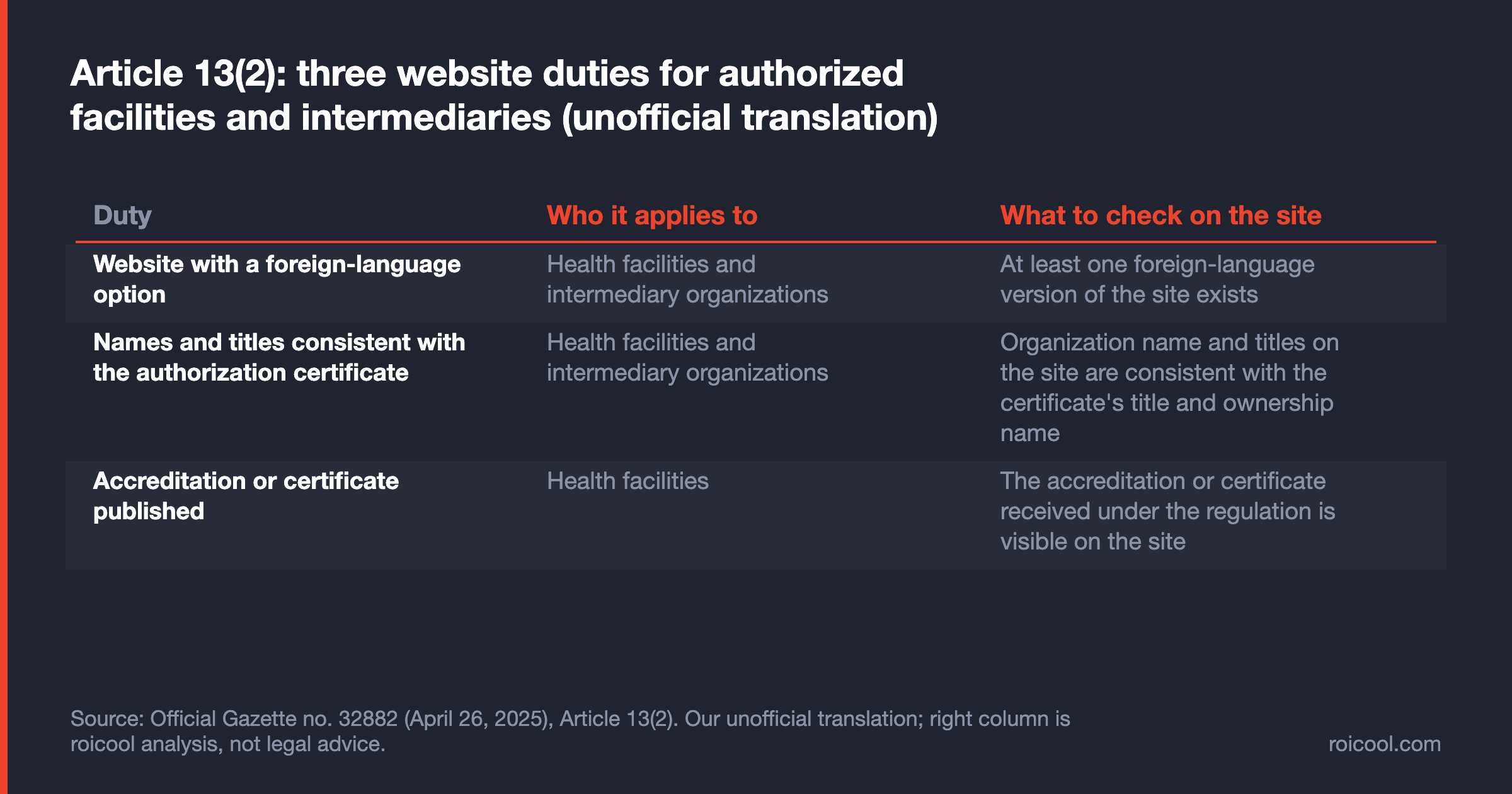
| Duty | Who it applies to | What to check on the site |
|---|---|---|
| Website with a foreign-language option | Health facilities and intermediary organizations | At least one foreign-language version of the site exists |
| Names and titles consistent with the authorization certificate | Health facilities and intermediary organizations | Organization name and titles on the site are consistent with the certificate's title and ownership name |
| Accreditation or certificate published | Health facilities | The accreditation or certificate received under the regulation is visible on the site |
A website with a foreign-language option
In our unofficial translation, the first duty reads: creating a website with a foreign-language option is mandatory for health facilities and intermediary organizations2. The sentence sets no number of languages and names no specific language. Which languages to add is a business decision; how those versions are built is governed by Google's documentation, covered in the next section.
A site name consistent with the authorization certificate
In our unofficial translation: the organization name and titles on the website must be consistent with the title and ownership name on the authorization certificate of the facility or intermediary2. The certificate's English name is the International Health Tourism Authorization Certificate, which all facilities and intermediaries offering international medical tourism services must receive3.
Keep this rule apart from Google's. Article 13(2) governs the names and titles on the website. A Google Business Profile name follows Google's own guidelines: their business name examples flag irrelevant legal terms (e.g. LLC, LTD, INC), and legal terms can only be part of the name with real-world proof such as signage, business cards or invoices11. Google adds that unnecessary information in a business name could result in suspension of the profile11. The certificate title is not automatically the right profile name.
The accreditation or certificate, published on the site
In our unofficial translation: a health facility must publish on its website the accreditation document or certificate it received under this regulation2. Which of the two applies depends on the facility type.
Article 6(1)(b) requires hospitals, medical centers, medical laboratories and dialysis centers to be accredited by TÜSKA, and all other health facilities to obtain the certificate issued by the Ministry2. The regulation defines TÜSKA as Turkey's Health Care Quality and Accreditation Institute, our translation of its Turkish name2.
The 2025 text repealed the earlier regulation published in Official Gazette no. 30123 on July 13, 20172, so guides that still cite the 2017 regulation are out of date. Facilities and intermediaries authorized before the new regulation took effect had six months from its entry into force to comply, and the authorization certificates of those that did not comply are canceled2. Transitional Article 1(3) separately gives health facilities until December 31, 2026 to meet the Article 6(1)(b) accreditation or certificate requirement2.
The 2025 promotion regulation: rules that reach search results and URLs
Article 13(1) of the health tourism regulation applies the Regulation on Promotion and Information Activities in Health Services published in Official Gazette no. 32263 on July 29, 20232. That 2023 text is no longer in force. A new regulation of the same name, published in Official Gazette no. 33075 on November 12, 2025 and in force from publication, repealed it, and references to the repealed regulation now count as references to the new one16.
Article 8 of the 2025 promotion regulation deals with international health tourism, and Article 8(4) applies the regulation's other relevant provisions, on matters outside Article 8, to health facilities and intermediaries offering international health tourism services16. One of those provisions is Article 5(1)(i). In our unofficial translation, its second sentence says that keywords used in search engines and the information on the results page may not conflict with the regulation's principles16. In our reading, that reaches page titles and meta descriptions.
Article 5(1)(ı) of the promotion regulation, in our unofficial translation, requires websites to state clearly the last update date of their information and contact details for reaching the site editor16.
Article 8(1) also reaches site names and URLs. Under Article 8(1)(f), in our unofficial translation, the facility name and title on the website of a health facility offering international health tourism services, and the site's URL, must be consistent with the title and ownership name on the facility's Ministry license16. Under Article 8(1)(h), an intermediary's website URLs must carry its trade name, business name or an abbreviation of them16.
Under Article 8(1)(ı), in our unofficial translation, a health facility or intermediary offering international health tourism services that wants to use its trademark registration in its URL must notify the Ministry of the registration documents16. In our reading, Articles 8(1)(f), 8(1)(h) and 8(1)(ı) make the domain a legal decision for facilities and intermediaries alike, not only a keyword choice.
Article 8(1)(b), in our unofficial translation, requires the health tourism authorization certificate to be published on the website or social media platform of the health facility or intermediary offering international health tourism services16. These are the provisions of the two regulations most relevant to a website and to search; they are not a complete list.
How Google handles language versions of a clinic site
Give each language its own page, tell Google which pages are versions of each other, and keep one language per page. Google's documentation says that telling it about the language or regional versions of a page helps Google Search point users to the most appropriate version4.
Language itself is read from the page, not from the markup. Google doesn't use hreflang or the HTML lang attribute to detect the language of a page; it uses algorithms instead4. Its multilingual guide adds that Google uses the visible content of a page to determine its language, not lang attributes or the URL5. A page with an English menu wrapped around German treatment text therefore sends a mixed signal.
The fix is editorial as much as technical. Google says you can help it determine the language correctly by using a single language for content and navigation on each page, and by avoiding side-by-side translations5.
hreflang: every version lists itself and all others
hreflang is reciprocal. Each language version must list itself as well as all other language versions4. If the German treatment page lists the English one but the English page does not list the German one, the set breaks that rule. When a clinic adds a language, every existing version needs an update, not only the new page.
These rules describe Google. If a target market relies mainly on another engine, check that engine's own documentation; our overview of search engines beyond Google is a starting point.
Machine translation and the scaled content abuse policy
Google's spam policies define scaled content abuse as many pages generated for the primary purpose of manipulating search rankings and not helping users8. One of the listed examples is scraping content to generate many pages, including through automated transformations such as translating, where little value is provided8.
Read closely, the policy is aimed at low-value pages at scale, not at translation as a tool. A clinic that pushes its whole site through a translation tool and publishes every language version unreviewed is much closer to that example than a clinic that uses machine output as a first draft and has a medical translator check it.
Trust on health pages: what E-E-A-T is and is not
E-E-A-T is not a dial a clinic can turn. In Google's own words, "E-E-A-T itself isn't a specific ranking factor"6. Google's systems do give even more weight to content that aligns with strong E-E-A-T on topics that could significantly impact people's health6, and of the E-E-A-T aspects, trust is the most important6.
Google's Search Quality Rater Guidelines explain why health is singled out: some topics have a high risk of harm because content about them could significantly impact the health, financial stability or safety of people7. Treatment information for patients abroad falls under that description.
On a clinic site, trust takes concrete forms. The list below is roicool's working checklist, not a set of signals Google names:
- Named doctor profiles with qualifications and professional registration details.
- The accreditation or certificate the facility received under the 2025 regulation, published on the site as the law requires.
- Organization names and titles on the site kept consistent with the authorization certificate.
- The physical address and contact details of the clinic in Turkey.
- Treatment pages that explain procedures and risks and name the doctor who reviewed them.
One boundary applies to every item: no treatment outcomes, no success rates and no price promises. At least one marketing guide advises clinics to publish success rates; this article does not. Clinic marketing is not medicine, and a number a clinic cannot document becomes a liability rather than a trust signal.
Reviews and structured data after Google's 2026 changes
Two points matter most for clinics. Google no longer shows the FAQ rich result in Search; the feature stopped appearing on May 7, 20269. And review markup a clinic adds for its own reviews runs into Google's self-serving reviews limit10.
FAQ rich results are gone
Even before the removal, Google's documentation stated that the FAQ rich result was only shown for well-known, authoritative government and health websites9. FAQ markup added to win that result now has nothing to win. An FAQ section can still answer patients' questions on the page; only the search feature has gone.
The table below summarizes Google's documentation on the points this guide covers, as retrieved in September 2026.
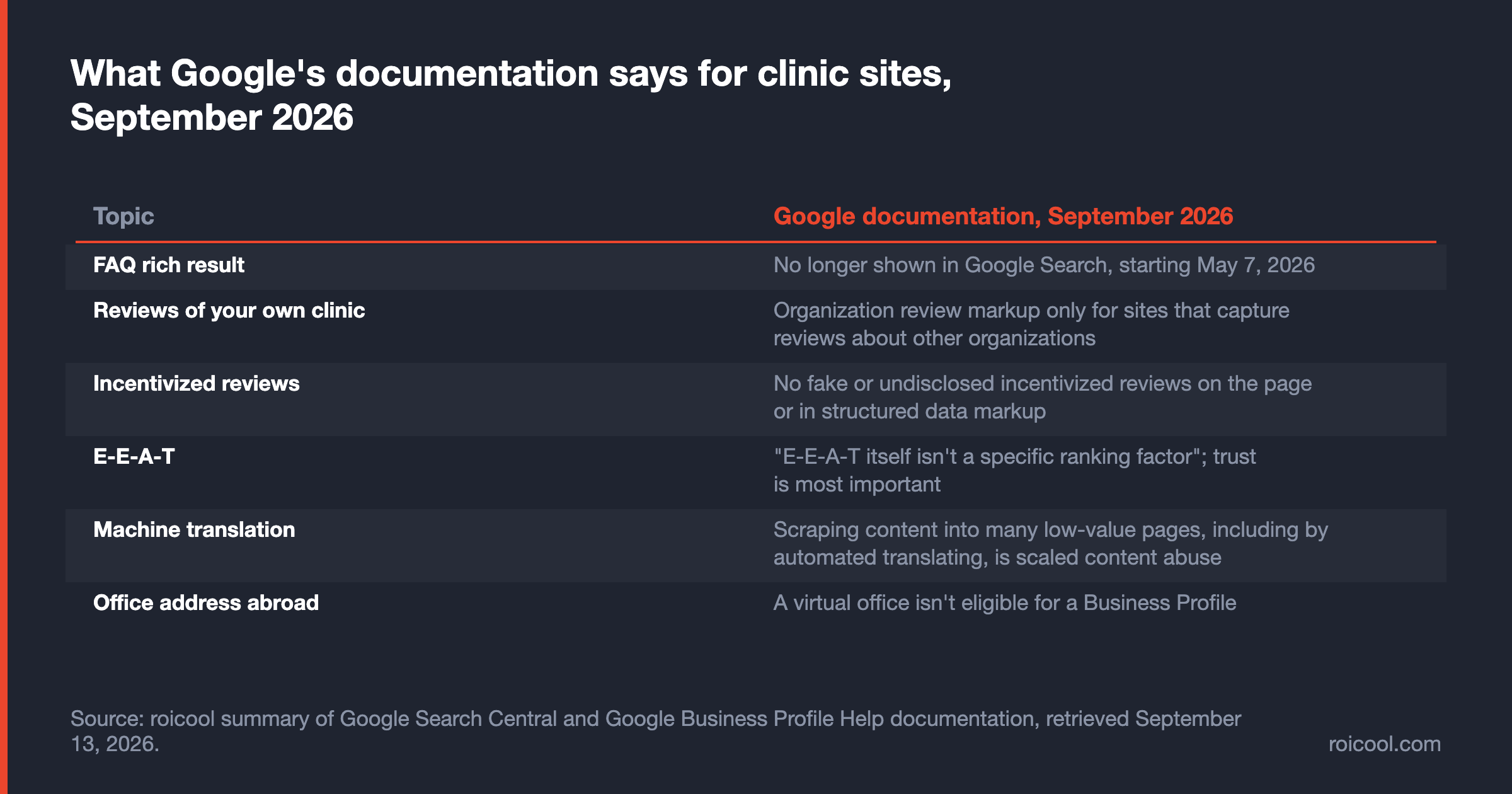
| Topic | Google documentation, September 2026 |
|---|---|
| FAQ rich result | No longer shown in Google Search, starting May 7, 2026 |
| Reviews of your own clinic | Organization review markup only for sites that capture reviews about other organizations |
| Incentivized reviews | No fake or undisclosed incentivized reviews on the page or in structured data markup |
| E-E-A-T | "E-E-A-T itself isn't a specific ranking factor"; trust is most important |
| Machine translation | Scraping content into many low-value pages, including by automated translating, is scaled content abuse |
| Office address abroad | A virtual office isn't eligible for a Business Profile |
Review markup: what a clinic can and cannot mark up
Google's review snippet documentation lists Organization as a supported type only for sites that capture reviews about other organizations, and it refers to the guidelines about self-serving reviews10. A clinic marking up praise for itself on its own website is the situation that limit describes.
In July 2026 Google added a new guideline on fake and undisclosed incentivized reviews to the same documentation9. The rule is direct: don't include fake or undisclosed incentivized reviews on your page or in your structured data markup10. It covers what a clinic publishes on its own pages and in its own markup.
Turkish law adds its own conditions. In our unofficial translation, Article 5(1)(e) of the 2025 promotion regulation bars posts of an advertising nature built on patients' or their relatives' expressions of thanks or satisfaction with a health service, in media such as the press, social media platforms and websites16.
Article 8(1)(ç) sets the rule for international health tourism. In our unofficial translation, a health facility offering international health tourism services may include treated patients' stories, patient reviews or expressions of thanks on its website or social media platform created for audiences abroad, provided it respects patient privacy, general morality and patient rights and documents that the patient's explicit consent was obtained16.
What Google Business Profile does for patients abroad
A Business Profile stands for a real place the business operates from. As of September 2026, Google's guidelines say that if a business rents a physical mailing address but doesn't operate out of that location, also known as a virtual office, that location isn't eligible for a Business Profile11. A rented representative office abroad that the clinic does not work from fits that description.
Local results are mainly based on relevance, distance and popularity12. Distance suggests the local pack does little for a searcher in another country; that is our reading, not a statement from Google. Google also states that there's no way to request or pay for a better local ranking12.
Inside Turkey the profile still earns its place. Individual practitioners and departments within hospitals may have separate pages11, which suits a hospital with named specialists. The name should reflect the business's real-world name as used consistently on its storefront, website and stationery11. That field follows Google's naming rules, including the limit on legal terms without real-world proof11. Setup steps are covered in the Google Maps SEO guide.
What SEO cannot do for a clinic
SEO cannot buy rankings, cannot promise a timeline or a number of patients, and cannot replace the legal and trust basics described above. Paying for placement is not an option in local results either12.
We found no published, sourced timeline for medical tourism SEO, and no sourced comparison of organic and paid conversion either. The one review we found on bariatric and cosmetic medical tourists lists information-seeking behavior as a quantitative research gap13. Anyone quoting a fixed number of months is offering an estimate, not evidence.
Judging progress without invented benchmarks
Measure each language version against its own starting point: visibility and clicks per language folder, inquiries by language and target market, and how many of those inquiries become consultations. This is roicool's method, not a sourced benchmark. It swaps borrowed sector figures for numbers the clinic already owns. Paid search is a separate channel with its own rules and its own measurement.