Can You Buy ChatGPT Ads in Turkey? What Is Available to a Non-US Advertiser Today
Yes. ChatGPT Ads in Turkey can be bought through self-service: on 26 September 2026 OpenAI's Ads Manager availability table listed Turkey as Available1. The condition is about the company, not the person — to use self-service Ads Manager, the legal entity that will advertise and be billed must be based in a country listed as available1.
OpenAI repeats the point in its setup guidance for the in-ChatGPT flow: the country attached to your ChatGPT login does not override it, and creating an advertiser account grants no access while the country remains unavailable6. Everything below is what changes when that entity sits outside the US.
ChatGPT Ads, defined in two sentences
Ads can appear below the end of a response, are clearly labeled as sponsored and are visually separated from ChatGPT's response4. They may appear for users on the Free and Go plans, while Plus, Pro, Business, Enterprise and Edu accounts will not have ads4. Ads do not influence ChatGPT's answers: they run on separate systems from the chat model, and advertisers have no ability to shape, rank or alter responses4.
Two different questions hide behind “ChatGPT ads Turkey”
“Am I seeing ads in Turkey?” and “can I buy ads from Turkey?” are different questions. The first is about delivery to users: ad testing started in the United States on February 9, 2026, and OpenAI says it is gradually rolling out ads to eligible Free and Go users in select regions4.
The second is about eligibility to buy, which the availability page ties to the country of the legal entity that will advertise and be billed1. No primary source gives a date on which ads began appearing to users in Turkey, so this article gives none.
Who sees the ads, and what one ad unit contains
Each ad includes the advertiser name, a favicon, the title, the copy, a landing page and an image asset5. One unit below an answer may feature one or more items from an advertiser, or multiple advertisers4. On the Free plan a user can switch to an Ads-Free experience, which removes ads but comes with lower usage limits and reduced feature access4. During this test, ads do not appear in the ChatGPT Atlas browser4.
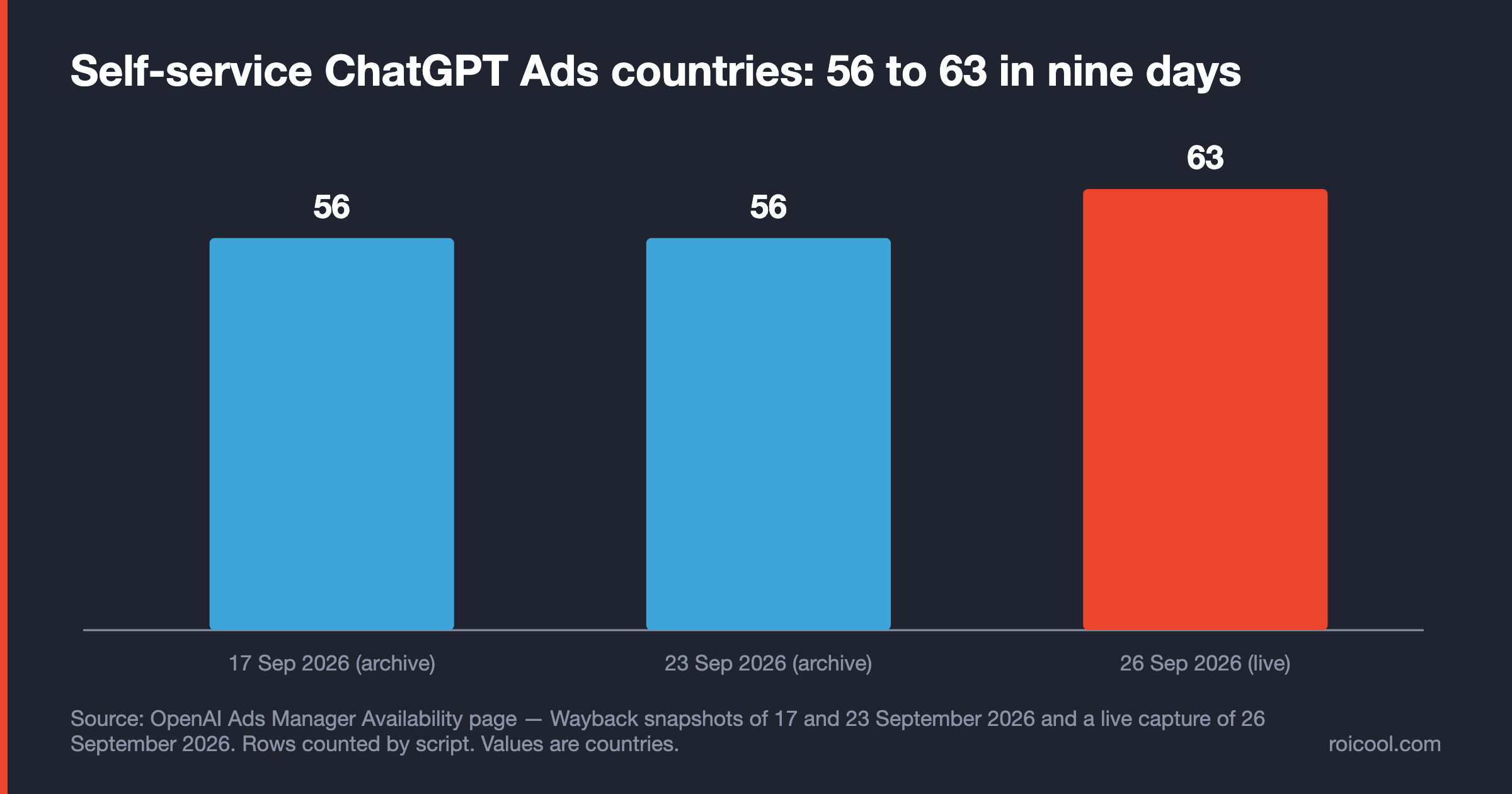
The Country List Went From 56 to 63 in Nine Days: Date Every ChatGPT Ads Fact
Date every ChatGPT Ads fact you publish, because the country list moves in days rather than quarters. An archived copy of OpenAI's availability page taken on 17 September 2026 at 13:09 UTC listed 56 countries as Available2. A second archived copy from 23 September 2026 at 22:45 UTC still listed 563. The live table on 26 September 2026 at 10:40 UTC listed 631.
Why the announcement date is not the table date
OpenAI's announcement page is dated 23 September 20268. It says ChatGPT Ads would begin rolling out across Indonesia, Malaysia, the Philippines, Singapore, Thailand, Vietnam and Taiwan8, and that ads were now available in over 60 countries8.
The self-service table did not agree that day. At 22:45 UTC on 23 September 2026 it still did not include the seven markets named in the announcement3. An announcement date is not a table date. The exact moment the rows appeared sits between 23 September 22:45 UTC and 26 September 10:40 UTC, and we do not know the day.
Turkey's own row deserves the same honesty. It was already there in the 17 September 2026 archived copy2, but no primary source records the day it was added, so this article does not name one. A country count or launch date copied from a blog post is a snapshot of someone else's Tuesday.
The three-minute check before you put ChatGPT Ads in a media plan
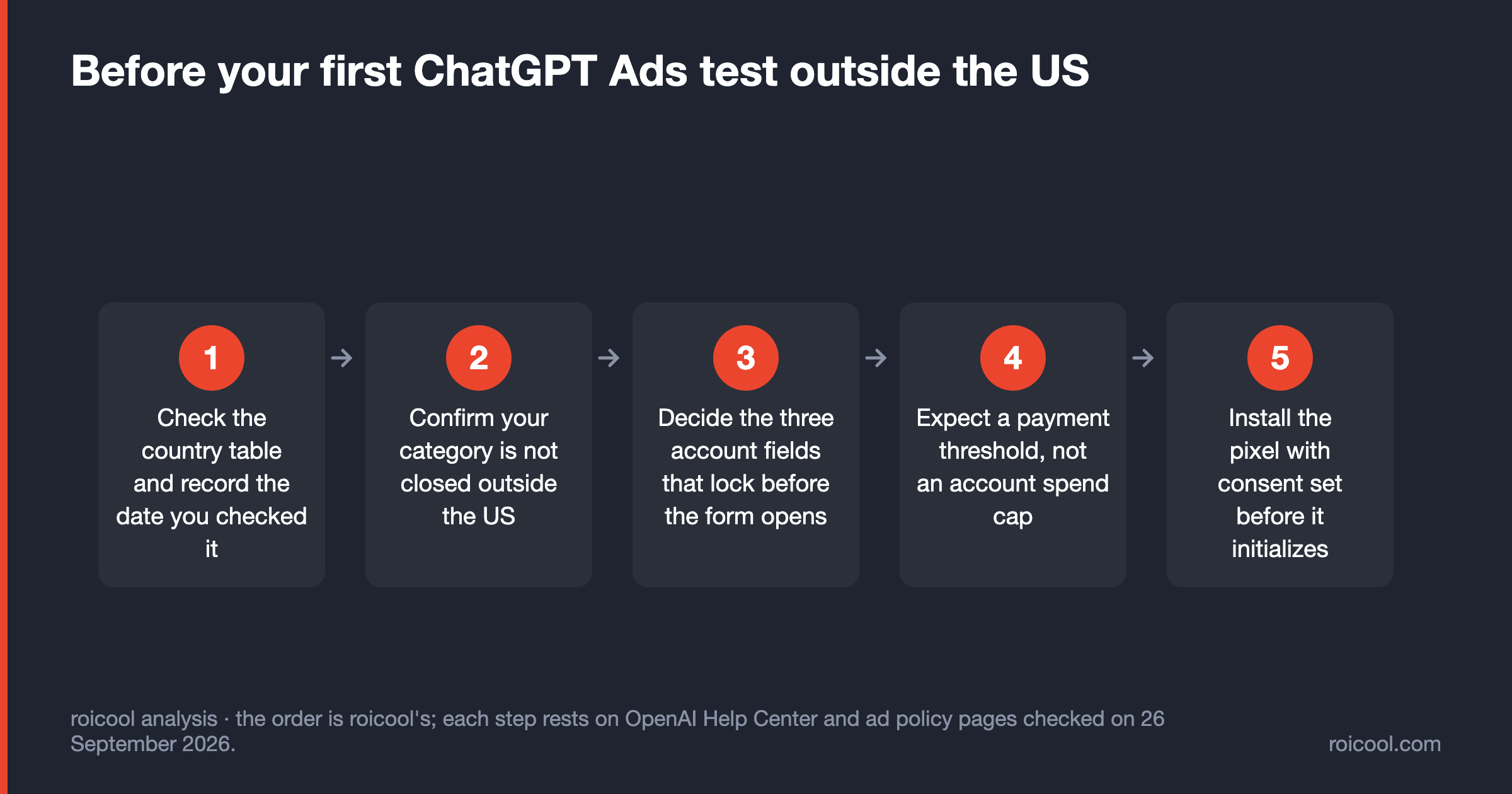
- Check the country table and record the date you checked it.
- Record the status against the date on the table, not against the date of an announcement.
- Put the screenshot and the check date into the media plan, so the next reader knows when the claim was true.
The rest of the surface moves at the same pace. Search Engine Journal's report of 12 August 202623 put it plainly: ad eligibility has changed four times since March, so campaign plans can go stale23. That count is itself dated — OpenAI's advertising policy changelog has added a September 2026 entry since then. OpenAI itself expects changes to delivery systems, inventory, ad formats, and how advertisers buy, manage, measure, and optimize campaigns during the beta18.
Three Account Fields You Cannot Undo — and Two Campaign Choices You Cannot Take Back
Setup is a decision meeting, not data entry. Decide the three account fields that lock before the form opens: the country or region, billing currency and time zone selected when an advertiser account is created cannot be changed later6. Nothing in the product undoes those three.
Two more choices are fixed, but one level down. When you create a campaign you choose one of the budget types7; after that the budget amount can be changed but the budget type cannot7 — and even then the budget is not a dial, because actual spend may vary based on delivery, user engagement, and the pricing model selected7.
OpenAI's campaign FAQ is looser than its billing page on the same rule: it says you can adjust supported budget amounts over time, but some budget type changes are not reversible — move a campaign-total budget to a daily budget and you cannot change that campaign back12. Two pages, two strengths of one rule; plan against the stricter one.
A campaign objective behaves the same way: it cannot be edited into a different objective, so a different objective means a new campaign12. Hold on to the difference. The three account fields are permanent; the two campaign choices are only fixed for that campaign, and the price of changing your mind is a rebuild rather than a new account.
OpenAI's reason is printed on the page: some account-level fields may not be self-serve editable after account creation, so use the details for the entity that will advertise and be billed6. Account setup happens in five steps — create the account, complete onboarding and verification, complete account information, set up billing and payment, invite team members6. Verification asks extra questions through Persona6, and because applications are reviewed in a rolling queue, account verification may take some time6. Ads will not serve until the account information step is complete6.
The home-country lock: a new account may only advertise where it is registered
Some new self-serve ad accounts can initially advertise only in their home country — the country associated with the ad account — and selecting other countries does not override this restriction12. The lock lifts after identity verification is approved and after a required level of spend in the home country; OpenAI does not publish that amount, so no figure is given here.
If a country is marked Coming Soon or is not listed, self-service access is not available there yet1, and advertisers in the new European markets can currently get started through the OpenAI Ads Solutions team, agency partners, or technology partners1. Turkey does not need that route while its row reads Available.
If you are an agency: your client opens the account, then invites you
In the ChatGPT flow, individual advertiser onboarding and agencies creating advertiser accounts on a client's behalf are not supported; an agency can be invited after its client creates an advertiser account6. Read the scope of that sentence: it covers the in-ChatGPT Ads Manager flow, and OpenAI has published no equivalent rule for the general web flow, so no general claim belongs here. A separate limit applies to everyone: once you belong to 10 or more ad accounts, you cannot create another account yourself6.
These are the choices worth an argument before the form is opened, which is the part our performance marketing team is usually brought in for.
When the Money Actually Leaves: Payment Thresholds, Card Holds and a Tax Table We Will Not Give You
ChatGPT Ads currently uses a postpay billing model that charges advertisers after ads have been delivered7. On a self-serve card account the card is charged when the account reaches its assigned payment threshold, and you cannot manually change your payment threshold; OpenAI's support team will not change thresholds on behalf of advertisers either7. Expect a payment threshold, not an account spend cap.
A payment threshold is not a budget and not a spend cap
OpenAI writes it plainly: this is not the same as a campaign budget and is not an account spend cap7. If your account still has an outstanding balance at the end of the month, that balance is charged at the end of the month even if you have not yet reached your payment threshold7.
And when a card is first added, a bank may show a temporary authorization hold. It is not a completed charge and is released after verification, though it may remain visible for 8 days or longer depending on your bank7.
There is no account-level daily cap on a self-serve card account
The account-level daily spending limit is offered to eligible postpaid invoiced accounts; that option is not available for self-serve card-billed advertisers7. The brake therefore sits at campaign level, not at account level. Pausing is not instant either: ads may continue to appear for up to 24 hours, and advertising costs incurred during this period remain billable7. Spend insights may be delayed 7-8 hours, so a temporary zero spend value does not necessarily mean that no charges have accrued21.
Why this article gives you no Turkey tax table
Billing has to match the entity the account was created for: a card or payment method associated with a different country may not be accepted7. You can add or update supported VAT and tax IDs directly in Ads Manager, and available tax ID types depend on your billing country7.
The only country-specific tax statement OpenAI publishes is Japan's: it does not currently charge Japanese Consumption Tax (JCT) on ChatGPT Ads invoices for advertisers billed in Japan, regardless of whether a Japanese tax ID is provided7. There is no equivalent sentence for Turkey, and OpenAI writes that it cannot provide tax advice7. That is why no Turkish rate and no Turkish tax table appear anywhere in this article.
For the shape of the question, our piece on Google Ads costs in Turkey follows how a foreign advertising invoice is read here. OpenAI has not published whether those items apply to a ChatGPT Ads invoice in the same way; it is a different contracting party and a different invoice, so settle it with your own tax adviser.
Health, Finance and Legal Services: What Closes the Moment You Are Outside the US
Confirm your category is not closed outside the US before anyone writes a single ad. Ads for health services outside the US are generally prohibited11. Ads for financial services outside the US are generally prohibited11. Ads for legal services outside of the US are currently prohibited11. The qualifiers are OpenAI's own and they carry weight: “generally” and “currently” are not “never”, and neither of them is a permission.
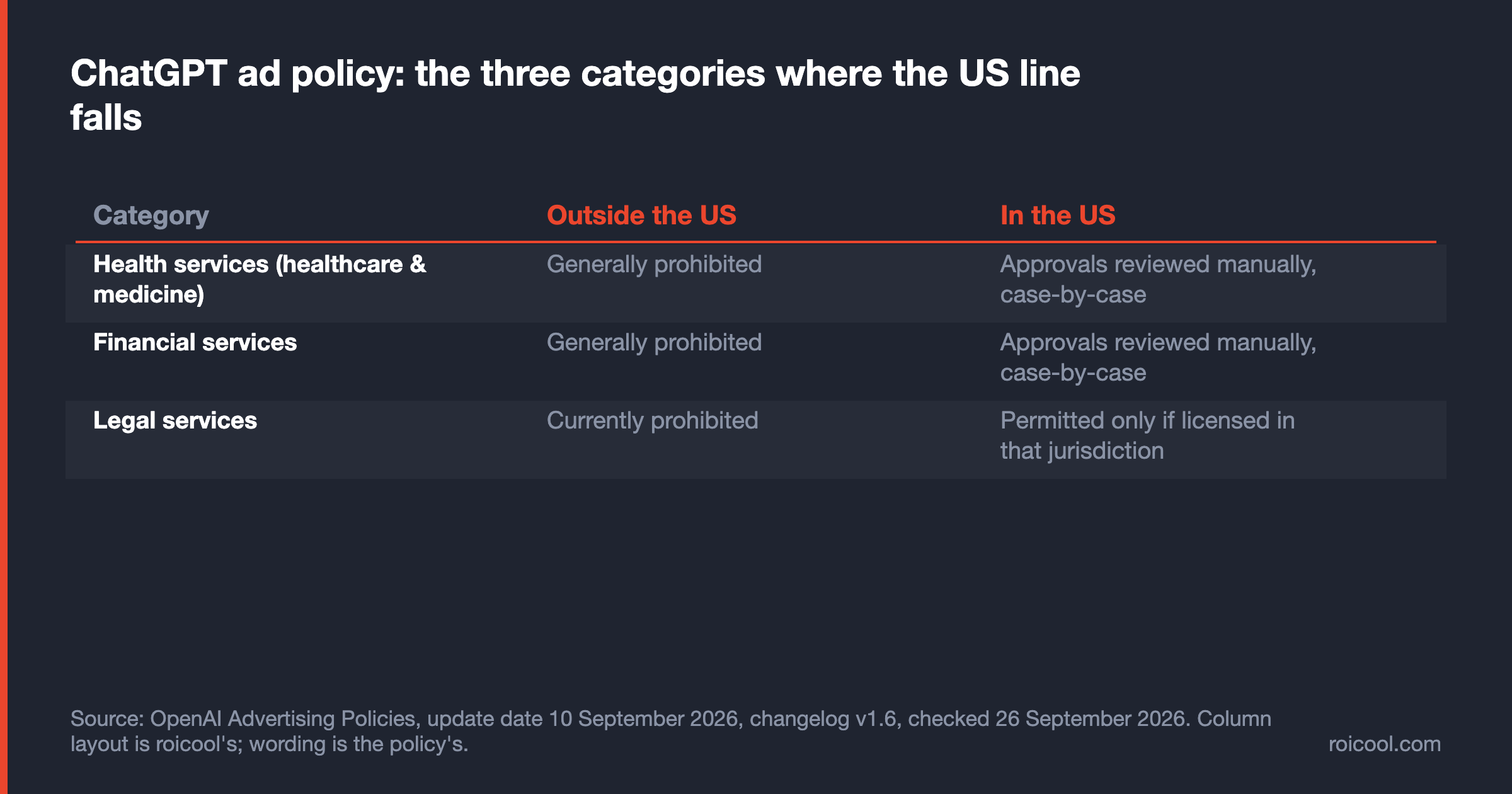
| Category | Outside the US | In the US |
|---|---|---|
| Health services (healthcare & medicine) | Generally prohibited | Approvals reviewed manually, case-by-case |
| Financial services | Generally prohibited | Approvals reviewed manually, case-by-case |
| Legal services | Currently prohibited | Permitted only if licensed in that jurisdiction |
| Individual job listings, housing rentals or sales | Prohibited | Prohibited |
| Placement near personal health, mental health or politics | Not eligible | Not eligible |
| Adult content, including dating apps | Disallowed | Disallowed |
Three rows of that full table carry the same value in both columns, because the policy draws no US line there: ads for individual job listings or housing rentals or sales are prohibited11; ads for adult content or services are currently disallowed, which includes dating apps11; and ads are not eligible to appear near sensitive or regulated topics, including personal health, mental health, or politics4.
What “generally prohibited” leaves open — and what it does not
The right-hand column is a real geography, and the policy writes it into each category. Ads for health services outside the US are generally prohibited, while in the US OpenAI may allow ads from approved advertisers on a case-by-case basis for categories it names — consumer medical devices, wearables and apps, dental services and dietary supplements among them11.
Finance has the same shape. Ads for financial products and services are restricted, and in the US OpenAI may allow ads from approved financial advertisers on a case-by-case basis for a named list that runs from auto loans and leasing through credit cards and deposit accounts to insurance11.
Legal is the third: ads for legal advice, representation, or legal services are permitted in the US only when the advertiser is licensed to practice law in the jurisdiction where the ad is shown11. Across the financial services, healthcare & medicine, and legal services categories, approvals are reviewed manually on a case-by-case basis11.
The changelog shows a direction. v1.1 (April 2026) recorded that medical, legal, and financial advice contexts are no longer categorically blocked from ads by default11, and v1.5 (August 2026) recorded that legal services are permitted in the US11. An OpenAI spokesperson told Marketing Brew the company is not widely including ads in financial, legal, or medical conversations, but that ChatGPT may show ads in limited circumstances in those verticals when they make contextual sense24. None of that promises approval for a clinic or a broker in Turkey.
Both surfaces keep moving, and the policy page moves more. On 26 September 2026 the page's own update stamp read 10 September 2026 and its latest changelog entry was v1.6 (September 2026), which clarified OpenAI's right to decline ads where they conflict with its advertising principles, business interests, or competitive position11.
The February announcement is not frozen either. Writing on 12 August 2026 about the July rework of the health and finance sections23, Search Engine Journal noted that OpenAI's February announcement has not been changed to match23, and that the company has updated that post three times, most recently on August 11 to include the UK, Mexico, Brazil, Japan, and South Korea in the pilot program23. Read the policy page for the rule and the announcement for the timeline, and date both.
In the initial test period ads are primarily limited to consumer verticals such as lifestyle and household goods, local services, travel and experiences, and digital products or education11.
Turkish advertising rules sit on top of OpenAI's, not instead of them
Platform policy is not the only layer. Turkey's Ticari Reklam ve Haksız Ticari Uygulamalar Yönetmeliği (Regulation on Commercial Advertising and Unfair Commercial Practices), published in the Resmî Gazete of 10/1/2015, no. 29232, opens Article 7(1) with a single line: advertisements must be accurate and honest26.
Article 22(1) prohibits surreptitious advertising in any communication medium, in audio, written or visual form26. The sponsored label satisfies the platform; the regulation is why you would not want it removed.
We found no official English translation of this regulation. The English wording of Articles 7(1) and 22(1) in this section is our unofficial translation of the Turkish text, and it is not legal advice.
OpenAI reserves the right to decline, restrict, or remove advertisers and to refuse to display ad content and website links for any reason, including where they conflict with its advertising principles, business interests, or competitive position11. Category eligibility is not a right.
What You Actually Buy: Context Hints, Objectives and a Minimum Set in Your Account Currency
The floor is set by your account's currency, not by a global number: the current minimum daily budget varies by your ad account's billing currency12. On 26 September 2026 the published Minimum Campaign Spend table listed 30 currencies12; the EUR row is 15 EUR and the GBP row is 15 GBP12.
Context hints are not keywords
Context hints help guide ad matching, but they are not exact-match keywords and do not guarantee delivery in specific conversations5. Platform targeting is a closed list of five: Android app, Android web, Desktop web, iOS app, or iOS web12. New product-feed campaigns support geographic targeting and exclusions only at country level12.
Custom audiences carry a floor. Inclusion targeting requires at least 25,000 matched users, while exclusions can use smaller audiences12; uploaded row counts do not equal matched-user counts, and inclusion and bid multipliers require at least 25,000 matched users while ready exclusion audiences have no minimum17. For campaigns targeting the EEA or Switzerland, OpenAI advises avoiding custom audiences while ads personalization is unavailable there12.
The $25 figure is a USD row — and there is no TRY row
The minimum daily campaign budget varies by market and currency, and the standard minimum for the US in USD is $2513. That is a USD row, not a global price. The table we read on 26 September 2026 has no TRY row — and a missing row does not prove TRY is not offered; the table only gives minimums for the currencies it lists. What a Turkey-registered account is billed in, and what its minimum comes out to, has to be read inside the account.
One primary sentence settles a rumor that travels well. For fixed-bid campaigns the daily budget cannot fall below the highest effective bid in the relevant ad groups, but this is not a universal $250 platform minimum13. No monthly floor of several thousand dollars appears in OpenAI's own documentation.
Budget week, the 2x day, and the objective you cannot edit
Your maximum daily spend is twice your daily budget13. The budget week runs from Sunday through Saturday in your ad account's timezone12, and if a campaign uses up its weekly allowance early, it may stop delivering until the next budget week even while marked active12. Change the daily budget mid-week and your seven-day spending limit is prorated from the time of the latest budget change through the next Sunday at midnight13.
Objectives are Views (CPM), Clicks (CPC) or Conversions12; on a conversion campaign you do not pay per conversion12. Selection runs through a relevance-weighted, second-price auction5, and Ads Manager may provide bid-strength guidance to indicate whether a bid is likely to be competitive or may limit delivery5. For CPC campaigns OpenAI recommends starting with a maximum bid of $3-$5 USD per click5 — a starting instruction, not a cost estimate, not a CPC expectation and not a benchmark.
What Comes Back: Pixel, Consent, Attribution Windows — and the Benchmark That Does Not Exist
Measurement starts with a data source: to measure conversions, create a data source in Ads Manager and send conversion events using the OpenAI Pixel, the Conversions API, or both15. Advanced matching data does not travel in the clear — encode each normalized value as UTF-8, compute its SHA-256 digest, and send the digest as a lowercase, 64-character hexadecimal string16.
Consent must be set before the pixel initializes
Install the pixel with consent set before it initializes. OpenAI's instruction is sequential: if consent is required to track conversion events, use the Pixel's consent feature and set consent before initializing the Pixel16. The order is the control; a flag written afterwards is not the same thing.
Reporting windows are a choice rather than a default. Ads Manager lets advertisers choose a 7-, 14-, or 30-day click-through reporting window and either 0 Day (disabled) or a 1-day view-through reporting window14. Changing the reporting window affects reporting only; it does not change campaign optimization, bidding, or billing14. Attribution uses OpenAI's existing last-touch attribution logic and is not multi-touch attribution14.
Then expect lag and disagreement. Attributed conversions can take 24-48 hours to be included in reporting14, and OpenAI Ads Manager, your analytics provider, and other ad platforms may report different conversion totals15. Static UTM parameters persist on ad clicks and can be used in existing analytics tools to understand traffic from ChatGPT Ads5.
Your landing page has to let OAI-AdsBot in
All landing pages must use valid links and must not block OpenAI user agents, OAI-AdsBot and OAI-SearchBot19. Link to the most relevant destination: use product pages, collections, or content pages rather than defaulting to a generic homepage19. And build for coverage, not just one message — a high volume and diverse set of ads, with multiple title and copy variations per offering19.
Then the part with no number in it. ChatGPT Ads is currently in beta and in the early stages of scaling18. As an early platform it does not yet have performance benchmarks across advertisers, industries, or campaign types18, and ongoing improvements to delivery systems and models can cause delivery and spend to fluctuate during the beta18. roicool has no ChatGPT Ads spend, so this article carries no CPC, no CTR and no conversion rate.
Paying for the Placement Does Not Put You in the Answer
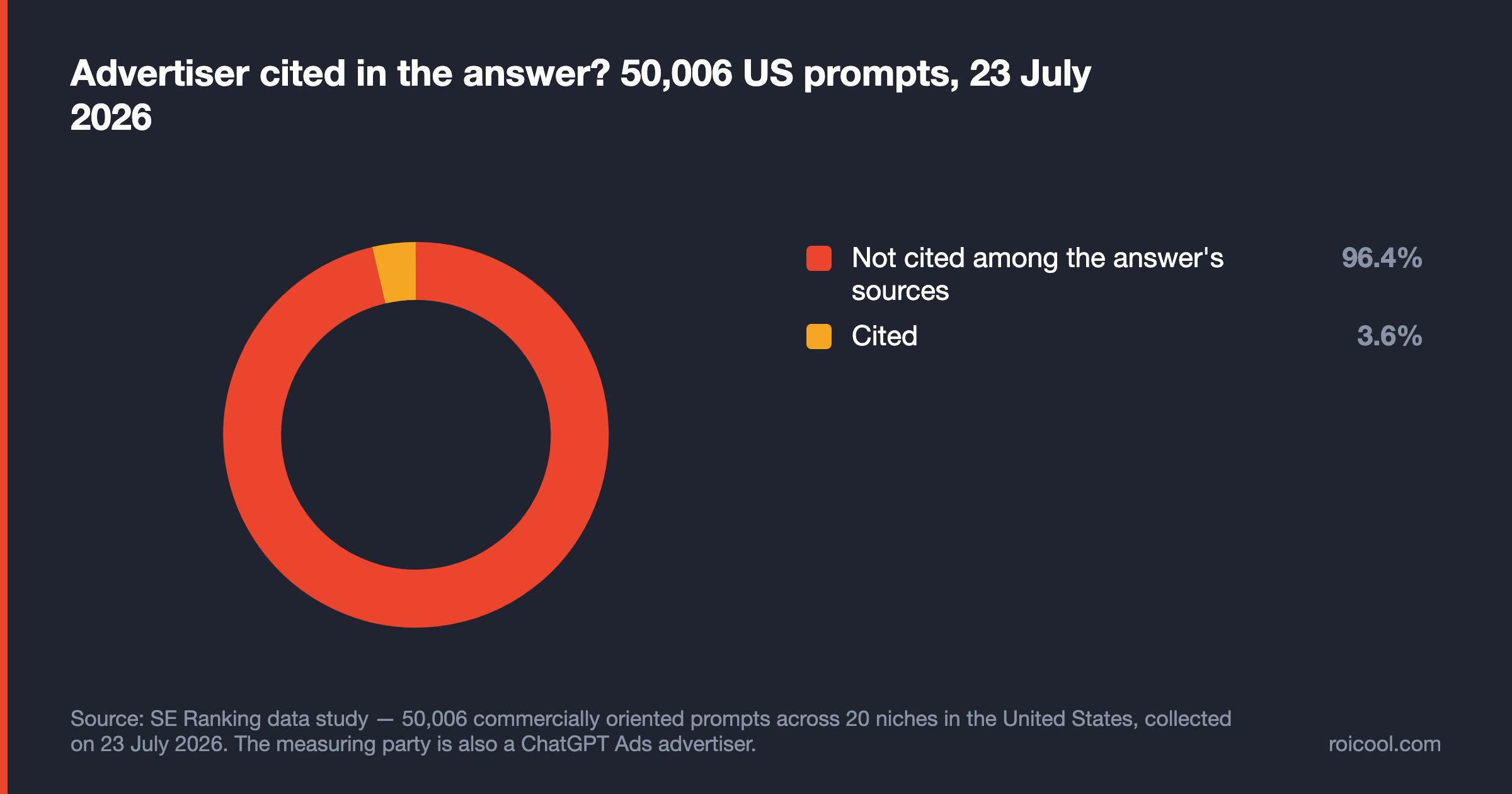
Buying the placement does not make you a source in the answer. SE Ranking analyzed 50,006 commercially oriented prompts across 20 niches in the United States, with data collected on 23 July 202622. In 96.37% of placements, the advertiser is not cited among the answer's sources22; the complement is that the advertiser was cited in 3.63% of them, in that same US-only measurement22.
That is not a malfunction; it is the measured result of the design this article opened with — ads run on separate systems from the chat model and advertisers cannot shape, rank or alter responses4. In the same US-only study ChatGPT showed ads on 25.94% of commercial prompts, close to AI Mode's 29.45%22, and that measurement also found that ChatGPT currently offers just one ad slot per answer, with no other placements available22.
Relevance and brand safety: about one impression in seven was off-topic
Across all ad impressions in that US-only dataset, 14.35% were no more closely related to their own query than an ad paired with a random query from the dataset22. The same US-only run identified 1,159 unique advertisers running ads in ChatGPT22. Within the same 50,006 prompts measured in the United States, one comparison site, BestMoney, accounts for at least 13.56% of all ChatGPT ads22, a concentration eMarketer also reported from SE Ranking's dataset at over 13%25 — inventory in few hands.
SE Ranking, the vendor behind that US-only study, also published its own campaign result: more than 97,000 impressions and 1,263 clicks, but very few sign-ups22. That is one advertiser's first-party outcome, not a benchmark.
Privacy closes the other half of the question. Advertisers never receive your chats, chat history, memories, name, email, precise location, IP address, or sensitive information4, and they only receive aggregated, non-identifying information about how their ads perform, such as total views or clicks4. Organic visibility in AI answers is a different job with a different method; our AEO case study for AI visibility covers that side, and this article does not.
What Landed on 16 September 2026 — and What Is Still US-Only
OpenAI's 16 September 2026 announcement, “Reimagining advertising with AI”, is where the most-discussed piece turns out to be unavailable outside the US. Sponsored Agents are now being tested with select advertisers in the United States9; the help center calls them available only to selected advertisers in a limited alpha test20 and says OpenAI is not accepting early access requests at this time20. A conversation with a Sponsored Agent is distinct from ChatGPT's independent answers and separate from the original conversation that the user started in ChatGPT9.
For a non-US advertiser, that is not inventory you can plan against. What is usable now came in the same post. Advertisers can use simple, natural-language prompts to create, update, and analyze campaigns directly in ChatGPT with the Ads Manager plugin9. When drafting an ad, advertisers can now receive suggested copy and imagery based on their landing page and campaign objective9.
OpenAI is also launching the ability to opt into AI-powered text customization9. If enabled, it adapts an advertiser's existing headlines and descriptions to better fit the context of a conversation and automatically translates ad copy to a user's preferred language9.
For an advertiser outside the US it is opt-in rather than default, and it is the advertising platform's own creative tooling — a narrower thing than artificial intelligence in advertising as a whole.
New integrations with HubSpot, its first CRM partner, and Shopify, its first ecommerce partner, bring ChatGPT Ads into the tools businesses already use9.
On the day of the announcement the Shopify app was open to US-based merchants9, and OpenAI wrote that the app will be available internationally in markets where ChatGPT Ads are available starting September 239.
That is a rule rather than a country list, and the announcement does not say which list it reads from — the self-service advertiser table, or the markets where ads are shown to users. Those are the two different questions this article opened with, so no bridge is built here: confirm the app in your own Shopify admin.
Read the help center alongside the announcement, because it describes a narrower tool under its own heading. Under Suggested ad drafts, the “Create Ads” article says that feature uses existing website metadata to prefill an ad draft with an image, title, and description for you to review, edit, and assign to a campaign and ad group19, and that it does not generate new copy or imagery with AI19.
Whether that is the same thing as the announcement's suggested copy and imagery is not stated on either page, so check what your own Ads Manager offers.
Scale, as context and not as a promise, and from a different post: OpenAI's announcement of 31 August 202610 reported that in less than 200 days after launch, ChatGPT Ads has reached $1 billion in annualized revenue run rate and the platform is now used by tens of thousands of advertisers10. OpenAI writes that over the next few months it will continue to expand into new markets, build new formats, optimization tools, and measurement solutions8. That is their sentence, not our forecast.
Before any of it reaches a media plan, do the five things this article has been arguing for: open the country table and write down the date you opened it, check your category against the policy, decide the fields that lock, plan for a payment threshold instead of an account cap, and set pixel consent before the pixel loads.