



Industrial marketing agency: B2B digital marketing for manufacturers and exporters
Procurement and engineering teams research suppliers in search, in directories and in AI answers. We plan which market to enter, in which language and through which channel, and we measure your quote requests all the way to the order.
 ManufacturersRoicool
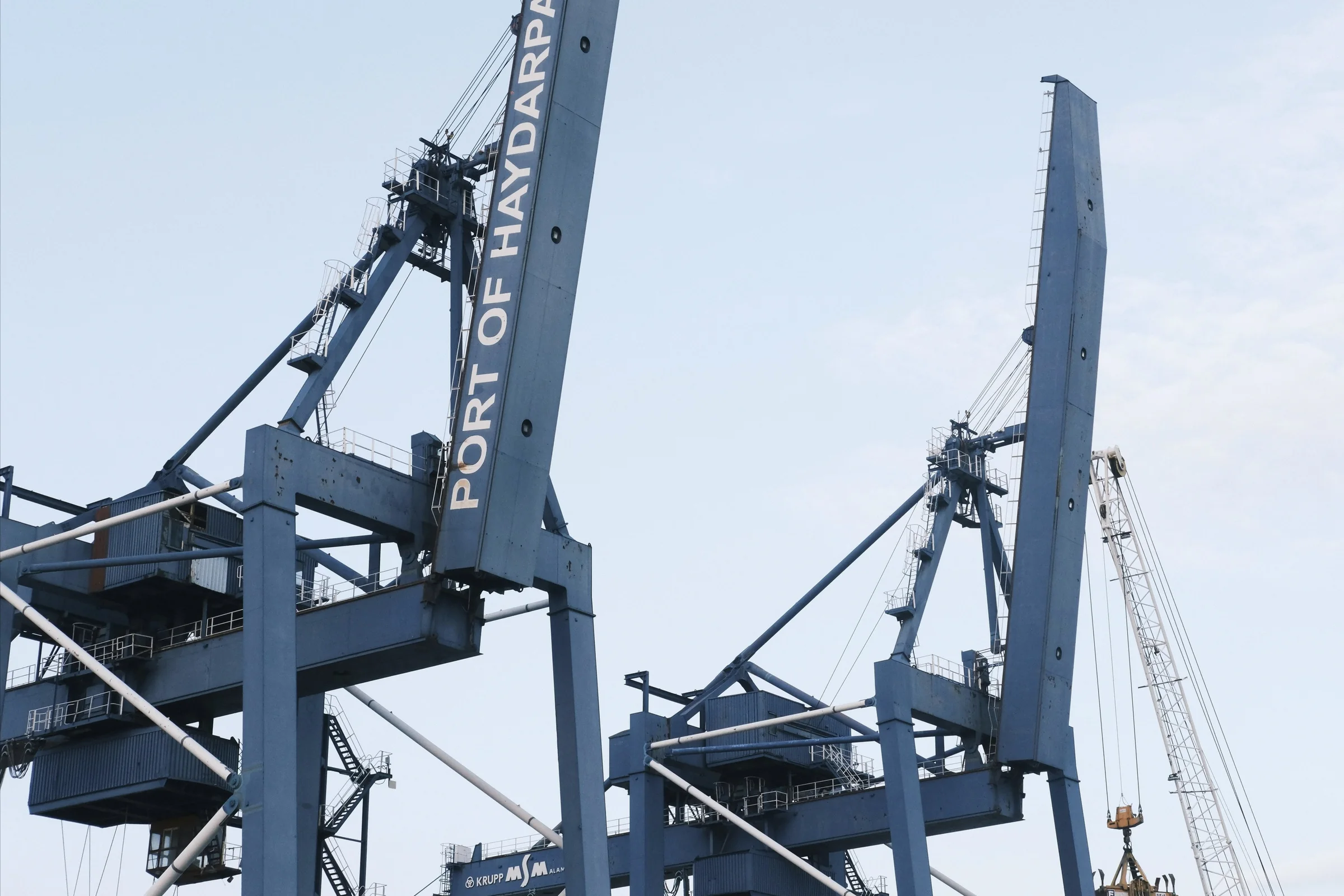 ExportersCemrecan Yurtman · Unsplash
 Industrial B2BSimon Kadula · Unsplash
Signature tool for manufacturers · live
Finding customers abroad: which market comes first?
Splitting the budget and the team across five export markets at once means building enough visibility in none of them. Every new market needs its own language version, its own keyword research, its own campaign structure and a sales process that can answer in that language. So the first decision is not the channel; it is the order of markets.
Look at five questions when you choose a market: How much does this country import under your HS code, and are those imports growing? How heavy are its tariffs and document requirements? Are Turkish suppliers already selling there? Is your product searched for in the local language? Can your team quote in that language and time zone? The matrix below scores these criteria with the weights you set and suggests a first test market. The result is not a decision; it is a starting order to discuss with your sales team.
Export market prioritisation matrix
Countries (3–8) and criteria
| Country | Imports (USD m) | Growth % | Barrier % | Turkish share % | Searches / mo | LPI 2023 | Readiness (0–5) |
|---|---|---|---|---|---|---|---|
+ add a country · Sources per criterion: UN Comtrade and ITC Trade Map (imports, growth, Turkish share), ITC Market Access Map (barrier), Keyword Planner (searches), World Bank (LPI).
Total weight 100; the calculation scales it to 100. Every value except LPI is an example; enter your own data. LPI 2023: World Bank. The calculation runs in your browser; no data is stored.
Germany
First test market · total 3.68/5
attractiveness 3.28 · accessibility 4.17
| # | Country | Total | Attract. | Access | Quadrant |
|---|---|---|---|---|---|
| 1 | Germany | 3.68 | 3.28 | 4.17 | Test first |
| 2 | USA | 3.07 | 4.27 | 1.59 | Needs preparation |
| 3 | Romania | 3.00 | 2.09 | 4.11 | Easy but small |
| 4 | Poland | 2.84 | 2.26 | 3.56 | Easy but small |
First test market: Germany (total 3.68/5; attractiveness 3.28, accessibility 4.17). USA is attractive but hard to reach: work on company readiness first. Start the digital campaign and the local-language product pages with the first market.
Scores are relative to the countries you chose only; they are not an absolute market value. The weights are Roicool's suggested starting values, not a standard.
Each criterion is scaled 1–5 across the chosen countries; tariff and barrier score in reverse. Attractiveness: imports, growth, search demand · Accessibility: barrier, logistics, Turkish share, company readiness.
Definition
What is B2B industrial marketing?
B2B industrial marketing is the work that helps companies selling to other businesses reach procurement, engineering and management teams through search engines, LinkedIn, industry directories and email, and collect quote requests. For manufacturers it is often called industrial or manufacturing marketing: the product is technical, the decision takes long and several people make it.
- Engineer
- technical fit
- Procurement
- price, lead time
- Quality
- certifications
- Management
- supplier risk
Challenges
3 things that make winning industrial customers hard
For a machine part or a raw material, the engineer checks technical fit, procurement checks price and lead time, the quality team checks certifications and management weighs supplier risk. Each looks for different information, and the process runs through quotes, samples and trial orders for weeks or months. One ad message can't answer all of them; your site needs information for every role.
Buyers research suppliers in search engines, in industry directories and, more and more, in AI assistants. If specifications, tolerances, standards and certifications live only in a PDF, search engines and assistants can't read them or connect them to the product. The information belongs on the page as HTML; the PDF is the second layer.
Requests come from fairs, dealers, email, phone and the website, and most of them never reach the CRM with their source. Then no one can see which channel brings orders, and the budget is split out of habit.
Channel plan
A channel plan by buying stage
In industrial markets, you choose the channel by the stage the buyer is in. The table links each stage to what the buyer looks for, the channel, the content and how it is measured.
| Stage | What the buyer looks for | Channel | Content | How it's measured |
|---|---|---|---|---|
| Research | Solutions, materials, application examples | B2B and international SEO, AI answers | Application and problem pages, technical guides | Organic visibility by language and country |
| Shortlist | Production capacity, certifications, reference industries | Industry directories, LinkedIn, Google Ads by country | Product pages, a certifications and quality page, factory information | Target account visits, directory profile clicks |
| Quote (RFQ) | Price, minimum order, lead time, delivery terms | Google Ads (product and technical terms), the quote form | Quote form, technical specification upload | Qualified quote requests (CRM) |
| Sample and trial | Quality, fit, speed of communication | Email, the sales team, LinkedIn | Sample process, common questions, document pack | Sample → order rate (CRM) |
| Repeat orders | Continuity, new products | Email, LinkedIn content | New product and application announcements | Share of customers who reorder |
Countries and languages. Each market gets its own language version, product pages written with local search terms, and hreflang tags that link the language versions together. In Google Ads, campaigns are split by country and language, so each market's cost and quote requests show separately. On LinkedIn, targeting runs on industry, company size, job title and a target account list.
Trade fairs
Trade fairs and digital, together
Trade fairs are still one of the strongest points of contact in industry. Digital doesn't replace the fair; it carries what happens before and after it.
1 · Before the fair
Build your target account list around the fair's visitor profile. Invite them to a meeting at your stand by LinkedIn and email, and run a short search campaign in the country hosting the fair.
2 · During the fair
Enter the cards you collect into the CRM the same day, with "fair name + year" as the source; add the meeting notes and the product they asked about.
3 · After the fair
Send a personal follow-up email within the first week, then show your content to the companies you met on LinkedIn. Track how fair-sourced quotes turn into orders separately in the CRM.
Taking part in trade fairs abroad is covered by the Turkish Ministry of Trade's export support schemes (see Support schemes).
Technical information
How to put technical information on the page
- A separate page for each product or product family, with the specification table in HTML.
- Standards and certifications by name and number; the certificate image or PDF as an attachment.
- Applications: which industry it is used in, and for which problem.
- Downloadable data sheets and CAD files as the second layer; if they go behind a form, ask only for an email address.
- In each language version, units and standard names in the form that market uses.
RFQ funnel
From quote request to order: the RFQ funnel and the CRM
- 01Quote request
- 02Qualified requestproduct and quantity fit
- 03Quoted
- 04Sample
- 05Order
In industry, the conversion is not "form submitted". It is the stages that lead to an order: quote request, qualified request (product and quantity fit), quoted, sample, order. The quote form should ask qualifying questions: the product or HS code, estimated annual quantity, delivery country, company name and a technical specification upload. These questions save the sales team's time and show which requests the campaigns bring. The source of every request (campaign, country, keyword, trade fair) is written to the CRM automatically.
What we do
Our service package for manufacturers
B2B and international SEO
Visibility on product, application and market searches; language versions and hreflang.
Multilingual corporate website
Product and application pages that carry the technical content as HTML.
LinkedIn and Google Ads
Reaching target companies and job titles; search campaigns by country and language.
CRM and quote tracking
Source fields, stage definitions, offline conversions.
Visibility in AI answers
Being named correctly as a supplier.
Reporting
A report by country × channel × stage.
Process
How we work
- 01
Market order
Choosing the first 1–2 markets from your sales data and the matrix; the language and product list.
- 02
Tracking setup
CRM stages, the quote form, source fields, offline conversion flows.
- 03
Site and content
Product, application, certification and quote pages in the chosen languages; hreflang.
- 04
Campaigns
Google Ads by country and language, LinkedIn target account campaigns, work tied to the trade fair calendar.
- 05
Reporting and expansion
A monthly quote and order report by market; the next market once the first one delivers.
KPIs
What we measure
Qualified quote requests
Quote requests the sales team takes forward; by market and channel
Cost per quote
Total marketing cost ÷ qualified quote requests
Quote-to-order rate
The share of quotes from digital sources that turn into orders (CRM)
Organic visibility by market
Visibility on product searches in the target countries and languages
Target account engagement
Website and LinkedIn engagement from the accounts on your target list
How do you measure lead quality? A form fill is never sent to the platforms as the primary conversion. When a request is marked qualified in the CRM, it goes back to Google Ads as an offline conversion and to LinkedIn through its conversions API. Because the order arrives months later, the platforms learn from the qualified-request stage; orders and revenue are read from the CRM in the report. For visitors in Europe, consent rules reduce the tracking signal; the report shows that gap separately. → Google Ads offline conversion tracking · Offline conversion · Server-side tracking · Consent Mode and KVKK
Support schemes
Legal rules, export support and platform rules
General advertising law applies when industrial products are promoted online; product certifications, standards and technical claims must be provable. In Türkiye, commercial electronic messages fall under Law no. 6563 and the İYS rules; contacting and tracking buyers in Europe falls under the GDPR and consent rules. Export support. The Turkish Ministry of Trade's Decision no. 5973 on Export Support (Official Gazette, 18.08.2022) includes these schemes, which bear directly on a digital marketing plan:
| Scheme | What it covers | Rate |
|---|---|---|
| Market entry project (art. 5) | Consultancy and report costs for target market, pricing, marketing and channel strategy; at most 2 projects per company | 50% |
| Market research abroad (art. 6) | Travel and accommodation costs of a market research trip | 50% |
| Trade fairs abroad (art. 7) | Fair participation, by stand square metres | 50%; 70% in target countries, 75% in target countries and sectors |
| Promotion (art. 12) | Promotion and marketing costs abroad for products made in Türkiye; a registered trademark is required for companies without a unit abroad; up to 4 years | 50% |
Platform rules. Country targeting in Google Ads and LinkedIn is set separately for each market; before you upload a target account list to LinkedIn, check the legal basis for the data. You and your legal adviser decide the legal framework.
Who this is not for
- Companies that sell only to a single local buyer or through public tenders.
- Teams that can't answer quote requests in the target language within a few business days.
- Companies that don't record quotes and orders in any system and have no plans to: nothing can be measured.
- Businesses looking for retail exports through ecommerce: this work is for B2B quote processes.
Digital marketing for manufacturers and exporters FAQ: common questions
How do industrial companies get leads from digital marketing?
Buyers research suppliers on search engines, in industry directories and, increasingly, with AI assistants. Product and application pages, technical documentation, language-specific pages for export markets, and LinkedIn targeting of decision-makers are the most effective channels.
Which languages does an exporter's website need?
The languages of your target markets. Starting with one or two languages chosen from your sales team's inquiries and the country data in Search Console works better than shallow translations into many languages.
How should content for technical products be written?
Around what engineering and procurement teams look for: technical specifications, standards and certifications, applications, comparison tables and downloadable documents. This information should be on the page as HTML, not only in a PDF.
How do trade shows and digital marketing work together?
Before the show, invite target accounts to meetings via LinkedIn and email; at the show, get collected business cards into the CRM quickly; after the show, run retargeting. Trade show leads should be tracked as a separate source in the CRM to see their impact on sales.
Do B2B directories still matter?
Yes. Industry and international B2B directories are sources that both buyers and AI assistants look at. The company description, product list and contact details in those profiles need to match your website exactly.
Related resources
Worth reading and trying
- BlogGoogle Ads offline conversion tracking
- BlogHow to choose a CRM
- BlogHow does ChatGPT choose brands?
- GlossaryB2B marketing
- GlossaryICP
- GlossaryMQL
- GlossaryHreflang tag
- GlossaryMarketing funnel
- ToolsAd budget calculator
- ToolsROI calculator
- ToolsLTV:CAC calculator
- ToolsConversion rate calculator
- ToolsGoogle Ads audit grader
Sources

Let's work out which market to start with.
Tell us about your products, your target countries and your quote process; we'll prepare a roadmap with the market order, site, campaign and tracking steps.