





Marveltour × Roicool. Webflow for a B2B incoming travel agency.
Marveltour is an Istanbul-based B2B incoming travel agency that has run cultural, faith, educational and bespoke programmes for groups travelling to Türkiye since 1982. We designed and built the brand's new English website on Webflow, structured so that search engines and AI assistants understand Marveltour correctly.



- Client
- Marveltour
- Industry
- Travel and tourism marketing
- Services
- Website, Webflow, GEO
- Status
- Delivered
In short
Marveltour is an Istanbul-based B2B incoming travel agency that has run cultural, faith, educational and bespoke programmes for groups travelling to Türkiye since 1982. We designed and built the brand's new English website on Webflow, structured so that search engines and AI assistants understand Marveltour correctly.
- New website design
- Webflow development and CMS
- Destination guide: 6 regions, 15 destinations
Roicool × Marveltour
Marveltour is an Istanbul-based B2B incoming travel agency that has worked with groups travelling to Türkiye since 1982. It works with tour operators, travel agencies and advisors, educational institutions and faith groups, running cultural tours, faith and pilgrimage travel, educational trips and bespoke programmes. Roicool designed, built and launched Marveltour's new English website on Webflow: UI/UX design, GSAP animation, Webflow CMS, a topic cluster structure and a GEO and technical SEO layer were all part of the project. The site is structured so that search engines and AI assistants understand Marveltour correctly.
The goal: a trade partner should understand Marveltour on the first visit
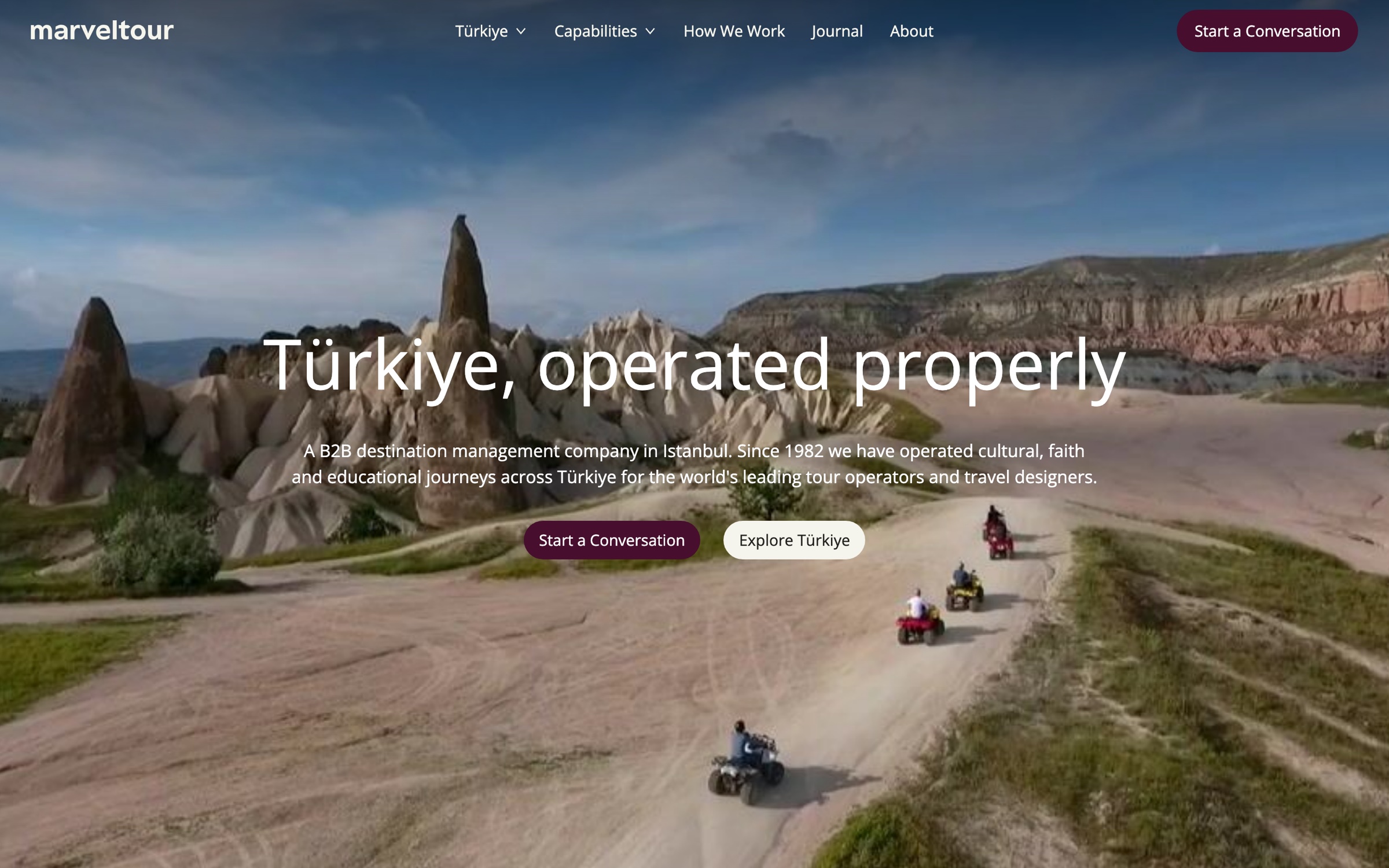
Most visitors to Marveltour's site are tour operators, agencies or institutions abroad. On the first visit they need answers to three questions: who Marveltour is, which programmes it operates where in Türkiye, and how working together goes. We built the site structure, the page templates and the contact flow around those three questions. The site is published in English, the language of its audience.
UI/UX design: information architecture for B2B partners
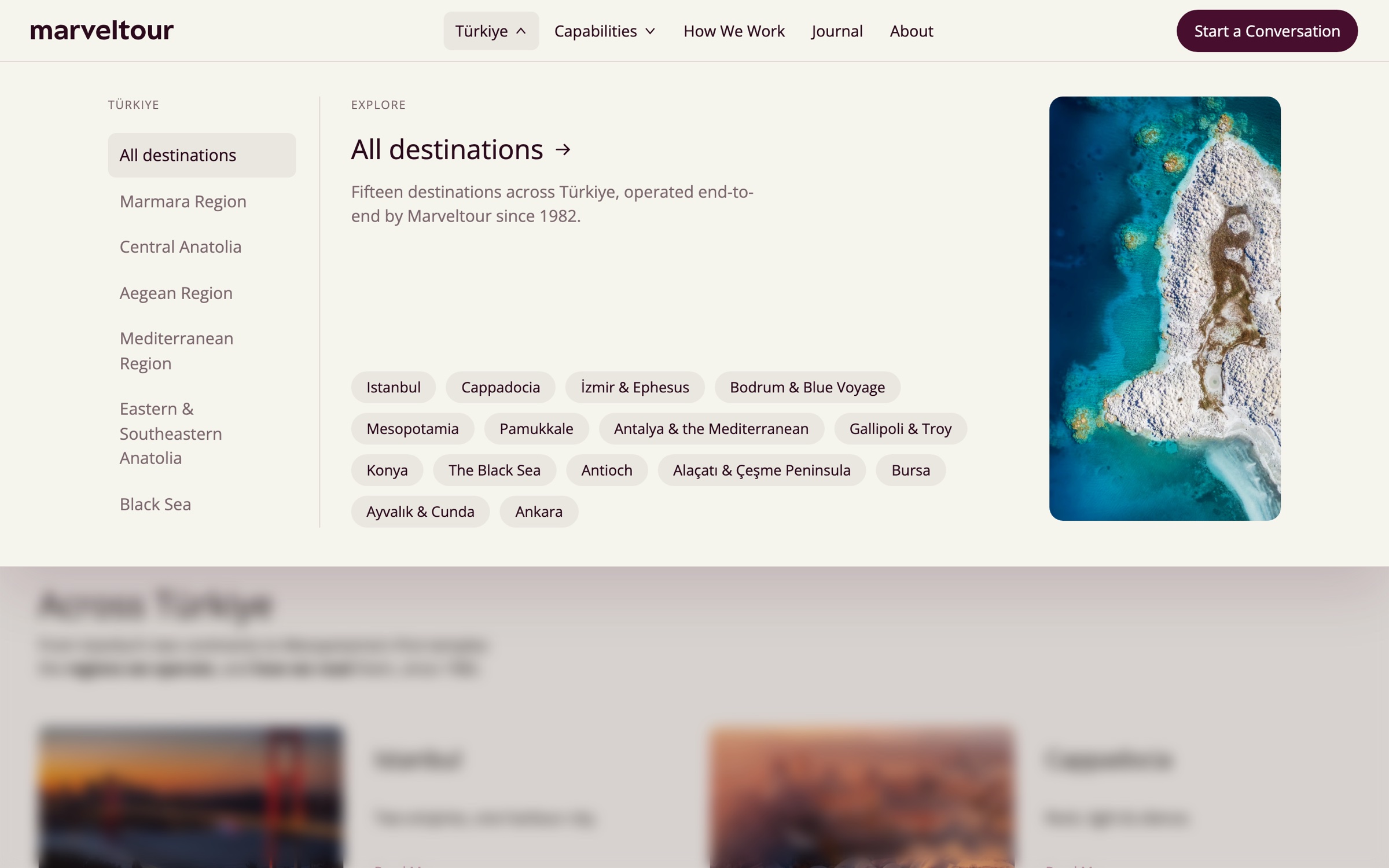
We built the information architecture in the order a tour operator uses the site: first where in Türkiye they can operate, then which speciality and which programme, and finally how to work together. The main menu follows that order: Türkiye, Capabilities, How We Work, Journal and About, with a "Start a Conversation" button always in the menu.
- Menu panels: the Türkiye panel lists destinations under the six regions. In the Capabilities panel, hovering a speciality shows its featured programme in the side column; that card comes from the CMS.
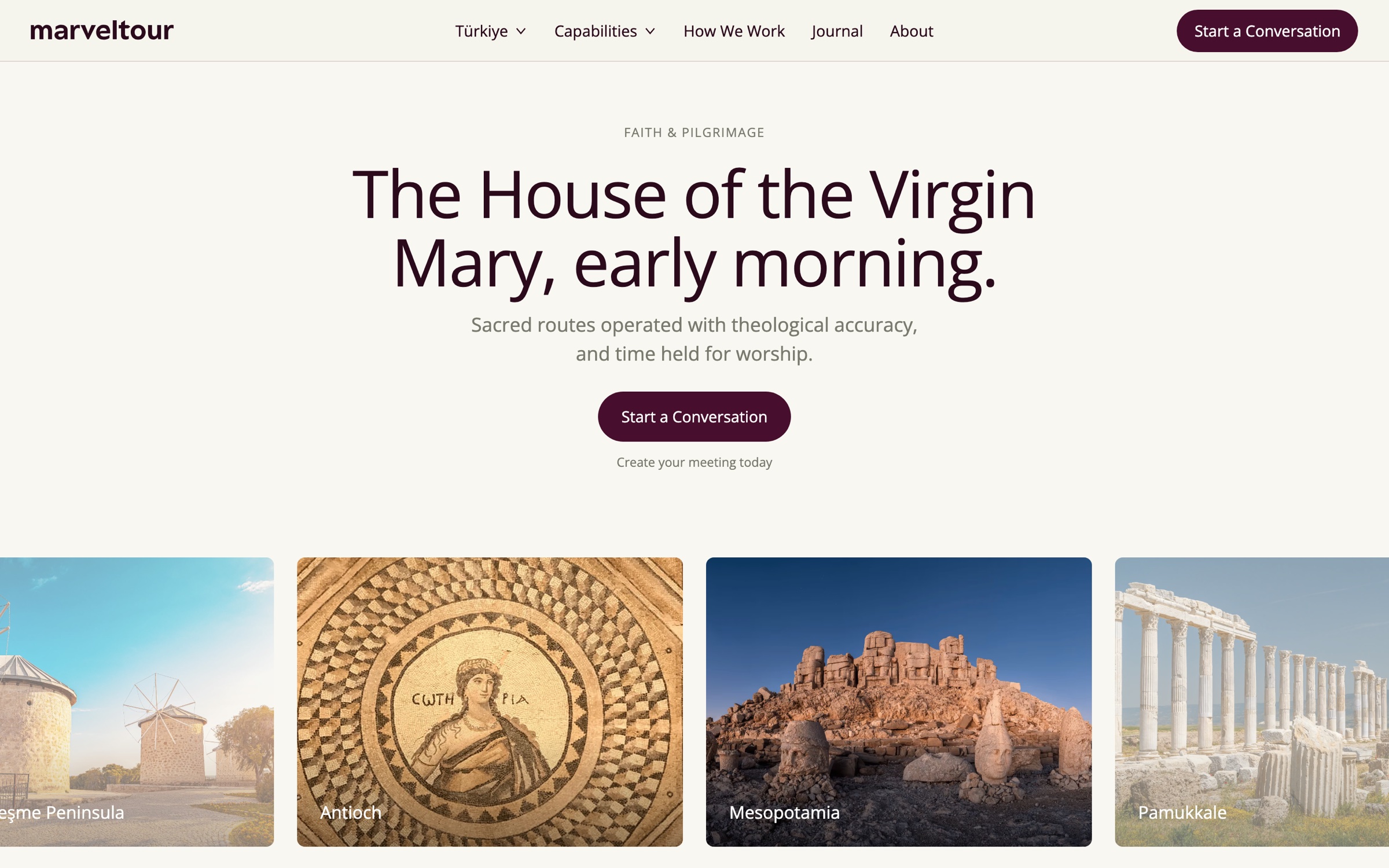
- Card layouts: the expertise showcase on the home page presents destination stories as cards grouped by cultural, educational and faith labels; featured programmes and journal articles are listed as cards too.
- Mobile: below 992 pixels the menu switches to its mobile layout, and card rows that scroll sideways on desktop become a touch carousel with the same content on mobile.
Destination guide: six regions, 15 destinations
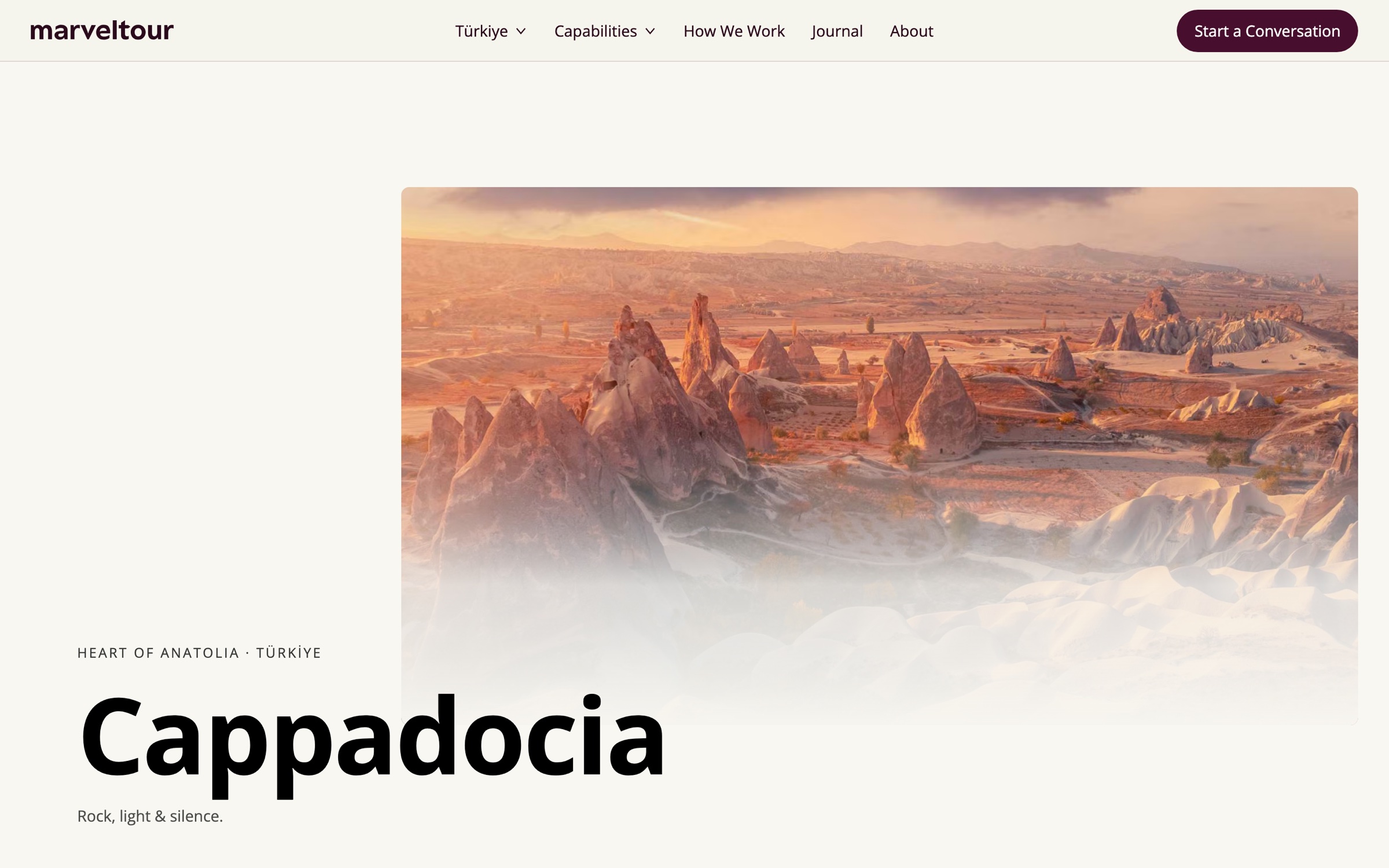
The Türkiye section of the main menu groups destinations into six regions: Marmara, Central Anatolia, the Aegean, the Mediterranean, Eastern and Southeastern Anatolia, and the Black Sea. Each region has a short operating note. From Istanbul to Cappadocia and from Ephesus to Mesopotamia, each of the 15 destinations has its own page covering the place, how Marveltour operates it and planning notes.
Capabilities and programmes
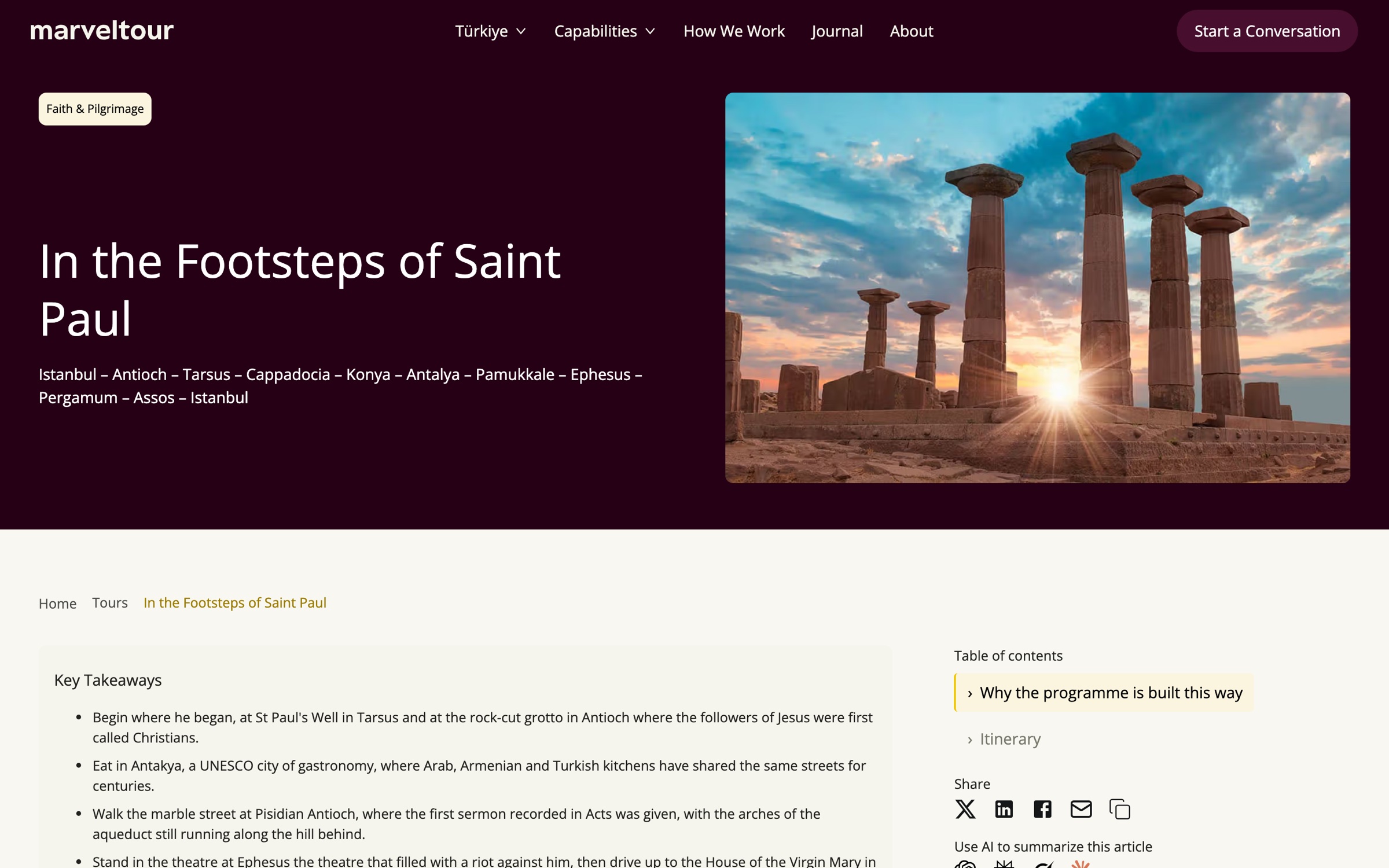
Cultural touring, faith and pilgrimage, educational travel and bespoke experiences each have their own capability page. Sample routes have pages of their own: the site lists 10 programmes, among them The Grand Tour of Türkiye, In the Footsteps of Saint Paul and The Seven Churches. The In the Footsteps of Saint Paul page, for example, is built from:
- Key takeaways: the main stops of the route in short points.
- Why the programme is built this way: the logic behind the order of the route.
- A summary table: duration, UNESCO sites, domestic flights, overnight stops, total distance, best months and walking.
- A day-by-day itinerary and FAQs.
Working model and contact flow
The How We Work page explains the partnership in four steps: conversation, plan and route, operation, and support on the ground. Tour operators, travel advisors and educational institutions each get their own section, followed by an FAQ. The "Start a Conversation" call on every page leads to the contact form, which asks for the type of programme, the travellers' source market, the kind of business and whether the trip is for groups or individuals. A request therefore reaches a destination specialist with the right information in the first message; the site states that a specialist replies within 24 hours.
Journal and author pages
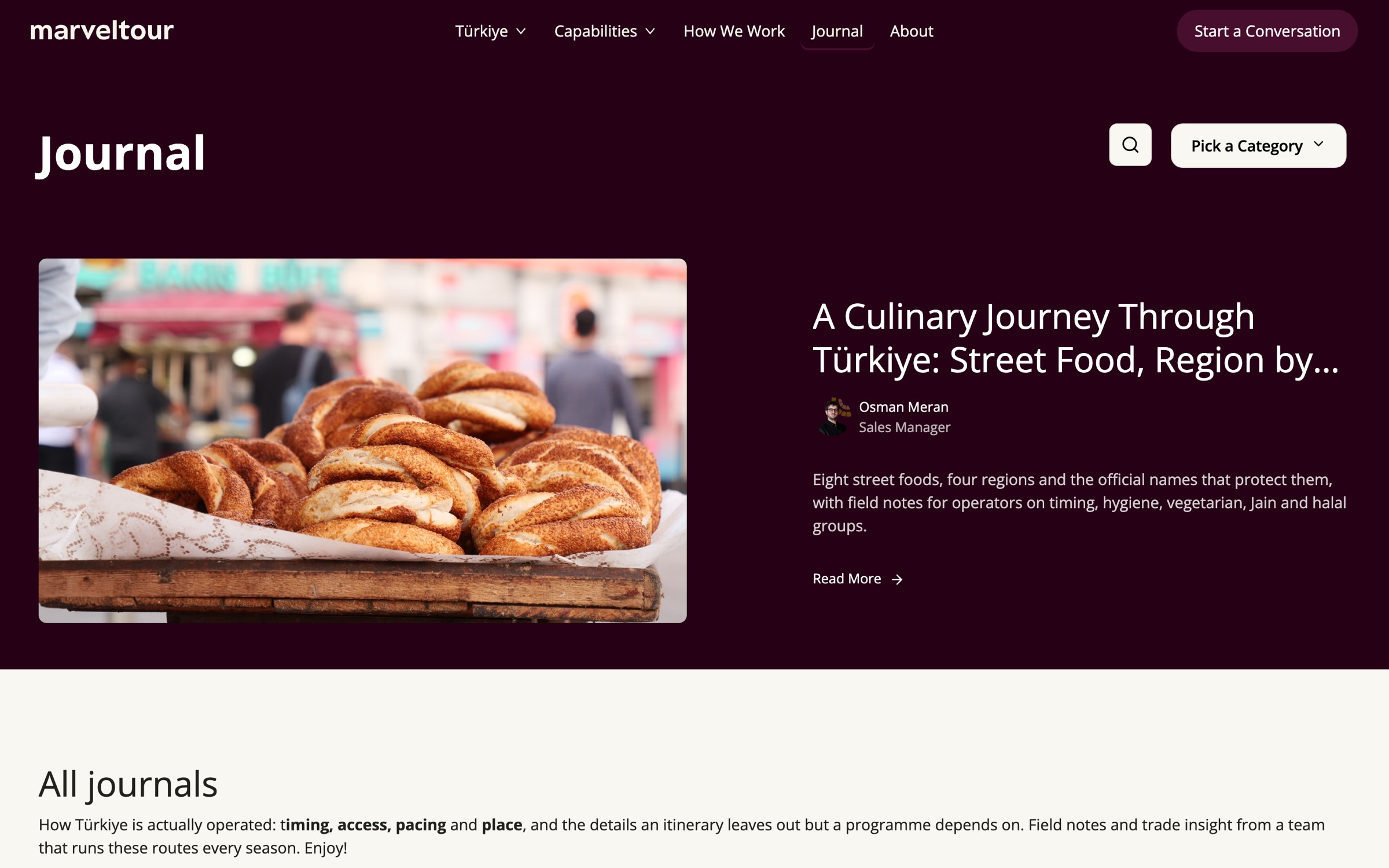
The journal has four categories: destinations, faith and pilgrimage, culinary, and trade insights. Articles open with key takeaways; some use question headings, FAQs and a list of sources. Every article has a named author, and authors from the Marveltour team have their own profile pages.
GSAP animation: motion that carries the content
We built the site's motion with GSAP, driven by scrolling. The aim is not decoration but moving the visitor to the next step in the content. The site runs GSAP 3.13 with the ScrollTrigger and SplitText plugins, Lenis for smooth scrolling and Barba for page transitions.
- Text reveals: headings and standfirsts rise line by line out of a mask as they enter the screen.
- Masks and parallax: images and video open as if through a window when they enter the screen; the parallax moves only transforms, so the layout never shifts.
- Pinned scenes: the expertise showcase, the process steps and the figures section pin to the screen while scrolling and reveal their content in sequence; some card rows scroll sideways on desktop.
- Page transitions: a curtain transition between pages makes the site feel like one continuous flow.
- Accessibility: for visitors with "reduce motion" turned on in their system, the animations are not set up and the content shows directly.
Webflow CMS: collections and how they connect
The content pages are generated from Webflow CMS collections: destinations, programmes, capabilities, journal articles, journal categories and authors. The collections reference each other: each journal article belongs to a category and an author, an author's page lists their articles, and in the menu each speciality shows its own featured programme. When the Marveltour team adds a destination, a programme or an article, the page goes live with the same template and the same structured data, with no code needed. We added a custom code layer on top of Webflow for the interface components and animations.
Topic cluster structure
We built the site as a cluster structure, so search engines and AI assistants can see Marveltour's expertise in Türkiye topic by topic:
- Hub page: the Destinations page gathers the 15 destinations under the six regions, and the Türkiye panel in the main menu follows the same regional layout.
- Destination pages: each destination's planning block gives the best time to go, the typical stay and which destinations it combines with; a "Keep Exploring" section leads to related destinations.
- From speciality to programme: capability pages link to the programmes in their field; the faith and pilgrimage page, for example, links to The Seven Churches and Jewish Heritage of Türkiye.
- Programmes and journal: each programme page links to other programmes, and each journal article links to other articles and to its author.
This internal linking means every topic (a region, a destination, a type of tour) is told through pages that support each other. A search engine or an AI assistant reads Marveltour's expertise in, say, faith travel not from a single page but from a whole made of the capability page, the related programmes and the journal articles.
GEO and technical SEO: a clear source for AI assistants
A tour operator looking for a ground partner in Türkiye can now ask ChatGPT, Claude or Perplexity. So we built the site to let assistants read the key facts about Marveltour straight from the source:
- Entity facts: schema.org TravelAgency markup on the home page gives the company name, founding year (1982), Istanbul address, phone and email, the area served (Türkiye) and the 15 destinations in one place.
- Structured data per page type: TouristDestination on destinations, TouristTrip on programmes, Service on capabilities, BlogPosting with author and dates on journal articles, Person on author pages, and FAQPage on How We Work.
- Question-and-answer structure: FAQs on programme pages and on How We Work; key takeaways on journal articles.
- Crawler access: robots.txt explicitly allows AI crawlers such as GPTBot, OAI-SearchBot, ClaudeBot, PerplexityBot and Google-Extended alongside Googlebot and Bingbot, and the pages are listed in sitemap.xml.
- "Ask Marveltour to LLMs": buttons in the site footer open ChatGPT, Claude, Perplexity or Grok with a ready-made question asking them to describe Marveltour using the site as the primary source.
Services used
This project brought together our Webflow agency, Webflow development and CMS, web design, corporate web design and AEO services.
Gallery. The site and the work.
Last updated
Results.
Added here as they are measured.
DeliveredWebsite, Webflow, GEO results are published here with their method and period as they are measured.
Frequently asked questions
What is Marveltour?
Copy linkMarveltour is an Istanbul-based B2B incoming travel agency that has worked with groups travelling to Türkiye since 1982. It works with tour operators, travel agencies, educational institutions and faith groups.
What did Roicool do for Marveltour?
Copy linkWe designed, built and launched Marveltour's new website on Webflow: UI/UX design, GSAP animation, the destination guide, capability and programme pages, the journal and author pages, the Webflow CMS setup, the topic cluster structure, schema.org markup and a technical SEO layer open to AI crawlers.
Which platform and language is Marveltour's site in?
Copy linkThe site is built on Webflow and published in English. Destinations, programmes, capabilities, journal articles and authors are managed in Webflow CMS.
Which animation technologies does the site use?
Copy linkGSAP 3.13 with ScrollTrigger and SplitText, Lenis for smooth scrolling and Barba for page transitions. Animations are off for visitors who have "reduce motion" turned on.
How was the site prepared for AI assistants?
Copy linkThe company facts and every page type are marked up with schema.org, FAQs are written as questions and answers, pages are linked in topic clusters, robots.txt explicitly allows AI crawlers, and the footer buttons take visitors to ChatGPT, Claude, Perplexity and Grok with a ready-made question about Marveltour based on the site.

Let your project be next.
Tell us the scope; we put the proposal in writing.